Common myths about the axolotl and its relatives, gently corrected — each one checked against a named source, never a pet-shop rumour.
“There's a blue axolotl morph.”False
Research recognises four single-gene colour mutants (white, melanoid, albino and axanthic), and the pet trade adds copper and transgenic lines; none of them is blue. The bright-blue axolotl is the one Minecraft colour not based on a real axolotl. — Scientific Reports (Ambystoma Genetic Stock Center, 2024) · Minecraft Wiki
“My axolotl will grow up and crawl onto land like a tiger salamander.”False
Axolotls keep their gills and aquatic larval body for life, and even breed in that form. Metamorphosis is rare (typically under 1% even in labs, under stressful conditions), and an exotic-vet hospital warns it should never be encouraged. — AmphibiaWeb · Animal Diversity Web · Chicago Exotics Animal Hospital
“It's illegal to own an axolotl in the US.”Mostly false
Not federally. Since January 2025, U.S. Fish and Wildlife has listed their genus, Ambystoma, as injurious: importing them, or shipping them to or from Hawaii, D.C. or territories, needs a permit issued only for zoo, education, medical or science use. Owning, breeding and moving them between continental states aren't affected. But Arkansas and New Jersey, among others, ban them as pets. — U.S. Fish & Wildlife Service · Arkansas Game and Fish Commission · New Jersey Division of Fish & Wildlife
“Axolotls are a kind of fish.”
They are actually amphibians — neotenic salamanders that keep their feathery gills and stay aquatic for life instead of transforming to live on land. Think aquatic salamander, not fish. — Animal Diversity Web
“Axolotls are fine in warm or room-temperature water.”
They are cold-water animals from cool high-altitude lakes and do best around 16–18°C, never above 24°C. Warm water stresses them and leaves them prone to illness, so many keepers use a chiller or fan in summer. — Royal Veterinary College
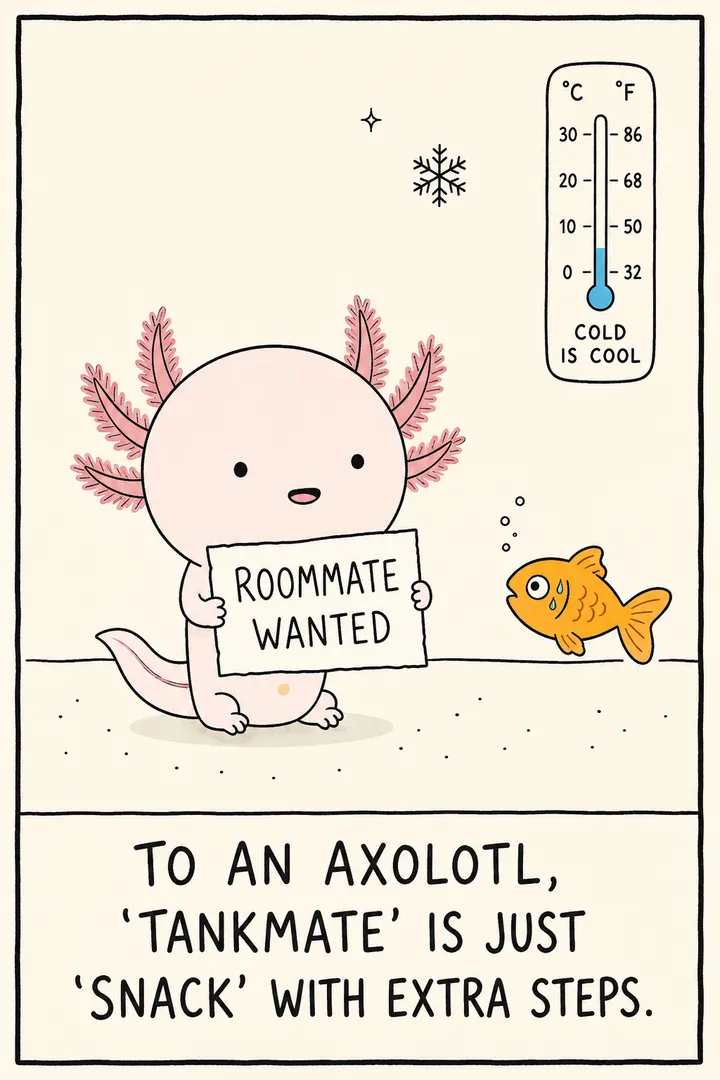
“Axolotls do fine sharing a tank with fish or other tankmates.”
Axolotls are solitary top predators that eat just about anything they can catch, including fish and even other axolotls. They are safest kept alone, where nothing nips their delicate gills and nothing becomes a snack. — Animal Diversity Web
 Axolotls
 Axolotl
 Free tools for the axolotl


