How Axolotl Regeneration Works (and What It Means)
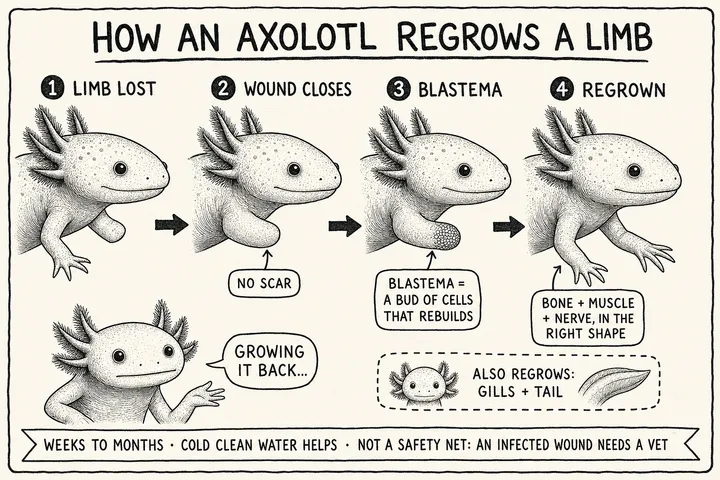
Of everything people search about axolotls, one topic comes up more than almost any other: they can regenerate. And unlike a lot of internet claims, this one is completely true — an axolotl really can regrow a lost leg, gills, and more. This is the science of how, written honestly, plus the part that actually matters if you keep one: what regeneration means for an injured axolotl, and when it isn’t enough. It’s the deep-dive companion to is my axolotl sick? warning signs.
🐸 The 30-second version: axolotls genuinely regrow limbs, gills, tail, and even parts of the heart, spinal cord and brain — by forming a blastema, a cluster of cells that rebuilds the missing part in the right shape, without scarring. It takes weeks to months, faster in young animals, and works only in a healthy, well-fed axolotl in clean cold water. The keeper takeaway: it’s a reason axolotls are resilient, not a reason to be careless — prevent injuries and treat infected wounds like the emergencies they are.
Why this is the axolotl’s signature superpower
It’s fair to say regeneration is the reason axolotls captured the world’s imagination (and half the internet’s). In our demand pull, “axolotl can regenerate,” “how axolotls regenerate,” and “masters of regeneration” together make up one of the biggest advanced clusters we see. So it deserves a real, honest answer — the science and the husbandry.
What an axolotl can actually regrow
Not everything, but a genuinely astonishing list:
- Limbs — a whole amputated leg, rebuilt with bone, muscle, nerves, and blood vessels, in the correct shape.
- Gills — those feathery external gills, so often nipped, regrow readily.
- Tail — including spinal tissue within it.
- Parts of internal tissues — remarkably, portions of the heart, spinal cord, brain, and eye — tissues that are essentially off-limits to repair in mammals.
For you as a keeper, the everyday relevance is limbs and gills; the deeper biology is what makes axolotls a model organism in laboratories worldwide.
How it works: the blastema
Here’s the honest, non-hand-wavy version of the mechanism:
- The wound closes quickly with a special skin layer — and crucially, without forming the scar that blocks regeneration in mammals.
- Cells at the site revert to a flexible, building state and gather into a blastema — a bud of progenitor cells at the wound.
- The blastema rebuilds the missing structure in the correct pattern and orientation — a hand grows back as a hand, pointing the right way — then re-grows the bone, muscle, nerve, and skin to match.
Scientists are still working out the full molecular detail, but the blastema is the heart of it. That “send cells back to a building state, then rebuild without scarring” trick is exactly what most animals, including us, can’t do.
How long it takes
Regeneration is real but not instant:
- A full limb typically takes several weeks to a few months, appearing first as a small bud and then a recognisable, correctly-formed limb.
- Younger axolotls regenerate faster than older ones.
- Cold, pristine water and good feeding speed it up; warm water, poor water quality, or an unwell animal slow it down or stall it.
The keeper’s part: don’t treat it as a safety net
This is the bit that matters most, and it’s where good intentions go wrong. Regeneration is not a reason to relax about injuries. It:
- Costs the animal energy — a regrowing axolotl needs to be healthy and well fed.
- Only works well in clean, cold water — in poor water, a wound can get infected (fungus or bacterial infection) faster than it heals.
- Doesn’t fix everything — a systemic illness, a bad infection, or a wound that won’t close still needs veterinary care.
So the responsible mindset is: prevent the injury in the first place — no gravel (impaction risk), no incompatible tankmates, and cold, cycled water (check it with the water interpreter). Then, if a limb is lost, keep the water immaculate so it can regrow cleanly — and if the wound looks fungused, red, or spreading, or the axolotl is declining, see a vet rather than trusting nature to sort it.
Why it matters beyond the tank
The reason your pet is a scientific celebrity: understanding how an axolotl regrows a limb without scarring could, one day, inform human regenerative medicine. You’re keeping a living window into one of biology’s biggest open questions — which is a rather wonderful thing to have in your living room, in cold clean water, watching you back.
💚 Yes, your axolotl really can regrow a lost gill or leg — it’s one of the most remarkable things in the animal kingdom, and it’s sitting in your tank. Just don’t let that superpower make you casual: clean cold water and a well-fed, un-injured axolotl is always the goal. Regeneration is the backup, never the plan.
Go deeper: what a healthy vs poorly axolotl looks like → is my axolotl sick? · why tankmates cause the injuries → can axolotls live together & with fish? · keep the healing water perfect → how to cycle a tank + water interpreter · the full basics → complete Axolotl Care Guide.
Sources & further reading
This guide was written and fact-checked against these authorities. It’s honest general guidance — not a diagnosis:
- Regeneration-biology research on Ambystoma mexicanum (limb, spinal cord, heart and brain regeneration via blastema formation; the axolotl as a model organism) — the established scientific literature, named here in plain text.
- Caudata Culture — Treatment of Sores and Wounds in Caudates — a vet-written guide (Heather Björnebo, DVM) to treating wounds in newts and salamanders, and why clean water and good husbandry come first for healing; the Axolotl Sanctuary’s Photos of Sick Axolotls shows a bitten axolotl limb regrowing.
- Our own fact-checked axolotl warning-signs guide and care sheet — for when a wound needs a vet.
Written and fact-checked by The Bognook Team against veterinarian-authored sources — regeneration is not a substitute for treatment: if a wound is fungused, red, spreading, or your axolotl is off its food and declining, see an exotics vet.
Common questions
Can axolotls really regrow lost limbs?
Yes — genuinely, and it's not a myth. A healthy axolotl can regrow an amputated leg complete with bones, muscles, nerves and blood vessels, and can also regenerate its feathery gills, tail, and parts of tissues most animals can't repair. It does this by forming a structure called a blastema — a cluster of cells at the wound that rebuilds the missing part in the correct shape. It's why axolotls are one of the most-studied animals in regeneration science.
How long does it take an axolotl to regrow a limb?
It varies with age, temperature and health, but a full limb typically takes several weeks to a few months to regrow, and it comes back gradually — first a small bud, then a recognisable, correctly-formed limb. Younger axolotls regenerate faster than older ones, and regrowth slows in poor water quality or if the animal is unwell. The single most important thing you can do to help is keep the water pristine and cold so the wound doesn't get infected while it heals.
Can axolotls regenerate organs, not just limbs?
Remarkably, yes to a degree — beyond limbs, gills and tail, axolotls can regenerate parts of tissues that are normally off-limits in mammals, including portions of the heart, spinal cord, and brain, as well as parts of the eye. This is exactly why they're a model organism in regeneration and biomedical research. For a keeper, the everyday relevance is limbs and gills, but the deeper biology is part of what makes them so scientifically special.
Does regeneration mean I don't need to worry about injuries?
No — please don't treat regeneration as a safety net. Regrowth costs the animal energy, works well only in a healthy, well-fed axolotl in clean cold water, and an untreated wound can still get infected (fungus or bacterial infection) faster than it heals. Regeneration is a reason axolotls are resilient, not a reason to be careless: prevent injuries (no gravel, no incompatible tankmates, cold clean water), and if a wound looks infected or the animal is declining, see a vet rather than waiting for nature.
Why can axolotls regenerate when humans and most animals can't?
The short honest answer is that axolotls retain an ability that most animals lose — they can send certain cells at a wound back into a flexible, building state (forming a blastema) and rebuild the exact structure that was there, without the scarring that blocks regeneration in mammals. It's tied to their unusual biology, including their neoteny (staying in a juvenile, aquatic form for life). Scientists study it precisely because understanding it could one day inform human medicine — but the full mechanism is still being worked out.

Join the Bognook burrow
Cozy amphibian care tips, aesthetic freebies, and the occasional frog fact — straight to your inbox. No spam, just good bog vibes.
Free amphibian care cheat-sheet when you join. No spam — pinky-promise. Unsubscribe anytime. See how we handle your data in our privacy notice.