Is My Axolotl Sick? 10 Warning Signs Every Keeper Should Know
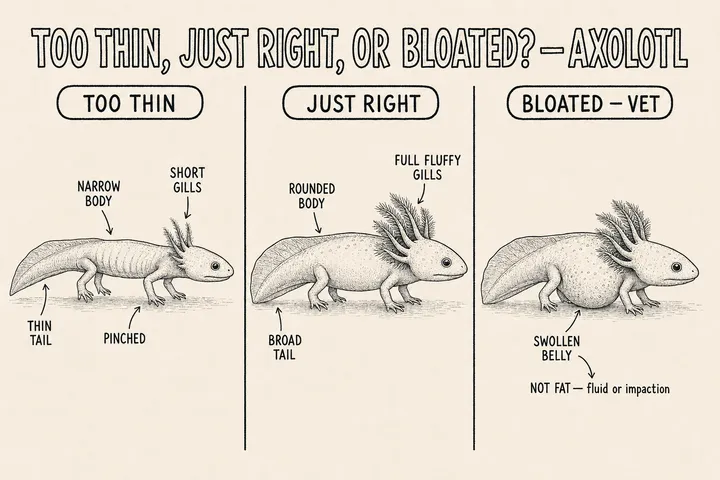
First: if you’re reading this because something looks off, take a breath. Axolotls are hardy, most problems are caught in time, and the fact that you’re checking makes you a good keeper. Here’s the honest checklist.
🔧 Worried about a symptom? Our free symptom checker takes you from what you’re seeing to watch · adjust · see-a-vet in about a minute.
The 30-second version
A healthy axolotl has full, forward-facing fluffy gills, all four legs and toes, clean unbroken skin, a steady appetite, and calm resting on the bottom. If you notice any of the signs below, don’t panic — do these three things first, because they fix many issues:
- Test the water — ammonia and nitrite should both read 0.
- Check the temperature — it should be 16–18°C (60–64°F). Warm water stresses axolotls and invites illness.
- If in doubt, tub — move them to a clean container of cool, dechlorinated water with daily 100% changes while you sort the tank.
Now the signs, roughly from “monitor” to “act now.”
The 10 warning signs
1. Gills curling forward or shrinking 🟡
A stress sign — strong filter flow is one known cause of forward-curled gills. Do: reduce or baffle the flow, then test the water and check the temp. Gills that shrink or fray over time are an early sign of illness (poor water and strong flow can both damage them) — if they keep getting worse, see an exotics vet.
2. Not eating for over a week 🟡
A day or two off food is normal. A week-plus usually means the water is too warm or dirty. Do: check temp and parameters, then tempt with a live earthworm at night.
3. Floating or unable to stay upright 🟡
Usually trapped gas or constipation, often linked to heat. Do: cool the water, reduce stress; a short fridging/tubbing period is the common first step. Persistent or with a swollen belly → vet.
4. Cotton-like white fuzz (fungus) 🟡→🔴
Fluffy white tufts on gills or body, usually after stress. Do: improve water, keep it cool, tub. Mild often clears; if it spreads, see a vet.
5. Red, irritated, or unusually pale skin (or bright red gills) 🔴
Often an ammonia burn or poor water quality. Do: immediate water test + large water change (or tub in clean cool water). This one climbs the ladder fast.
6. Frantic swimming or gulping at the surface 🔴
A distress signal — bad water, heat, or low oxygen. Do: test and change water now, cool the tank, add gentle surface movement for oxygen.
7. Curled tail tip or a hunched, tense posture 🟡
Ongoing stress. On its own it’s a “check everything” flag. Do: review temp, params, flow, and hiding spots.
8. Skin sores, open wounds, or a “melting”/degrading look 🔴
A real emergency — infection and/or severe water problems. Do: pristine cool water immediately and contact an exotics vet. Don’t wait this one out.
9. Weight loss (very thin) or a swollen, bloated belly 🔴
Thin = not eating/illness; bloated = possible impaction (often from swallowed gravel) or internal issue. Do: remove any gravel, review feeding, and get vet advice if the belly is distended.
10. Lethargy + hiding + refusing food, together 🔴
Any one alone can be minor; all three together points to a systemic problem. Do: full water test, cool the tank, tub, and call a vet if it doesn’t turn around quickly.
See a vet now if…
Open wounds or “melting” tissue · spreading fungus · a badly swollen belly · anything that doesn’t improve after you’ve cooled the water and fixed the parameters. A vet call is never the wrong move.
The pattern to remember
Notice how often the fix is the same three things — cool water, clean water, less stress. That’s not a coincidence: many axolotl “illnesses” are really water problems wearing a costume. Aquatic veterinarian Jessie M. Sanders, DVM, CertAqV puts the target plainly — “The ideal temperature for Axolotls is between 60-64° F (16-18° C)“¹ — noting you need no heater, and in warm climates a chiller. That cool, stable water is exactly what keeps most of this list from ever appearing.
💚 You don’t have to figure this out alone or feel silly for asking. Cool the water, keep it clean, and reach out to an exotics vet or a kind keeper community. Most problems, caught early, are completely fixable.
Go deeper: the complete Axolotl Care Guide · axolotl questions answered · the printable care sheet · Is my amphibian okay? — the all-species check.
Sources & further reading
This checklist was written and fact-checked against these authorities. It’s kind, general guidance — not a diagnosis or a substitute for an exotics vet:
- Caudata Culture — Caudate Illness: Symptoms and Treatments — how fungus looks on axolotls, refrigeration as a treatment, and how warm water and poor water quality combine to cause illness; see also its salt-bath article on Saprolegnia fungus, the Axolotl Sanctuary’s fridging procedure, and the University of Kentucky’s Ambystoma Genetic Stock Center Guide to Axolotl Husbandry on keeping axolotls in plain bowls or tubs of cool, dechlorinated water changed daily to every other day, and moving one with skin sores temporarily into a clean bowl with frequent water changes.
- Chicago Exotics Animal Hospital — Axolotl care sheet — how strong water current stresses axolotls, and that forward-curled gills can be a sign of it; plus the Ambystoma Genetic Stock Center (University of Kentucky) — Guide to Axolotl Husbandry on stress from poor husbandry and why loss of appetite and gill deterioration are the first signs of illness.
- ¹ PetMD, “Axolotl — Ambystoma mexicanum” — by Jessie M. Sanders, DVM, CertAqV (Certified Aquatic Veterinarian). The quoted cool-water target (16–18°C, no heater, chiller in warm climates).
- Merck Veterinary Manual — Infectious Diseases of Amphibians — fungal and bacterial skin infections and edema; its Environment and Husbandry page gives the gravel rule (too large to swallow, or small enough to pass).
- Standard aquarium water-quality science (the nitrogen cycle) — why ammonia 0 / nitrite 0 and 16–18°C matter.
- Association of Reptilian & Amphibian Veterinarians (ARAV) — a find-an-exotics-vet directory.
Written and fact-checked by The Bognook Team against veterinarian-authored sources — open wounds, “melting” tissue, or spreading fungus need an exotics vet.
Common questions
How do I know if my axolotl is sick?
Watch for these warning signs: gills curling forward or shrinking, not eating for over a week, floating or unable to stay upright, cotton-like fungus, red or irritated skin, frantic swimming or surface gulping, curled tail, skin sores, weight loss or a bloated belly, and lethargy with hiding. Many trace back to water quality or temperature, so test the water and check the temperature first.
Are curled gills on an axolotl serious?
Gills that curl forward are a stress sign, and strong filter flow is one known cause, so turn the flow down or baffle it first. It is not an emergency on its own, but it is a good prompt to test the water and check the temperature (16 to 18C / 60 to 64F) too. Gills that shrink, fray or keep getting worse are more serious: gill deterioration is one of the first signs of illness, so see an exotics vet.
When should I take my axolotl to the vet?
See an exotics vet promptly for open sores or wounds, tissue that looks like it is melting or degrading, spreading fungus, a badly swollen belly, or any symptom that does not improve after you cool the water and correct the parameters. When in doubt, a vet call is never the wrong move.
Why is my axolotl not eating?
Often the cause is water that is too warm or a water-quality problem, since stress suppresses appetite. Check that the temperature is under about 20C and that ammonia and nitrite are both 0, then offer a wriggling earthworm at night. A few days off food is not an emergency, but a week or more combined with poor water is.
What does axolotl fungus look like?
Fungus appears as white, cotton-like or fuzzy tufts on the gills or body, usually after stress, warmth, or poor water. Improve water quality, keep it cool, and consider tubbing (daily 100 percent water changes in a clean container). Caught early it is very treatable; if it spreads, see a vet.

Join the Bognook burrow
Cozy amphibian care tips, aesthetic freebies, and the occasional frog fact — straight to your inbox. No spam, just good bog vibes.
Free amphibian care cheat-sheet when you join. No spam — pinky-promise. Unsubscribe anytime. See how we handle your data in our privacy notice.