Axolotl Care Guide: The Complete Beginner Setup
Last updated October 13, 2026 · a Bognook care guide 💗
Axolotls are hardy, wonderfully weird, and — despite the "easy starter pet" reputation — genuinely easy to get wrong if you treat them like tropical fish. This is the honest, complete version: get these fundamentals right and your axolotl can thrive for 10–15 years.
 Illustration
 Is an axolotl right for you?
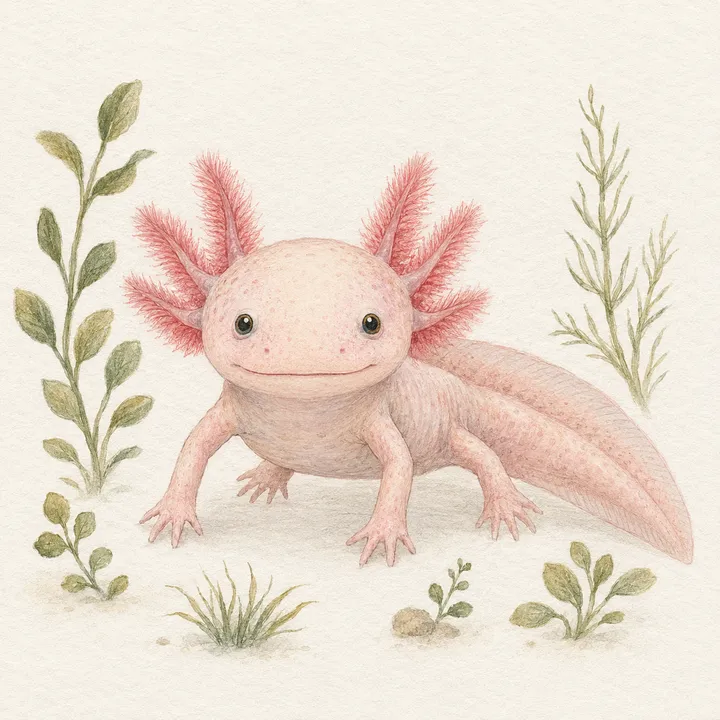
Axolotls are a 10–15 year commitment to a cold, clean, stable aquarium. They're perfect if you like the keeping — water testing, a calm bottom-dweller with permanent feathery gills and a permanent smile. They're a poor fit if you want a pet to handle, or if your home regularly runs warm without a way to cool the tank. If that's you, keep reading — most "axolotl problems" are really just water and temperature problems, and both are solvable.
Tank & equipment
- Tank: 20 gallons long for one adult (vets say 10 can do, but 20 keeps the water far more stable); keeping more than one needs more room.
- Filter: gentle flow only (for example a sponge filter, or a filter with its outflow baffled): strong current stresses axolotls, and forward-curled gills can be a sign of it.
- Lid: yes. Axolotls can and do launch themselves out.
- Thermometer: non-negotiable. You are managing a cold-water tank in a warm world.
- Test kit: for ammonia, nitrite and nitrate, and a log of every reading.
- No heater. Cooling gear (a clip fan, or a chiller in hot climates) matters far more.

Get the free Axolotl Starter Kit
The complete setup criteria checklist + a first-30-days plan to get your axolotl right from day one — plus honest care emails. No spam, no gatekeeping.
Free amphibian care cheat-sheet when you join. No spam — pinky-promise. Unsubscribe anytime. See how we handle your data in our privacy notice.Water & cycling (the big one)
Never add an axolotl to a brand-new tank. A serious beginner mistake is skipping the nitrogen cycle. A cycled tank has grown enough beneficial bacteria to convert toxic ammonia (from waste) into nitrite, then into far less harmful nitrate. Cycling a new tank ("fishless cycling" with an ammonia source) typically takes about 4–6 weeks.
Target water parameters:
- Ammonia: 0 ppm
- Nitrite: 0 ppm
- Nitrate: ideally under 10 ppm (the level vets recommend); keeper guides allow up to 20; never above 40
- pH: 6.5–8 (around 7.4–7.6 is ideal)
- Always dechlorinate tap water before it touches the tank.
Then keep a weekly rhythm: test the water, do partial water changes as the results call for (keeper guides find about 20% every two weeks enough in a lightly stocked tank; vets suggest 30–50%, one to three times a week, when the tests call for it), and watch your axolotl. Full, feathery gills = happy. Curled-forward gills, or sitting hunched = something is stressing it (check the filter flow, the water and the temperature).
Temperature — the cold-water rule
This is the rule people break most. Axolotls are cold-water animals and do best at 16–18°C (60–64°F). They can tolerate up to about 22°C (the low 70s °F), but above ~24°C (75°F) they overheat: loss of appetite, stress, fungus, and worse. In summer, cool the tank with a clip-on fan blowing across the surface, frozen water bottles, or an aquarium chiller in hot climates. Never use a heater.
Substrate & décor
- Floor: bare bottom or fine sand only. Gravel can kill — axolotls swallow it and can get fatal impactions.
- Hides: at least one shaded cave. Axolotls dislike bright light and need places to hide — give them shade.
- Plants: live low-light plants (java fern, anubias, moss) or silk plants. No sharp plastic.
- Lighting: keep it dim; a low light on a timer is plenty.
Feeding
Axolotls are carnivores that grip and swallow their food whole rather than biting it. Best staple foods:
- Earthworms / nightcrawlers — the gold-standard staple (cut to size).
- Soft sinking axolotl pellets — convenient.
- Bloodworms / blackworms — great for juveniles.
Feed adults 3–4 times a week; young, growing axolotls eat small meals every day. Avoid feeder fish: they often carry parasites. Remove uneaten food so it doesn't foul the water.
Tankmates & handling
Keep axolotls alone or with similarly sized axolotls — and even then, watch for nipping (young ones will bite each other's gills and limbs; they regenerate, but still). No fish. And don't handle them: their skin has no protective scales and tears easily. If you must move one, guide it into a soft container underwater rather than lifting it out. For the full reasoning, see can axolotls live together — and with fish?
Common health problems
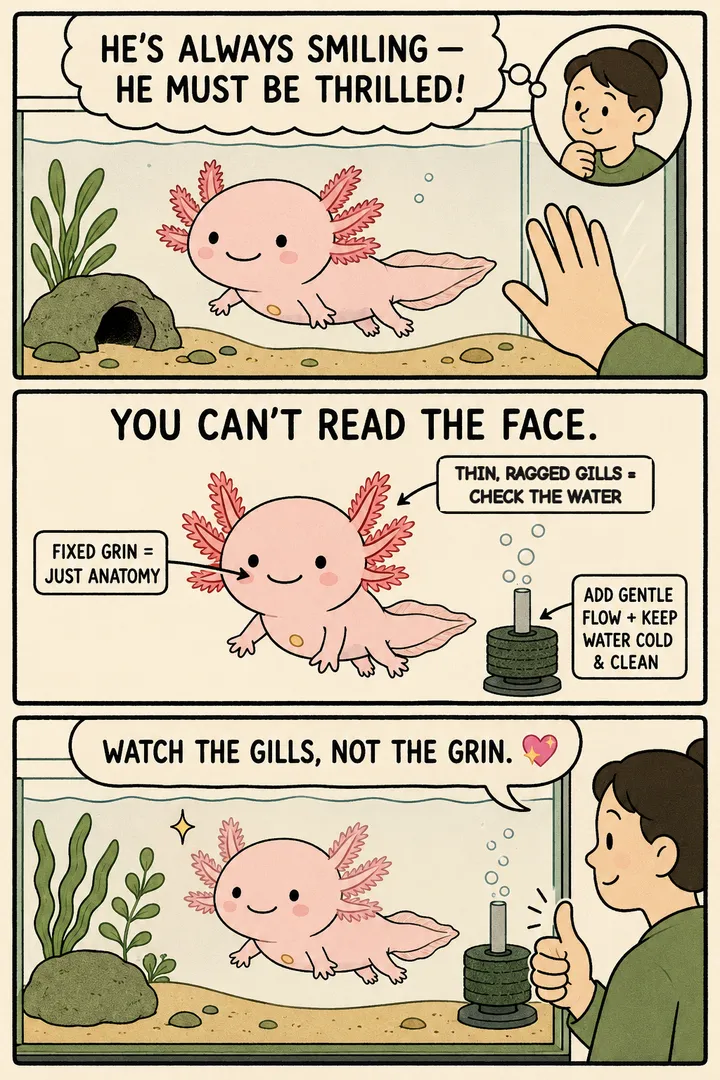
- Stress from flow, heat or bad water: forward-curled gills (strong filter flow is one known cause), hunching, not eating. Fix the flow, water and temperature first: poor water quality is linked to infection.
- Fungus or other infection: often after stress or poor water. Get advice from an exotics vet before treating.
- Impaction: from swallowed gravel — a medical emergency and the reason we use sand.
- Floating: uncontrolled floating can be a sign of overheating, so check the temperature first, then get advice.
"Tubbing" (daily 100% water changes in a clean tub) and, for some issues, brief fridging at 5–8°C are first-aid methods from the keeper community, not vet-set numbers: confirm with an exotics vet before you use them.
Morphs & colours
Part of the fun: axolotls come in gorgeous colour morphs. The common ones are wild type (mottled brown-green), leucistic ("lucy" — pale pink with dark eyes), albino (golden or white with pink eyes), melanoid (all black), and the striking glow-in-UV GFP. Care is identical across morphs — colour is cosmetic.
Where to buy a healthy axolotl
Always buy captive-bred from a reputable breeder or specialist — never wild-caught (they're critically endangered in the wild). A healthy axolotl has full fluffy gills, all four legs and toes, no injuries or fungus, and is alert. Skip any shop keeping them on gravel or in warm water.
💚 A note on conservation: wild axolotls are down to a tiny remnant population in Mexico City's Lake Xochimilco. Keeping captive-bred axolotls (and supporting their conservation) is part of the hobby done right. Read why amphibians are disappearing →
Frequently asked questions
- What size tank does an axolotl need?
- We recommend a 20-gallon long tank for one adult: vet care sheets say 10 gallons can do, but 20 keeps the water far more stable. Keeping more than one needs more room: young axolotls should not share a small space. A long footprint matters more than height — axolotls live on the bottom.
- What temperature do axolotls need?
- Axolotls are cold-water animals. Keep them at 16–18°C (60–64°F). Above about 22–24°C (72–75°F) they become stressed and prone to illness, so no aquarium heater — and you may need cooling in summer.
- Can axolotls live with fish?
- It is not recommended. Fish can nip axolotl gills, and feeder fish often carry parasites. Axolotls are best kept alone or with similarly sized axolotls.
- How long do axolotls live?
- With correct cold-water care, axolotls commonly live about 10 to 15 years.
- Why should the tank have sand, not gravel?
- Axolotls suck in food and often swallow substrate with it. Gravel can cause a fatal intestinal impaction. Use a bare bottom or fine sand instead.
Sources & further reading
This guide was written and fact-checked against these authorities. It's kind, general guidance, not a substitute for an exotics vet:
- PetMD — Axolotl (Jessie M. Sanders, DVM, CertAqV, a certified aquatic veterinarian): the cool-water target of 16–18°C with no heater and a chiller in warm climates; up to 30 cm and up to 15 years; anything smaller than 3 cm gets swallowed (gravel impaction); cycling takes about 4–6 weeks; one axolotl can start in a 10-gallon tank; small meals rather than one big meal; skin without protective scales tears easily.
- LafeberVet — Axolotl basic information sheet: water above 24°C (75°F) causes overheating: poor appetite, floating and infections.
- Agave Veterinary Care — Axolotl care sheet (an exotic animal hospital): 10 gallons may do but 20 keeps the water better, and young axolotls should not share a small space; a lid at all times; slow water movement; 60–65°F ideal, the low 70s °F tolerable, over 74°F heat stress; 30–50% water changes one to three times a week by test results, with a water-quality log; pH 6.5–8 (ideal 7.4–7.6), ammonia 0 and nitrate under 10 ppm; no fish (they nip gills) and young axolotls bite each other's legs and gills; no small pebbles; dim light and hiding places; earthworms, nightcrawlers, blackworms and sinking pellets, which axolotls grip and swallow rather than bite, adults 3–4 meals a week; lifespan up to 15 years.
- Tree of Life Exotic Pet Medical Center — Axolotl care (an exotic-animal vet clinic): ammonia and nitrite 0 ppm, nitrate under 40 ppm.
- Chicago Exotics Animal Hospital — Axolotl care sheet: strong water current stresses axolotls, and forward-curled gills can be a sign of it.
- Caudata Culture — Axolotl caresheet: earthworms, bloodworms and blackworms, and why feeder fish are best avoided (they often carry parasites); about 20% water every two weeks in a lightly stocked tank; young ones fed twice a day until about 10 cm; sand or rocks bigger than the head; listed as Critically Endangered.
- Axolotl Sanctuary (caudata.org) — Fridging procedure (a keeper-community page): fridge temperature 5–8°C, never below 5.
- Merck Veterinary Manual — Environment and Husbandry for Amphibians: water must be clean and free of chlorine, ammonia and nitrite; its Infectious Diseases page links poor water quality to infection.
- Axolotl Central — Axolotl care guide (a keeper community): nitrate between 5 and 20 ppm, the range keeper guides allow.
- San Diego Zoo Wildlife Alliance — Axolotl fact sheet: up to 30 cm; about 10 years in managed care; Critically Endangered (2019 assessment), found only at a few isolated sites in southern Mexico City, including Xochimilco.
- Wikipedia — Axolotl: the colour morphs (wild type, leucistic, albino, melanoid) and the IUCN status; NIH (NIGMS) — Glow-in-the-dark salamanders: GFP axolotls, genetically modified to make green fluorescent protein, glow under ultraviolet light.
Written and fact-checked by The Bognook Team against veterinary and keeper-community sources. If your axolotl looks unwell, check the water first and see an exotics vet.
Join the Bognook burrow
Cozy amphibian care tips, aesthetic freebies, and the occasional frog fact — straight to your inbox. No spam, just good bog vibes.
Free amphibian care cheat-sheet when you join. No spam — pinky-promise. Unsubscribe anytime. See how we handle your data in our privacy notice.