Why Are Amphibians Disappearing? (And 7 Things That Actually Help)
Amphibians are the canaries of the natural world — their thin, permeable skin makes them exquisitely sensitive to change, so they feel environmental stress long before most other animals do. And right now, they’re the most threatened vertebrate group on the planet: roughly 2 in 5 amphibian species (about 41%) are at risk of extinction, and many have already vanished.
The good news: this is a crisis with real, doable answers — and some of them start in your own garden.
What’s driving the decline
It’s rarely one thing. These threats overlap and reinforce each other:
- Habitat loss — the biggest driver. Wetlands, ponds, and vernal pools are drained and paved for development. No bog, no bognook: without breeding sites, populations simply disappear.
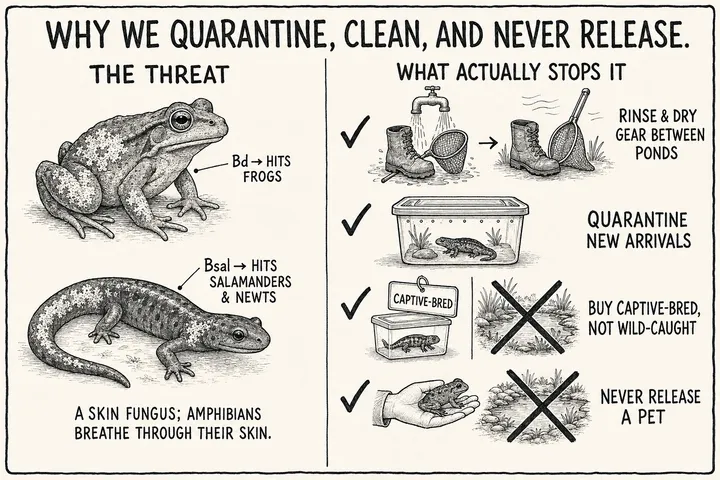
- Chytrid fungus (Bd). A skin-attacking fungal disease that has devastated frogs worldwide, disrupting how they breathe and hydrate through their skin. A related fungus, Bsal, specifically threatens salamanders and newts.
- Climate change. Shifting rainfall and temperatures throw off breeding cues and dry up breeding sites before tadpoles can develop.
- Pollution. Pesticides, fertilisers, and runoff hit amphibians especially hard because they absorb their environment, literally, through their skin.
- Over-collection & the wild trade. Taking animals from the wild for pets or food drains local populations.
- Invasive species. Introduced fish, bullfrogs, and other predators eat native amphibians and their eggs.
7 things that actually help
None of these require being a scientist — just a bit of care:
- Build a pond. Even a small, fish-free wildlife pond is a lifeline for local frogs, toads, and newts — arguably the single most powerful thing a person can do.
- Go pesticide-free. Skip the slug pellets and sprays; amphibians eat the pests for you anyway.
- Leave shelter. Log piles, leaf litter, a “toad abode,” and a wild corner give amphibians damp places to hide and hunt.
- Never release pets into the wild. It spreads disease like chytrid and introduces animals that don’t belong. This one is critical.
- Buy captive-bred, never wild-caught, if you keep amphibians — and quarantine new arrivals.
- Practise simple biosecurity. Rinse and dry boots, nets, and gear between different ponds so you don’t move disease around.
- Support the work. Groups like SAVE THE FROGS!, the Amphibian Ark, and local herpetological societies do real conservation on the ground — and citizen-science projects (like frog-call surveys) let you help with data.
If you keep amphibians, you’re part of this
Responsible keeping isn’t at odds with conservation — done right, it supports it. Keepers who buy captive-bred, never release, quarantine new animals, and share good husbandry help reduce pressure on wild populations and spread the knowledge that keeps animals healthy. Our care guides are written with that in mind.
Why it matters
Amphibians eat the pests, feed the birds, and tell us when an ecosystem is sick — they’re a keystone in the middle of the food web. As Kelsey Neam — a lead author of the 2023 global amphibian assessment and Re:wild’s species-priorities & metrics coordinator — put it, “Amphibians are disappearing faster than we can study them, but the list of reasons to protect them is long, including their role in medicine, pest control, alerting us to environmental conditions, and making the planet more beautiful.“¹ When they vanish, the effects ripple outward in every direction. Helping them is really helping the whole bog: the insects, the birds, the water, and us.
And it’s genuinely not hopeless. Habitat protection, disease research, and captive-breeding programs have pulled specific species back from the very edge. Amphibians live and breed at a local scale, which means local action counts — your pond, your pesticide-free garden, your choice to buy captive-bred all add up.
💚 You don’t have to save every frog to matter. Dig a little pond, skip the sprays, leave a wild corner, and tell one other person why it matters. That’s how a bog gets protected — one small nook at a time.
Go deeper: why you should always buy captive-bred · all conservation guides · free keeper tools & printables.
Sources & further reading
The extinction-risk figures on this page come from the second Global Amphibian Assessment:
- ¹ Luedtke, J.A., Neam, K., et al. (2023). “Ongoing declines for the world’s amphibians in the face of emerging threats” — Nature 622:308–314. The IUCN-led assessment of 8,011 species behind the “~41% threatened / most threatened vertebrate class” figures; the Kelsey Neam quote above is from Re:wild’s summary of that paper.
- IUCN SSC Amphibian Specialist Group — Global Amphibian Assessment 2 & AmphibiaWeb (chytrid — Bd, salamander chytrid — Bsal) — global amphibian status, chytrid (Bd/Bsal), and conservation.
Common questions
Why are amphibians disappearing?
Amphibians are declining because of several overlapping threats: habitat loss (drained wetlands and ponds), the chytrid fungal disease that attacks their skin, climate change disrupting their breeding, pollution and pesticides that their permeable skin absorbs readily, over-collection from the wild, and invasive species. Because their thin, permeable skin makes them extremely sensitive to their environment, they feel these pressures before most other animals do.
What is chytrid fungus?
Chytrid is a fungal disease (Batrachochytrium dendrobatidis, or Bd) that infects amphibian skin and disrupts how they breathe and balance water and salts through it, which can be fatal. It has devastated frog populations worldwide and is one of the worst wildlife diseases ever recorded. A related fungus, Bsal, specifically threatens salamanders and newts. Never releasing pets and cleaning outdoor gear between ponds both help slow its spread.
How can I help amphibians?
You can genuinely help by building even a small wildlife pond, gardening pesticide-free, leaving log and leaf piles for shelter, keeping cats indoors at dusk, never releasing pet amphibians into the wild, buying captive-bred rather than wild-caught if you keep them, and supporting conservation groups like SAVE THE FROGS! and local herp societies. Small local actions add up, because amphibians live and breed at a local scale.
Are amphibians really going extinct?
Amphibians are the most threatened vertebrate group on Earth: roughly 2 in 5 species (about 41 percent) are at risk of extinction, and many have already been lost. It is a real crisis, but not a hopeless one — habitat protection, disease research, captive-breeding programs, and simple local actions have all helped bring specific species back from the brink.
Does buying captive-bred amphibians help conservation?
Yes. Buying captive-bred animals means you are not taking frogs, toads, newts, or salamanders out of wild populations, and it avoids the parasites, disease, and stress that come with wild-caught animals. Combined with never releasing pets into the wild, choosing captive-bred is one of the most direct ways a keeper supports amphibian conservation.

Join the Bognook burrow
Cozy amphibian care tips, aesthetic freebies, and the occasional frog fact — straight to your inbox. No spam, just good bog vibes.
Free amphibian care cheat-sheet when you join. No spam — pinky-promise. Unsubscribe anytime. See how we handle your data in our privacy notice.