Best Beginner Amphibian: How to Choose (Axolotl, Toad, Tree Frog, Dart Frog & Newt)
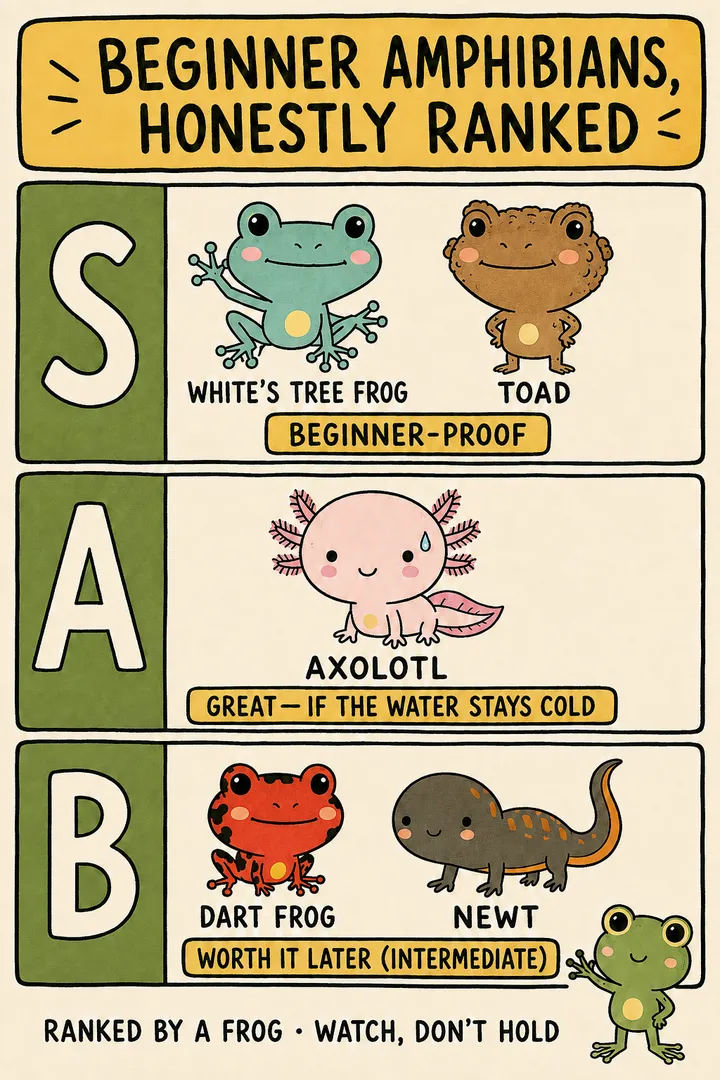
Amphibians make wonderful, low-drama pets — but “which one should I get?” is the right first question, because they differ a lot in what they need. Here’s an honest side-by-side, and a pick for every situation.
🔧 Still deciding? Weigh the options side by side in the free species compare tool.
Quick comparison
| Species | Difficulty | Key requirement | Active by day? | Lifespan |
|---|---|---|---|---|
| Toad | 🟢 Beginner | Moist terrestrial setup | Dusk/night | 10–20+ yrs |
| White’s tree frog | 🟢 Beginner | Tall vivarium, moderate humidity | Night | 10–16 yrs |
| Axolotl | 🟡 Beginner–Intermediate | Cold water (16–18°C), cycled tank | Yes (aquatic) | 10–15+ yrs |
| Poison dart frog | 🟡 Intermediate | Bioactive viv, 80–100% humidity, fruit flies | Yes | 10–15 yrs |
| Newt | 🟡 Intermediate | Land + cool water, secure lid | Varies | 10–15+ yrs |
Note: none of these are “handling” pets — amphibians are for watching, not holding.
The honest rundown
- Toad — the most forgiving. Hardy, long-lived, undramatic. Downside: nocturnal and loves to burrow, so it’s not always on show.
- White’s tree frog — calm, chunky, charming, and beginner-proof. The classic “first frog.” Easy to overfeed (they get pudgy).
- Axolotl — hardy and fascinating, active in the daytime, and a great first aquatic pet — but only if you can keep the water cold. In a warm home with no chiller, skip it.
- Poison dart frog — dazzling and active by day (a big plus), and captive-bred ones are non-toxic. The catch: a stable bioactive vivarium and a live fruit-fly culture. Intermediate, not hard.
- Newt — fascinating semi-aquatic life, but you’re managing both land and cool water, plus escape-proofing.
Which is right for you?
- “I want the easiest possible pet” → Toad.
- “I want a cute, calm frog to start with” → White’s tree frog.
- “I want something active I can watch during the day” → Poison dart frog (or an axolotl, if you can keep it cold).
- “My home runs cool / I love aquariums” → Axolotl or a newt.
- “My home runs warm” → avoid axolotls and newts; a toad or tree frog is friendlier.
- “Small space, want a planted display” → a dart frog vivarium is compact and beautiful.
The one universal rule
Whatever you pick, the setup costs more than the animal, and getting the environment right is 90% of the job. Match the species to your home’s temperature and the space you have, and you’ll do great.
💚 There’s no wrong first amphibian — only a mismatch between a species and your setup. Not sure which suits your home? That’s exactly the kind of question worth asking before you buy.
Go deeper: read the complete buying guide (real costs, shopping list & what to check before you buy), browse the printable care sheets for each species, start with the Axolotl Care Guide, or see the Pacman frog care guide — one of the easiest first amphibians.
Common questions
What is the best beginner amphibian?
For most beginners, a toad or a White's tree frog is the easiest and most forgiving amphibian, and the axolotl is an excellent choice if you can keep the water cold (16 to 18C). Poison dart frogs and newts are a step up in effort. The best one depends on your home temperature, space, and how much husbandry you want.
Are amphibians hard to keep?
Amphibians are not hard once their environment is right, but they are sensitive to temperature, humidity, and water quality, so the difficulty is in the setup, not the daily care. Choose a species that matches your home conditions and most of the work is done up front.
What is the easiest amphibian for a beginner who wants a low-effort pet?
A toad is usually the lowest-effort choice: hardy, forgiving, long-lived, and happy with a simple terrestrial setup of moist substrate, a hide, and a shallow water dish. White's tree frogs are similarly easygoing.
Can you handle pet amphibians?
Not really. Amphibians are look-don't-touch pets because their skin absorbs oils, soaps, and salts. If handling a pet is important to you, an amphibian is probably not the right choice.
How much does a beginner amphibian cost to keep?
The animal itself is often inexpensive, but the setup usually costs more than the animal. Budget for the enclosure, correct heating or cooling, and husbandry supplies, then a small monthly cost for food and upkeep.

Join the Bognook burrow
Cozy amphibian care tips, aesthetic freebies, and the occasional frog fact — straight to your inbox. No spam, just good bog vibes.
Free amphibian care cheat-sheet when you join. No spam — pinky-promise. Unsubscribe anytime. See how we handle your data in our privacy notice.