Pacman Frog Care: The Complete Beginner's Guide (Setup & Feeding)
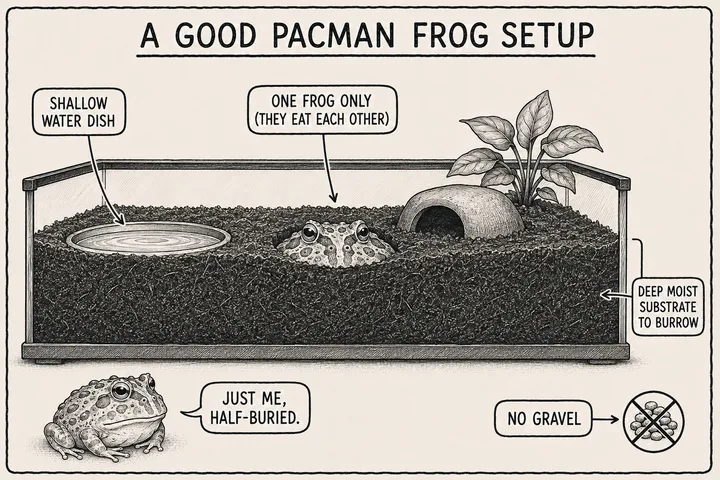
Pacman frogs are, honestly, one of the best first amphibians there is — a round, grumpy-looking “mouth with feet” that spends its life comfortably half-buried, waiting for dinner to wander past. They’re nicknamed after the arcade character for a reason: they are basically an appetite with legs. The good news for a nervous first-time keeper is that keeping one well comes down to just a few things. Get those right and you’ve got a hardy, characterful little blob for years. Here’s all of it.
🐸 Want a tick-as-you-go version? Our free Simple Setup & Feeding checklist gives you the exact values for a Pacman frog on one screen — no shopping wizard, just confidence that you’ve got the basics right. This guide is the “why” behind it.
The 30-second version
- They’re a “pet rock” with an appetite — low-effort, mostly buried, no climbing needed.
- Substrate is the one that matters most: deep, moist coco fibre to bury in — never gravel (swallowed gravel can cause a fatal gut blockage).
- Keep it warm: 78–82°F by day, never above ~85°F, at 60–80% humidity.
- Don’t overfeed: juveniles ~daily, adults once or twice a week. That bottomless appetite makes obesity easy.
- They’re for watching, not holding — they will bite.
- A buried, quiet frog is usually a happy frog. Don’t panic.
Is a Pacman frog right for you?
They’re a fantastic starter amphibian — but be honest about what they are:
- Lifespan: 6–10+ years. A genuine commitment, not a throwaway pet.
- They barely move. A Pacman frog is a sit-and-wait ambush predator; if you want an active, roaming pet, this isn’t it. If you find a chunky, low-drama blob charming, you’ll love it.
- They’re not handleable. These are display animals with a real bite — you keep them to watch, not to hold.
- Live feeders forever. You’ll always have crickets or roaches on the go.
The setup: simple and terrestrial
Pacman frogs don’t climb and don’t roam, so the setup is refreshingly uncomplicated — floor space beats height.
- Enclosure: a single adult is happy in a 10–20 gallon terrestrial tank, longer than tall, with a secure, ventilated lid. They’re ground-dwellers, so don’t waste money on a tall arboreal viv.
- One frog per tank — always. Pacman frogs are cannibals and will genuinely try to eat a tankmate. This is not a social animal.
Substrate: the safety-critical choice
If you take one thing from this guide, make it this.
- Use several inches of moist coco fibre (coconut-husk substrate), deep enough for the frog to bury itself — which is where it wants to be most of the time.
- Never use gravel, small bark chips, or any loose material it could swallow. Pacman frogs snap at food with a wide, indiscriminate gulp, and impaction — a gut blockage from swallowed substrate — can be fatal.
- Keep it damp, not soggy, and feed off tongs or a shallow dish so the frog can’t gulp substrate along with its meal.
Temperature & humidity
- Temperature: daytime 78–82°F, a little cooler at night, and never above ~85°F (overheating is dangerous).
- Humidity: around 60–80% — damp substrate, a water dish, and light misting as needed.
- Measure both. A cheap thermometer and hygrometer turn “I think it’s fine” into “I know it’s fine.” Most Pacman frog problems trace straight back to temperature or humidity being a little off, so this small step prevents most trouble.
Water
- A shallow dish of clean, dechlorinated water, always available. Pacman frogs soak and drink through their skin, so this matters more than it looks.
- Change it often — they foul it, and dirty water causes skin problems.
Feeding — without overfeeding
Pacman frogs are insectivores, and the whole art here is portion control, because they will always act starving.
- Staple: gut-loaded, calcium/D3-dusted insects — crickets, dubia roaches, and worms.
- Prey size: no wider than the frog’s head (oversized prey can injure or even rupture the gut).
- Frequency: juveniles roughly daily; adults once or twice a week.
- Go easy on the treats. Fatty feeders like waxworms and the occasional pinkie mouse are occasional — frequent rodents lead to obesity and liver problems. Feed to a schedule, not to their begging — that hungry face is not data.
Handling
Don’t. A Pacman frog is an ambush predator that can and will mistake a finger for food, and its bite is surprisingly strong. If you must move it, coax it into a container with clean, wet hands rather than picking it up. These are watch-don’t-touch animals — and that’s part of the low-effort charm.
If it buries and stops eating — don’t panic
This worries new keepers constantly, so here’s the reassurance:
- Burrowing and going quiet is normal. A Pacman frog that’s tucked down and still is usually just being a Pacman frog.
- If it stays buried and won’t eat, the temperature or humidity is usually slightly off — check both first.
- When conditions get too dry, it may form a dry skin “cocoon” and wait things out (this is called aestivation). Raise the humidity and it will shed and eat the thickened skin itself; gently correct the warmth and keep the substrate damp, and it will surface on its own.
- See an exotics vet if it’s buried for weeks with weight loss, or won’t rouse once conditions are corrected.
The two mistakes to avoid
Two common Pacman frog problems are easy to avoid:
- Impaction — from unsafe substrate or oversized prey. Keep it on coco fibre, feed appropriately sized prey off a dish/tongs.
- Obesity — from overfeeding that bottomless appetite (and too many rodents can also cause liver problems). Feed to a schedule and keep rodents rare.
Avoid those two and you’ve headed off two problems vets commonly flag in Pacman frogs.
Thinking bigger? Meet the giant cousin
If you love the Pacman’s chunky, sit-and-wait charm but want something much bigger, the African bullfrog (Pixie frog) is its giant relative — same simple care philosophy, but it gets huge (males reach 8–9 inches and generally live 15–25 years) and has a genuinely powerful bite. The same Simple Setup checklist covers it — just know what you’re signing up for before you commit to a decades-long, dinner-plate-sized frog.
💚 Pacman frogs are proof that “beginner” and “rewarding” aren’t opposites. Nail the substrate, keep it warm and damp, feed sensibly, and let it be the grumpy little blob it wants to be — you’ve genuinely got this.
Set yours up right: run the free Simple Setup & Feeding checklist for a Pacman frog, and if you ever spot something worrying, the symptom checker — or our Pacman frog warning-signs guide — will help you tell “normal” from “call a vet.”
🎓 Ready to go further — the advanced tier. Can Pacman frogs or bullfrogs live together?
More Pacman help: what to feed beyond crickets · why is it sitting in its water bowl? · Pacman & bullfrog questions answered
Sources & further reading
This guide was written and fact-checked against these authorities. It’s kind, general guidance — not a substitute for an exotics vet:
- PetMD — Pacman Frog Care Sheet (Maria Zayas, DVM) & Reptiles Magazine — Pacman frog (Ceratophrys) husbandry: temperature, humidity, diet and supplements, and handling.
- Tree of Life Exotic Pet Medical Center — Pacman Frog Care & Chicago Exotics Animal Hospital — Argentine Horned Frog care sheet — safe coco-fibre substrate, enclosure size, and impaction prevention.
- Merck Veterinary Manual — noninfectious disorders of amphibians — obesity from overfeeding.
- AZA Amphibian Husbandry Resource Guide — aggressive feeders such as horned frogs can swallow gravel by accident, causing a digestive-tract impaction.
- PetMD — Pacman frog care sheet — adults fed one to two times a week, and why gravel is a fatal-obstruction risk.
- Association of Reptilian & Amphibian Veterinarians (ARAV) — a find-an-exotics-vet directory.
Written and fact-checked by The Bognook Team against veterinarian-authored sources — if your frog is buried for weeks with weight loss or seems unwell, see an exotics vet.
Common questions
Are Pacman frogs good beginner pets?
Yes — they are one of the easiest amphibians to keep well. A Pacman frog is a sit-and-wait "mouth with feet" that spends most of its time buried, needs no climbing space, and asks very little once the basics are right. The catch is that they are for watching, not handling (they are ambush predators that will bite), and they live 6 to 10+ years, so it is a real commitment. Get the substrate, warmth, water and feeding right and the rest genuinely takes care of itself.
What do Pacman frogs eat and how often?
Pacman frogs are insectivores with a bottomless appetite. Feed gut-loaded, calcium/D3-dusted insects — crickets, dubia roaches, and worms — sized no wider than the frog's head. Juveniles eat roughly daily; adults once or twice a week. The real skill is not overfeeding: obesity and liver problems come easily with that appetite, so feed to a schedule, not to their begging, and keep fatty treats like pinkie mice occasional at most.
What substrate is safe for a Pacman frog?
Use several inches of moist coco fibre (coconut-husk substrate) deep enough for the frog to bury itself. This is the single most safety-critical choice you make: never use gravel, bark chips, or any loose material small enough to be swallowed, because swallowed substrate can cause a fatal gut blockage (impaction). Keep the substrate damp but not soggy, and feed off tongs or a shallow dish so the frog cannot gulp substrate with its food.
What temperature and humidity does a Pacman frog need?
Aim for a daytime temperature of about 78 to 82F, a little cooler at night, and never above roughly 85F. Humidity should sit around 60 to 80%, which you maintain with damp (not waterlogged) substrate, a water dish, and light misting as needed. Use an actual thermometer and hygrometer so you can confirm both rather than guessing — most Pacman frog problems trace back to temperature or humidity being slightly off.
Why is my Pacman frog buried and not eating?
Burrowing and going quiet is completely normal — Pacman frogs are ambush predators that sit and wait. If yours stays buried and refuses food, the temperature or humidity is usually a little off, so check both first. When conditions get too dry, a Pacman frog can form a dry skin "cocoon" and wait it out (aestivation) — raising the humidity lets it shed and eat the thickened skin itself, so gently correct the warmth, keep the substrate damp, and it will surface on its own. Weeks buried with weight loss, or a frog that won't rouse once conditions are corrected, warrants an exotics vet.

Join the Bognook burrow
Cozy amphibian care tips, aesthetic freebies, and the occasional frog fact — straight to your inbox. No spam, just good bog vibes.
Free amphibian care cheat-sheet when you join. No spam — pinky-promise. Unsubscribe anytime. See how we handle your data in our privacy notice.