Why Is My Pacman Frog Sitting in Its Water Bowl?
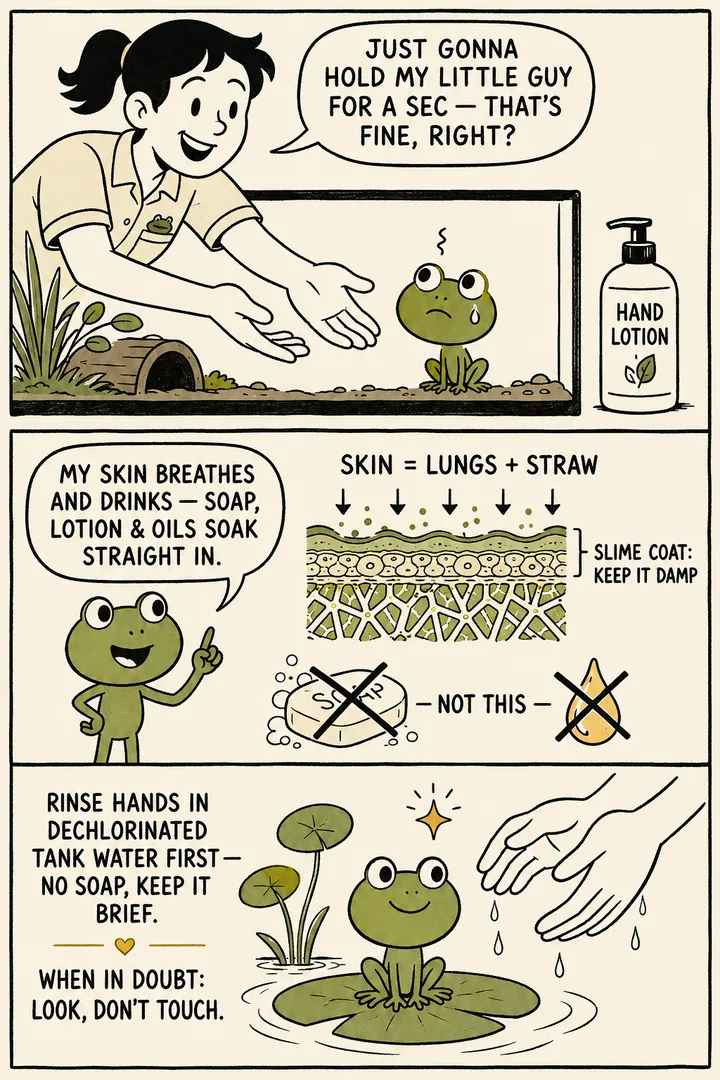
If your Pacman frog has decided its water dish is now its permanent address, it’s usually trying to tell you something — and the good news is that the fix is normally simple. Take a breath, and let’s read the message.
🐸 Want to check your setup in 30 seconds? The free Simple Setup & Feeding checklist gives you the exact temperature, humidity, and substrate targets for a Pacman frog — the three things that cause most water-sitting.
The short answer
A Pacman frog that constantly sits in its water bowl is almost always too hot or too dry, and it’s soaking to cool down or rehydrate. So the very first things to check are:
- Temperature — it should be ~78–82°F, never above ~85°F. A tank that’s too warm sends a frog straight into the water.
- Humidity & substrate — 60–80%, with substrate that’s damp, not bone-dry. If the coco fibre has dried out, the water dish becomes the only moist spot left.
Fix those two and, most of the time, the frog goes back to burrowing like normal.
Is some soaking normal? Yes.
Absolutely — brief soaking is healthy. Pacman frogs drink and hydrate through their skin, so a clean water dish is essential, and dipping in and out is exactly what they should do. What you’re watching for is the difference between visiting and living there: a frog that soaks occasionally is fine; a frog that won’t leave the water for days is flagging a problem.
The other reasons a Pacman frog camps in the water
If the temperature and humidity check out, run down this list:
- Dirty or irritating substrate. If the coco fibre is fouled, or something’s wrong with it, the frog may retreat to the “cleanest” spot. Refresh the substrate and make sure it’s an appropriate, damp coco fibre.
- Constipation or mild impaction. A frog that’s blocked up will often soak, because a warm soak helps it pass — that’s actually the standard first-aid for mild impaction. Watch for a firm, bloated belly with no droppings. If a warm, shallow soak doesn’t get things moving in a day or two, escalate (below).
- Water that’s too dirty to be safe. Pacman frogs soak and defecate in their dish, so it fouls fast. Change it daily with clean, dechlorinated water in a shallow, easy-exit dish.
- The start of dropsy (the serious one). If the frog is also puffy and swollen all over — including the legs — and seems unwell, that’s a different, urgent problem. See below.
The safety line: soaking vs. dropsy
Here’s the distinction that matters most. Normal soaking is a comfortable frog dipping in and out of clean water. Dropsy (edema) is a frog that’s swelling up like a water balloon — soft, puffy, fluid-filled, often with puffy legs and lethargy — and it can signal a kidney, organ, or bacterial problem.
Dropsy is not fixed by a water change or a diet — it needs an exotics vet. If your water-sitting frog looks bloated and unwell rather than just soaking, treat it as urgent.
What to do, in order
- Check and correct the temperature (~78–82°F) — this alone solves most cases.
- Check and correct humidity/substrate — damp coco fibre, 60–80%.
- Give it clean water daily in a shallow, easy-exit dish.
- Look at the belly and body: a firm belly with no droppings → possible impaction (a warm soak can help; vet if it doesn’t clear in a day or two). A soft, puffy, all-over swelling → possible dropsy → exotics vet promptly.
- Note appetite and energy: lethargic + refusing food + water-sitting together → get a vet’s eyes on it.
💚 Most of the time, a water-logged Pacman frog just wants a cooler, damper home — an easy fix. Sort the temperature and humidity, keep the water clean, and it’ll be back to its buried, grumpy self in no time.
Go deeper: the Pacman frog care guide · Is my Pacman frog sick? · the free symptom checker.
Sources & further reading
This guide was written and fact-checked against these authorities. It’s kind, general guidance — not a substitute for an exotics vet:
- PetMD — Pacman Frog Care Sheet (Maria Zayas, DVM) & Reptiles Magazine — Pacman frog (Ceratophrys) temperature, humidity, and soaking behaviour.
- Tree of Life Exotic Pet Medical Center — Pacman Frog Care & Swiftail Exotic Veterinary Services — Pacman Frog Care Sheet — substrate, hydration, and impaction prevention.
- Merck Veterinary Manual — Noninfectious Disorders of Amphibians — fluid swelling (hydrocoelom and edema); its Environment and Husbandry page gives the gravel rule (too large to swallow, or small enough to pass).
- Association of Reptilian & Amphibian Veterinarians (ARAV) — a find-an-exotics-vet directory.
Written and fact-checked by The Bognook Team against veterinarian-authored sources — a puffy, balloon-like swelling with lethargy needs an exotics vet now.
Common questions
Why is my Pacman frog sitting in its water bowl all the time?
A Pacman frog that lives in its water dish is almost always trying to cool down or rehydrate, which points to a tank that is too warm or too dry. Check the temperature (it should be about 78 to 82F, never above ~85F) and the humidity (60 to 80%, with damp substrate) first. Other causes are dirty or irritating substrate, constipation (soaking to help pass a blockage), or — if the frog also looks puffy and unwell — the early stages of dropsy. Occasional soaking is normal; constant water-sitting is a signal worth acting on.
Is it normal for a Pacman frog to soak in its water?
Yes, brief soaking is completely normal and healthy — Pacman frogs drink and rehydrate through their skin, so a good water dish matters. What is not typical is a frog that sits in the water almost constantly, day after day. Think of the difference like a person having a drink versus refusing to leave the sink: the first is routine, the second means something in the environment needs fixing.
Could water-sitting mean my Pacman frog is constipated or impacted?
It can. A frog that is constipated or lightly impacted will often sit in water, because a warm soak helps it pass a blockage — which is also the first-aid step keepers use for mild impaction. Watch for a firm, bloated belly with no droppings. If a warm shallow soak does not get things moving within a day or two, or the frog is straining, lethargic, or off its food, see an exotics vet.
My Pacman frog's water bowl is always dirty — what should I do?
That is normal and expected: Pacman frogs soak, drink, and often defecate in their water, so the dish needs cleaning and refilling daily (sometimes more). Use a shallow dish the frog can easily climb out of, fill it with clean dechlorinated water, and never let it sit dirty — fouled water quickly causes skin problems for an animal that absorbs everything through its skin.
When is a Pacman frog sitting in water an emergency?
Treat it as urgent if the frog is also swelling up like a balloon (puffy all over, including the legs), has a reddened belly, or is lethargic and refusing food. A soft, all-over, fluid swelling can be dropsy or edema — a kidney, organ, or bacterial problem that needs an exotics vet, not a diet or a water change. For water-sitting with those signs, contact a vet promptly.

Join the Bognook burrow
Cozy amphibian care tips, aesthetic freebies, and the occasional frog fact — straight to your inbox. No spam, just good bog vibes.
Free amphibian care cheat-sheet when you join. No spam — pinky-promise. Unsubscribe anytime. See how we handle your data in our privacy notice.