Is My Pacman Frog Sick? 8 Warning Signs Every Keeper Should Know
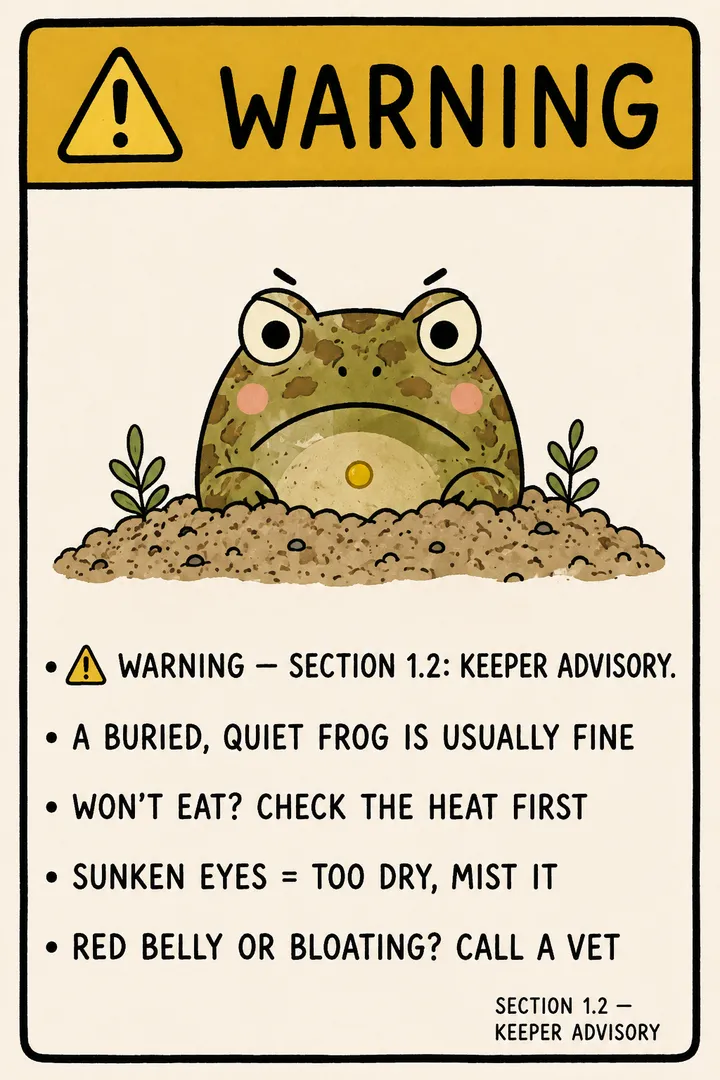
First: if you’re reading this because something looks off, take a breath. Pacman frogs are hardy, most problems are caught in time, and the fact that you’re paying attention makes you a good keeper. And here’s the reassurance most worried Pacman owners need first — a buried, quiet frog is usually a healthy frog. Here’s the honest checklist.
🐸 Not sure how serious it is? Tick what you’re seeing in our free symptom checker and it’ll suggest possible causes, safe first steps, and the “see a vet now” thresholds — for Pacman frogs and African bullfrogs. It never diagnoses; it helps you decide.
The 30-second version
A healthy Pacman frog has clear, full eyes, smooth (not dry, not slimy) skin, a rounded but not puffy body, and a strong feeding response — even if it spends most of its life buried. If something looks wrong, don’t panic — check these three things first, because they fix many Pacman frog problems:
- Temperature — daytime ~78–82°F, never above ~85°F, a little cooler at night. Overheating makes a Pacman frog burrow and stop eating.
- Humidity & substrate — ~60–80%, substrate damp but not soggy. Too dry and it dehydrates or forms a hard skin “cocoon.”
- Feeding & substrate safety — feed off tongs or a dish so it can’t swallow loose substrate (impaction), and don’t overfeed (adults eat once or twice a week).
Important: a Pacman frog you rarely see is usually a happy one. Judge health by body condition and feeding response, not by how often it surfaces.
The 8 warning signs
1. Buried and not eating — maybe a dry “cocoon” 🟡
This is the one that panics new keepers, and it’s usually the least worrying. Pacman frogs dig down and slow right down (aestivate) when the temperature or humidity is a little off, sometimes forming a dry skin cocoon to wait it out. Do: gently correct the warmth and dampen the substrate — raise the humidity so it can shed the cocoon and eat it, as PetMD advises; there’s no need to dig it up. It’ll surface on its own. Vet only if it’s weeks buried with weight loss, or won’t rouse once conditions are right.
2. Not eating for over a week 🟡
A few days off food is normal, especially after a move. A week-plus usually means the temperature is off, the prey’s too big, or it’s simply well-fed. Do: check the temperature first, offer a correctly sized food item, and give a new frog quiet time.
3. Getting noticeably fat 🟡
That bottomless appetite makes obesity easy — a frog with no shape and a heavy look is overweight, which can bring on liver problems. Do: feed adults to a schedule (once or twice a week), use leaner feeders, and cut fatty treats and frequent rodents. Feed the schedule, not the begging face.
4. Sunken eyes, dry or dull skin 🟡→🔴
Dehydration — the substrate is too dry or the water dish is dirty/empty. Amphibian skin is their drinking system. Do: dampen the substrate, refresh a shallow dechlorinated water dish, raise humidity. Usually rebounds within hours; sunken eyes that don’t recover after a soak need a vet.
5. Bloated belly with no droppings (impaction) 🔴
A firm, swollen belly plus no bowel movements points to a gut blockage, most often from swallowed substrate. Do: offer a warm shallow soak to encourage it to pass, stop feeding on loose substrate, and if it doesn’t clear within about 48 hours — or the frog is lethargic or straining — see an exotics vet.
6. Weak or bendy limbs, a soft jaw, trembling (MBD) 🔴
Metabolic bone disease from a calcium/D3 deficiency. Do: dust and gut-load every feeding going forward, and see an exotics vet if the jaw is soft or the limbs are bowed. Early MBD can be turned around; advanced cases need professional care.
7. Swelling up like a balloon all over (dropsy/edema) 🔴
Different from a food-filled belly: a soft, puffy, water-balloon swelling all over — including the legs — can signal a kidney, organ, or bacterial problem. This is not a diet issue and not wait-and-see. Do: review husbandry and contact an exotics vet for a diagnosis.
8. Reddened belly or legs (“red leg”) 🔴
Reddening of the underside is the classic sign of a bacterial infection (septicemia) — serious and potentially fast-moving. Do: clean the enclosure and water dish and correct husbandry immediately, and see an exotics vet right away. Don’t try to treat this one at home alone.
See a vet now if…
A puffy all-over (water-balloon) swelling · a bloated belly with no droppings that doesn’t clear · a reddened belly or legs · a soft jaw or bendy limbs · tissue protruding from the vent (prolapse) · sunken eyes that don’t recover after a soak · open sores, a “melting” look, or seizures · any Pacman frog buried for weeks with weight loss. A vet call is never the wrong move.
The pattern to remember
Notice how often the fix is the same handful of things — the right warmth (~78–82°F), damp (not soggy) substrate, impaction-safe flooring, and sensible feeding. Many Pacman frog “illnesses” are really husbandry problems wearing a costume, and impaction and obesity are two common ones. Get the tank right and most of this list never appears.
One reassurance worth repeating: burrowing and stillness are normal. The skill with Pacman frogs isn’t spotting drama — it’s learning that “quiet and buried” is usually exactly what a content Pacman frog does. (Keeping the giant cousin? See Is my African bullfrog sick? — same core signs, but obesity is a bigger risk.)
💚 You don’t have to figure this out alone or feel silly for asking. Correct the temperature and humidity, keep it clean, and reach out to an exotics vet or a kind keeper community. Most problems, caught early, are completely fixable.
Go deeper: the Pacman frog care guide · the free symptom checker · the Simple Setup & Feeding checklist · Is my amphibian okay? — the all-species check.
Sources & further reading
This checklist was written and fact-checked against these authorities. It’s kind, general guidance — not a diagnosis or a substitute for an exotics vet:
- PetMD — Pacman Frog Care Sheet (Maria Zayas, DVM) & Reptiles Magazine — Pacman frog (Ceratophrys) husbandry, and the temperature/humidity ranges these problems trace back to.
- Tree of Life Exotic Pet Medical Center — Pacman Frog Care & Swiftail Exotic Veterinary Services — Pacman Frog Care Sheet — safe substrate and impaction prevention; PetMD (Maria Zayas, DVM) & Josh’s Frogs — Pac-Man Frog Care Sheet — aestivation (the “cocoon”).
- Merck Veterinary Manual — Infectious Diseases of Amphibians — bacterial “red-leg” syndrome (septicemia) and edema; its Noninfectious Disorders page covers metabolic bone disease, and its Environment and Husbandry page gives the gravel rule (too large to swallow, or small enough to pass).
- Association of Reptilian & Amphibian Veterinarians (ARAV) — a find-an-exotics-vet directory.
Written and fact-checked by The Bognook Team against veterinarian-authored sources — a balloon-like swelling, a red belly, or a prolapse needs an exotics vet now.
Common questions
How do I know if my Pacman frog is sick?
Watch for these warning signs: not eating for more than a week or two, a bloated belly with no droppings, a puffy water-balloon swelling all over, sunken eyes and dry skin, weak or bendy limbs, a reddened belly, straining or tissue out of the vent, and true lethargy. Most problems trace back to temperature, humidity, or substrate, so check those first. Crucially, a Pacman frog that is simply buried and quiet is usually healthy, not sick — judge by body condition and feeding response, not by how often you see it.
Why is my Pacman frog not eating?
Common reasons are a temperature that is too warm or too cold, a recent move, prey that is too large, or that the frog is simply well-fed. Pacman frogs also bury and slow down (aestivate) when conditions are a little off, refusing food until things feel right. Check that the daytime temperature is about 78 to 82F and humidity is 60 to 80%, offer an appropriately sized food item, and give a new frog time to settle. A few days off food is normal; a week or more combined with weight loss is the concern.
Is it normal for a Pacman frog to bury itself and not move?
Usually, yes. Pacman frogs are sit-and-wait ambush predators that spend most of their time buried and still, so a frog that has dug down and gone quiet is typically just being a Pacman frog. When conditions get too dry, it may form a dry skin "cocoon" and wait things out (aestivation) — raise the humidity and it can shed and eat the thickened skin itself (PetMD's advice). Gently correct the temperature and keep the substrate damp, and it will surface on its own. See a vet only if it stays buried for weeks with weight loss, or will not rouse once conditions are corrected.
Why is my Pacman frog bloated?
There are two very different kinds of "bloated," and telling them apart matters. A firm belly with no droppings often means impaction — a gut blockage, usually from swallowed substrate — for which a warm shallow soak can help mild cases, but persistent cases need a vet. A soft, puffy, water-balloon swelling all over (including the legs) is more likely dropsy or edema, a sign of a kidney, organ, or bacterial problem, and is a genuine emergency that needs an exotics vet — not a diet. If in doubt, treat sudden all-over swelling as urgent.
When should I take my Pacman frog to the vet?
See an exotics vet promptly for a puffy all-over (water-balloon) swelling, a bloated belly with no droppings that does not clear, a reddened belly or legs, a soft jaw or bendy limbs, tissue protruding from the vent, sunken eyes that do not recover after a soak, open sores, or seizures. Also see a vet for any Pacman frog that has been buried for weeks with weight loss, or that will not improve after you have corrected temperature and humidity. When in doubt, a vet call is never the wrong move.

Join the Bognook burrow
Cozy amphibian care tips, aesthetic freebies, and the occasional frog fact — straight to your inbox. No spam, just good bog vibes.
Free amphibian care cheat-sheet when you join. No spam — pinky-promise. Unsubscribe anytime. See how we handle your data in our privacy notice.