African Bullfrog (Pixie Frog) Care: How Big, How Long, How To
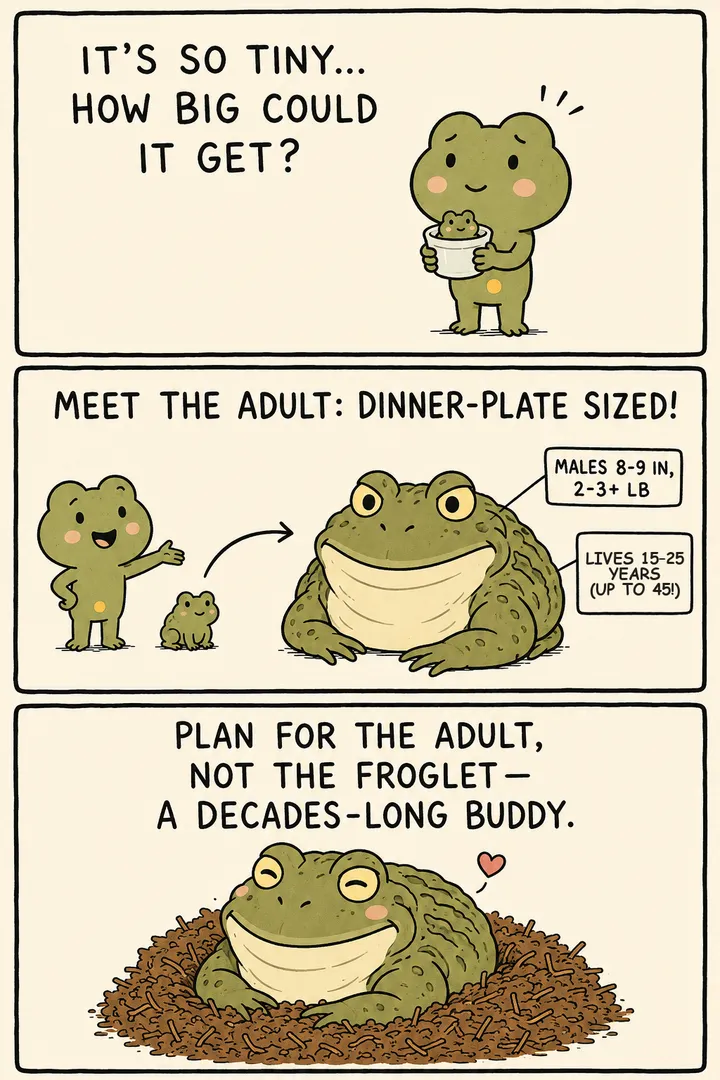
If you’ve landed here after seeing one and thinking “what kind of frog is this, and are they normally so huge?” — yes, they really are. The African bullfrog, better known as the Pixie frog (from its Latin name Pyxicephalus, not its size — the irony is not lost on anyone), is one of the biggest, most characterful frogs in the hobby: a grumpy, dinner-plate-sized giant. The care itself is refreshingly simple — nearly identical to its little cousin the Pacman frog — but the scale of the commitment is not. Here’s the honest, complete guide.
🐸 Want a tick-as-you-go version? Our free Simple Setup & Feeding checklist gives you the exact values for an African bullfrog on one screen. This guide is the “why” — and the reality check — behind it.
The 30-second version
- They get HUGE: males reach 8–9 inches and 2–3+ lb. Plan for the adult, not the froglet.
- They live a very long time: generally 15–25 years (documented to 45). A decades-long commitment.
- Care is simple — like a giant Pacman frog: deep coco fibre to bury in, warm, damp, fed sensibly.
- The bite is real. Tooth-like jaw ridges + a strong feeding response → long tongs, never fingers.
- Watch the waistline: rodents only every 2–3 weeks — pixies are prone to obesity.
- A buried, quiet frog is usually fine. Don’t panic.
Reality check: know what you’re signing up for
This is the most important section, because the froglet in the shop gives no hint of what’s coming.
- Size: a full-grown male reaches 8–9 inches and 2–3+ pounds — genuinely one of the largest pet frogs. Females are smaller but still substantial.
- Lifespan: 15–25 years is typical, and one has been documented at 45. You are, realistically, committing to a big frog for the better part of your adult life.
- Strength & attitude: pixies are bold, food-motivated, and powerful. None of that is a problem — it’s part of the charm — but it means respecting the animal.
If a decades-long, plate-sized, grumpy tank of a frog sounds wonderful rather than alarming, read on. If not, its little cousin the Pacman frog gives you the same sit-and-wait charm at a fraction of the size.
The setup: big, simple, terrestrial
Like a Pacman frog, a pixie doesn’t climb or roam — it sits, buries, and waits. So the setup is simple; it just needs to be big enough for the adult.
- Enclosure: an adult needs a large terrestrial tank — around 36×18×18 in (roughly 20–40 gallons), longer than tall, with a secure, ventilated lid. Don’t buy for the froglet; buy (or plan to upgrade) for the adult.
- One frog per tank — always. African bullfrogs are cannibalistic and will try to eat a tankmate. This is a solitary animal.
Substrate: the safety-critical choice
Same rule as every burrowing frog, and it’s the one that matters most.
- Use deep, moist coco fibre, enough for the frog to fully bury itself.
- Never use gravel or loose material it could swallow. Pixies gulp at food with abandon, and impaction — a gut blockage from swallowed substrate — can be fatal.
- Keep it damp, not soggy, and feed off long tongs (see the bite note) so the frog can’t gulp substrate with its meal.
Temperature & humidity
- Temperature: daytime 78–90°F with a ~5°F drop at night. (They tolerate the warmer end better than a Pacman frog, but don’t cook them.)
- Humidity: an exotic-vet hospital’s care sheet says about 80–90%; keeper guides often run lower. Either way: damp (not waterlogged) substrate, a soak dish, light misting as needed.
- Measure both with a thermometer and hygrometer. Most pixie problems trace back to temperature or humidity being off, so confirming the numbers prevents most trouble.
Water
- A shallow dish it can soak in — a pixie is not a strong swimmer, so keep it shallow with an easy exit. They soak and hydrate through their skin.
- Clean, dechlorinated, changed often. Big frogs foul water fast.
Feeding — the obesity trap
African bullfrogs are voracious and prone to obesity — especially when fed rodents often — so overfeeding is the trap to avoid.
- Staple: gut-loaded, calcium/D3-dusted insects and roaches.
- Prey size: no wider than the frog’s head (oversized prey can injure or even rupture the gut).
- Frequency: juveniles roughly daily; adults every 3–4 days.
- Rodents are a sometimes-food. Offer a mouse only every 2–3 weeks at most. Frequent pinkie/fuzzy mice fatten a pixie fast and lead to obesity and liver problems — a serious, common problem. Feed to a schedule, not to its begging.
Handling & the bite
This is a watch-don’t-hold animal, and here the bite is a real safety point.
- African bullfrogs have tooth-like ridges (odontoids) in the lower jaw and a strong, fast feeding response. A startled or hungry pixie can mistake a hand for food and latch on hard — it genuinely hurts.
- Always feed and move it with long tongs, never fingers.
- If you must relocate it, coax it into a container rather than picking it up. A startled pixie also puffs up defensively — let it settle.
If it buries and stops eating — don’t panic
- Burrowing and going quiet is normal. A pixie tucked down and still is usually just being a pixie.
- If it stays buried and won’t eat, the temperature or humidity is usually slightly off — check both first.
- In dry conditions it may form a dry skin “cocoon” and wait things out (aestivation). Leave the cocoon for the frog to shed: correct the warmth and raise the humidity (damp substrate), and it will shed it and surface on its own.
- See an exotics vet if it’s buried for weeks with weight loss, or won’t rouse once conditions are corrected.
The two mistakes to avoid
As with the Pacman frog, two common problems are easy to avoid:
- Impaction — from unsafe substrate or oversized prey. Coco fibre only, correctly sized prey off tongs.
- Obesity (and liver problems) — from too many rodents and too-frequent feeding. Keep mice rare and feed to a schedule.
Dodge those two and respect the bite, and a pixie is a genuinely hardy, low-effort — if enormous — companion.
💚 The African bullfrog asks for simple care and one big thing in return: that you go in clear-eyed about the size, the lifespan, and the bite. Do that, get the substrate and feeding right, and you’ve got one of the most characterful animals in the whole hobby for decades to come.
Set yours up right: run the free Simple Setup & Feeding checklist for an African bullfrog, and if something ever looks off, the symptom checker — or our Is my African bullfrog sick? guide — helps you tell “normal” from “call a vet.” Prefer a pocket-sized version? Meet the Pacman frog.
🎓 Ready to go further — the advanced tier. Can Pacman frogs or bullfrogs live together?
Sources & further reading
This guide was written and fact-checked against these authorities. It’s kind, general guidance — not a substitute for an exotics vet:
- Josh’s Frogs — Pixie frog care sheet — African bullfrog (Pyxicephalus adspersus) enclosure size, temperature, substrate (kept moist but not soaking), and feeding.
- Chicago Exotics Animal Hospital & Vet Verified — adult size and lifespan (generally 15–25 years), the obesity risk from frequent rodents, and bite safety; Chicago Exotics also gives the ~80–90% humidity figure. LafeberVet — Giant African Bullfrog (Christal Pollock, DVM) backs the damp-not-waterlogged substrate and light misting.
- AmphibiaWeb — Pyxicephalus adspersus — adult size and the documented 45-year age.
- Merck Veterinary Manual — noninfectious disorders of amphibians — obesity from overfeeding.
- AZA Amphibian Husbandry Resource Guide — aggressive feeders such as horned frogs can swallow gravel by accident, causing a digestive-tract impaction; sedentary genera including Pyxicephalus are prone to obesity.
- Association of Reptilian & Amphibian Veterinarians (ARAV) — a find-an-exotics-vet directory.
Written and fact-checked by The Bognook Team against veterinarian-authored sources — if your frog is buried for weeks with weight loss or seems unwell, see an exotics vet.
Common questions
How big do African bullfrogs get?
Big — bigger than most people expect. Male African bullfrogs (Pyxicephalus adspersus) reach about 8 to 9 inches and 2 to 3+ pounds, making them one of the largest frogs kept as pets; females are noticeably smaller. That "is this frog normally so huge?" reaction is exactly right — a full-grown male pixie is a genuine dinner-plate-sized animal, so plan your enclosure and your commitment around the adult size, not the little froglet you buy.
How long do African bullfrogs live?
A very long time. African bullfrogs generally live 15–25 years with good care, and one has been documented at 45. This is one of the longest commitments in the amphibian hobby — closer to adopting a parrot than a "starter" pet — so only take one on if you are ready for a big frog that may be with you for decades.
What do African bullfrogs eat?
They are voracious carnivores. Feed gut-loaded, calcium/D3-dusted insects and roaches as the staple — sized no wider than the frog's head. Juveniles eat roughly daily; adults every 3 to 4 days. Offer rodents only occasionally (every 2 to 3 weeks at most), because feeding pinkie or fuzzy mice too often causes obesity and liver problems, which is a common and serious problem in captive pixies. Feed to a schedule, not to their bottomless begging.
Do African bullfrogs bite?
Yes, and the bite is genuinely powerful and painful. African bullfrogs have tooth-like ridges (odontoids) in the lower jaw and a strong, aggressive feeding response — a startled or hungry pixie can mistake a hand for food and latch on hard. Always feed and move it with long tongs, never your fingers. These are watch-don't-hold animals; handling should be minimal and done by coaxing it into a container, not picking it up.
Why is my African bullfrog buried and not eating?
Burrowing and going still is normal for a Pixie frog. If it stays buried and refuses food, the temperature or humidity is usually a little off, so check both first. When conditions get dry, an African bullfrog can bury itself and form a dry skin "cocoon" to wait things out (aestivation) — leave it for the frog to shed; gently correct the warmth and raise the humidity (keep the substrate damp), which lets it shed the cocoon and surface on its own. Weeks buried with weight loss, or one that won't rouse once conditions are right, warrants an exotics vet.

Join the Bognook burrow
Cozy amphibian care tips, aesthetic freebies, and the occasional frog fact — straight to your inbox. No spam, just good bog vibes.
Free amphibian care cheat-sheet when you join. No spam — pinky-promise. Unsubscribe anytime. See how we handle your data in our privacy notice.