The Complete Amphibian Buying Guide: Costs & What to Buy
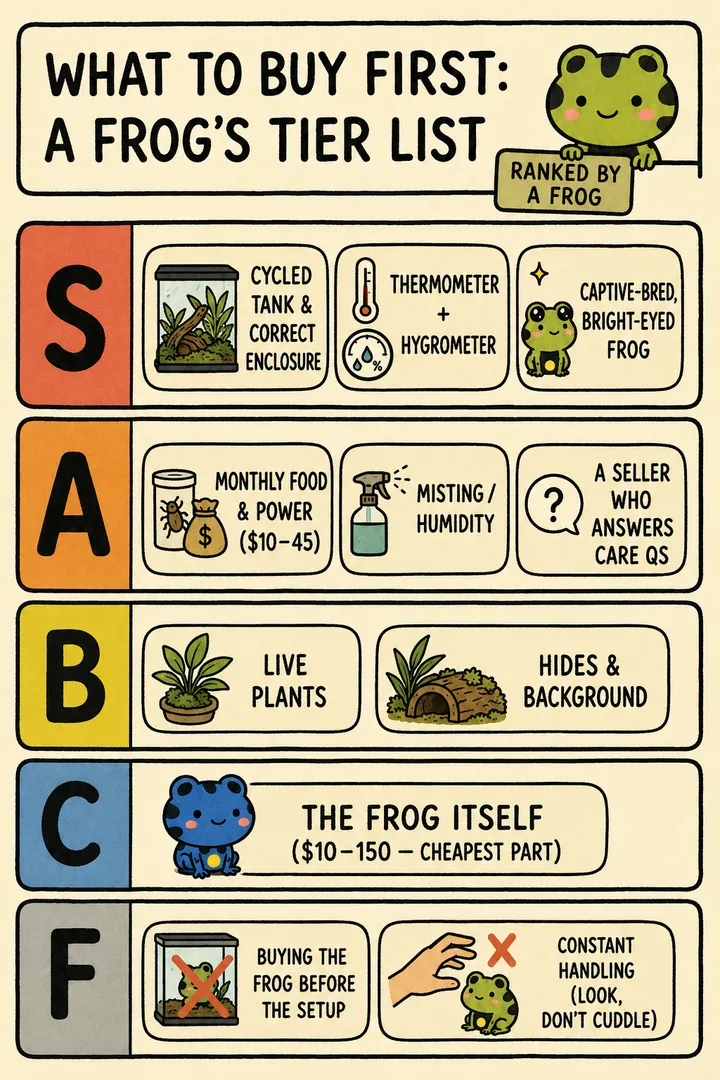
Bringing home your first amphibian is exciting — and the single best thing you can do for the animal is buy the setup before you buy the frog. This is the honest, end-to-end guide: what it really costs, exactly what to buy, where to buy it, and how to spot a healthy animal at the store.
The 30-second version: The animal is usually the cheapest part ($10–150). Budget $100–500+ for the setup depending on type, and $10–45/month to run it. Buy captive-bred from someone who can answer care questions, check the animal is bright-eyed and well-fleshed before you commit, and set up (and cycle, for aquatics) the enclosure before it comes home.
1. First — is an amphibian right for you?
Amphibians are wonderful, low-noise, fascinating pets. But before the fun part:
- They’re a real commitment. Many live a long time — axolotls 10–15+ years, some tree frogs and toads 15–20+, an African bullfrog 20+. This is a years-long relationship.
- They’re a look-don’t-cuddle pet. Their permeable skin means minimal handling. If you want a pet to hold constantly, an amphibian isn’t it — and that’s okay to know now.
- The setup is the pet. Getting temperature, humidity or water quality right is the hobby. A frog on the wrong setup suffers quietly.
Not sure which species fits you? Start with the best beginner amphibian and which amphibian is right for you?, then compare any two side by side.
2. What it really costs
Here’s the honest part most shops skip. Costs are driven by the setup type, not the animal. These are rough US-dollar ranges for a single-animal beginner setup — prices vary a lot by country, brand, and whether you buy new or second-hand.
| Setup type | Example species | Starter setup | Monthly running |
|---|---|---|---|
| Simple terrestrial | Pacman frog · toads · bullfrog | ~$100–250 | ~$10–25 |
| Small aquatic | African dwarf frog | ~$120–200 | ~$15–30 |
| Cold aquatic | Axolotl | ~$200–500 (chiller +$200–400) | ~$20–45 |
| Planted / bioactive vertical | Tree frogs · dart frogs | ~$250–500+ | ~$15–40 |
The animal itself: usually the cheapest line — most beginner amphibians are $10–150 (a common toad or ADF is a few dollars; a designer dart frog or axolotl morph more).
The costs people forget:
- Cooling for axolotls. A chiller ($200–400) is the priciest single item — but if your home stays reliably below ~68°F/20°C year-round, you can skip it. Plan for summer before you buy.
- Ongoing consumables. Live food (or feeder cultures), calcium/vitamin supplements, water conditioner, replacement UVB bulbs (yearly, for the species that need them).
- A vet fund. An exotics vet visit is the big unpredictable cost. Set a little aside — “I can’t afford the vet” is not a position you want to be in with a sick animal.
💚 The takeaway: the frog is cheap; keeping it well is the investment. Budget for the whole habitat first, and you’ll never be tempted to cut the corner that hurts the animal.
3. What you actually need — the shopping list
Buy this before the animal. Group it by your setup type:
Every amphibian needs:
- The right-sized enclosure with a secure, ventilated lid (they’re escape artists)
- A thermometer and hygrometer (guessing temperature/humidity is how animals get hurt)
- Dechlorinator / water conditioner (their skin absorbs everything — never untreated tap water)
- A shallow water dish of dechlorinated water
- Hides and clutter so they feel secure
Simple terrestrial (Pacman, toads, bullfrog): deep moist coco fibre to burrow in (never gravel — impaction), a low heat source on a thermostat if your room is cool, and feeding tongs.
Aquatic (axolotl, ADF): a cycled, filtered tank (a gentle sponge/baffled filter), a water test kit, fine sand or bare bottom (axolotls — never gravel), and cooling for axolotls / a gentle heater for ADFs.
Planted / bioactive vertical (tree frogs, dart frogs): a tall terrarium, drainage layer + bioactive substrate, live plants, a cleanup crew (springtails + isopods), low-level UVB/plant lighting, and often a misting system or a daily hand-mister. See the bioactive setup guide and the vivarium builder.
For aquatics, cycle the tank for 4–8 weeks before the animal arrives — a step that’s easy to skip. See do I need to cycle my tank?.
4. Where to buy
In rough order of best to riskiest:
- A reputable breeder — best health, best information, captive-bred, and they’ll answer your questions honestly. Ideal for dart frogs, axolotls, and most species.
- A reptile/amphibian expo — many breeders in one place; inspect the animal and ask about its history in person.
- A specialist reptile/amphibian shop — good ones keep animals well and know their care.
- A rescue — a kind, rewarding option; just go in knowing the animal’s history may be unclear.
Two rules whatever you choose:
- Ask: captive-bred or wild-caught? Choose captive-bred (CB) — wild-caught animals are stressed, often carry parasites or disease, adapt poorly, and their collection harms wild populations already in trouble.
- Avoid impulse-buying from a big-box store where staff can’t answer basic care questions. An amphibian is never a same-day impulse buy — the setup has to exist (and be cycled) first.
5. How to spot a healthy animal at the store
You can’t diagnose from the shop floor, but you can triage. Favour an animal that shows:
- Clear, bright eyes — not sunken, cloudy or crusted
- Smooth, intact skin — no wounds, sores, redness, or cotton-like fuzzy patches
- A rounded, well-fleshed body — not bony, sunken, or (the opposite) balloon-bloated
- Alertness — responsive when approached, not limp or unreactive
- Clean housing on safe substrate, without obviously sick tankmates
Walk away (don’t “rescue” on impulse) if you see: a thin or wasting body, lethargy, a red belly or legs, gasping or open-mouth breathing, floating/bloating in an aquatic animal, or fungus. These need a vet, and buying a sick animal on impulse — without a quarantine setup ready — usually ends badly for you and the animal.
If you can, ask to see it eat. A strong feeding response is one of the best signs of a healthy amphibian.
6. Bringing it home
- Quarantine first. Keep a new animal in a simple, separate, easy-to-clean setup for a few weeks before it goes anywhere near other animals — it protects your whole collection.
- Leave it alone to settle. Minimal handling, minimal fuss for the first week or two while it adjusts. A new frog that hides and skips a meal or two is usually just settling in.
- Watch, don’t panic. Learn what normal looks like for your species, and keep our symptom checker and an exotics vet’s number handy.
💚 Do the boring part first — budget honestly, buy the setup, cycle the water, choose a bright-eyed captive-bred animal — and the fun part takes care of itself. You’ve got this. 🐸
Go deeper: best beginner amphibian · which amphibian is right for you? · compare two species · browse all species · amphibian questions answered.
Sources & further reading
Cost ranges are compiled from current keeper price guides and should be treated as rough estimates that vary by region and retailer:
- PangoVet — axolotl cost guide and Aquarium Store Depot — axolotl cost breakdown
- Mr. Amphibian — how much pet frogs really cost and FrogPets — Pacman frog habitat setup
- Hoppy Darts — building a bioactive dart frog vivarium
Written and keeper-reviewed by The Bognook Team. This is honest general guidance, not veterinary advice — for a sick animal, see an exotics vet.
Common questions
How much does it cost to set up a pet amphibian?
It depends far more on the setup type than the animal. A simple terrestrial frog or toad (like a Pacman frog) can be set up for roughly $100–250; a small aquatic frog around $120–200; an axolotl about $200–500 (a cooling chiller adds $200–400 if your home runs warm); and a planted/bioactive vertical vivarium for tree frogs or dart frogs about $250–500+, sometimes more when fully automated. The animal itself is usually the cheapest part ($10–150).
What's the ongoing monthly cost of keeping an amphibian?
Modest once you're set up — roughly $10–45 a month, mostly live food (or feeder cultures), calcium/vitamin supplements, water conditioner and a little electricity. Aquatic setups like axolotls sit at the higher end (around $20–45). Always keep a separate fund for an exotics vet, since that's the big unpredictable cost.
Is the amphibian or the setup more expensive?
The setup, almost always. Most amphibians cost $10–150, but a correct enclosure with the right heating, humidity or filtration usually costs several times that. Budget for the whole habitat before you fall in love with the animal — the equipment is where corners get cut and animals get hurt.
Where should I buy a pet amphibian?
Buy captive-bred, from a reputable breeder, a specialist reptile/amphibian shop, a reptile expo, or a rescue — and ask whether the animal is captive-bred (CB) or wild-caught (WC). Avoid wild-caught animals (stressed, often parasitised, and harmful to wild populations) and avoid impulse-buying from a big-box store where staff can't answer care questions.
How do I know if an amphibian is healthy before I buy it?
Look for clear bright eyes, smooth intact skin with no wounds, sores, redness or cotton-like fungus, a rounded (not sunken or bony) body, and an alert, responsive animal. Ask to see it eat if possible, and check it's kept in clean conditions on safe substrate. Avoid an animal that's thin, lethargic, has a red belly/legs, gasping, or is housed with sick tankmates — and never 'rescue' a sick shop animal on impulse.

Join the Bognook burrow
Cozy amphibian care tips, aesthetic freebies, and the occasional frog fact — straight to your inbox. No spam, just good bog vibes.
Free amphibian care cheat-sheet when you join. No spam — pinky-promise. Unsubscribe anytime. See how we handle your data in our privacy notice.