Which Amphibian Is Right for You? Match a Pet to Your Life
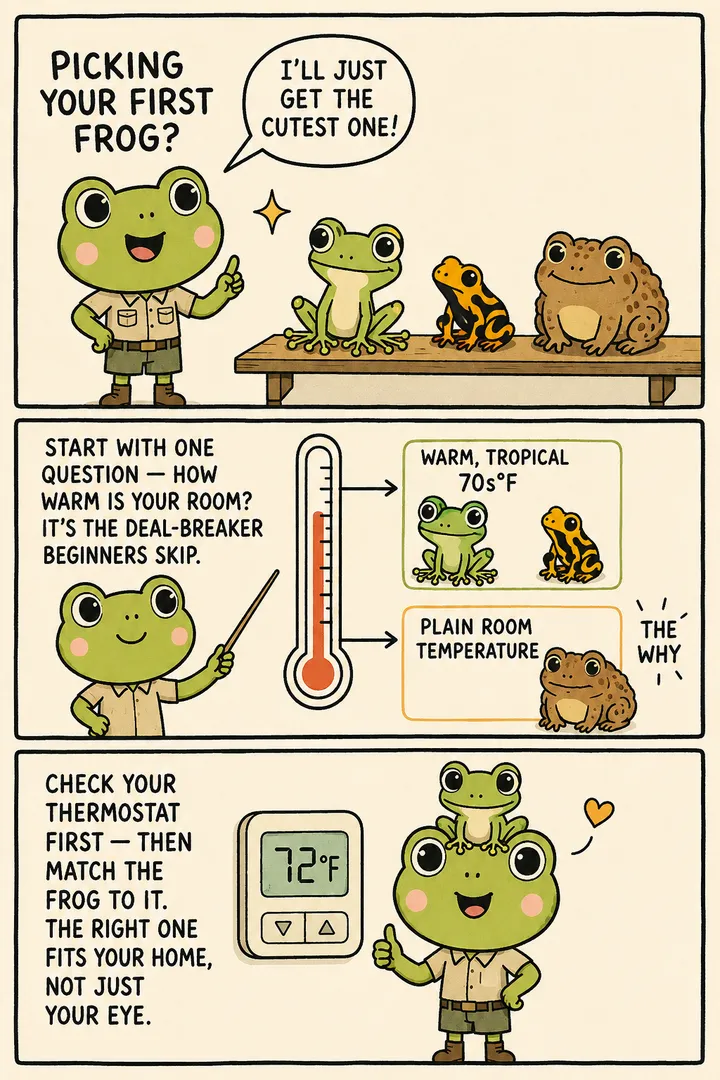
There’s no single “best” first amphibian — there’s the best one for you. The perfect match depends on your home, your habits, and what you actually want out of the experience. This guide sorts our six keeper species by the things that really decide it, so you can find your frog (or toad, or axolotl) fast.
Prefer a straight head-to-head of the beginner options? See the best beginner amphibian, compared.
🔧 Still deciding? Weigh the options side by side in the free species compare tool.
Start with the biggest question: how warm is your home?
Temperature is the deal-breaker most beginners overlook — so start here.
- Cool home / a naturally cold room? → an axolotl (needs cold water, 16–18°C), or a newt or salamander (cool-loving, ~60–68°F, no heater). A cold house is a gift here.
- Warm, room-temperature home? → a poison dart frog or a tree frog (tropical, comfortable in the 70s°F).
- Ordinary, temperate room? → a toad is happiest at plain room temperature, no special heating or cooling.
Do you want to actually see it?
Most amphibians are nocturnal — a gorgeous animal you’ll mostly glimpse at dusk. One big exception:
- Want a day-active pet that’s out and about while you are? → poison dart frogs are diurnal and endlessly watchable.
- Fine with a night-owl (or a burrower you spot at dusk)? → tree frogs, toads, and many salamanders come alive after dark.
- Happy watching an aquatic pet drift around? → an axolotl is visible and active in its tank day and night.
Water pet, or land pet?
- You like aquariums / a watery display → axolotl (fully aquatic) or a newt (semi-aquatic, water + land).
- You’d rather a planted terrarium → a dart frog bioactive vivarium or a tree frog arboreal setup.
- You want a simple, low-fuss land pet → a toad or a terrestrial salamander.
How much space do you have?
- Small / a single shelf or desk → dart frogs (18×18×18 in), a White’s tree frog (tall 18×18×24), or a small toad or fire-belly newt setup.
- A dedicated spot for a proper aquarium → an axolotl (a 20-gallon-plus cold-water tank).
How much effort do you want?
- Lowest drama, most forgiving → a toad or a White’s tree frog.
- Happy to maintain water quality → an axolotl or a newt.
- Enjoy the terrarium/gardening side → a dart frog bioactive vivarium (the setup is the hobby).
Quick matches
- 🖤 “I have a cold room and love a watery display” → Axolotl
- 🔵 “I want a colourful pet that’s active by day” → Poison dart frog
- 🌳 “I want a classic, calm, forgiving pet frog” → White’s tree frog
- 🟤 “I want the easiest, most low-key amphibian” → Toad
- 🦎 “I love cool-water caudates and a bit of a project” → Newt or Salamander
Whatever you pick: the universal rules
No matter which animal wins, these always apply:
- Set up the habitat before the animal (and cycle the tank for aquatic species).
- Buy captive-bred, never wild-caught.
- Match cool-vs-warm to your home honestly — don’t fight your climate.
- Budget for the setup, which usually costs more than the animal.
- It’s a 10–20 year commitment. Choose for the long haul.
💚 Found your match? Read its full care guide before you buy anything — knowing the setup first is what turns a good intention into a thriving animal. And if you’re still torn, that’s normal; ask away.
Go deeper: the best beginner amphibian, compared · my kid wants a frog — which one? · free printable care sheets · new-keeper checklist & keeper tools.
Common questions
What is the easiest amphibian to keep?
For most beginners, the hardiest and most forgiving choices are toads (like the American toad), White's tree frogs, and axolotls. Toads are famously low-drama terrestrial pets, White's tree frogs are calm and tolerant climbers, and axolotls are easy as long as you can keep their water cold and cycled. The "easiest" one really depends on whether you can provide cool temperatures and whether you want an aquatic or land setup.
What amphibian is best for a cold house or cool room?
A cool home is perfect for cold-loving amphibians. Axolotls need cold water (16 to 18C / 60 to 64F) and suit a naturally cool room, and most newts and salamanders also thrive at cool temperatures (around 60 to 68F) with no heater. Warmth-loving species like poison dart frogs and red-eyed tree frogs are a better match for a warmer home.
Which amphibians are active during the day?
Poison dart frogs are the standout day-active (diurnal) amphibians — they hunt and explore in the open while you're awake, which makes them a fantastic display pet. Most other amphibians, including tree frogs, toads, and many salamanders, are nocturnal and come alive at dusk and after dark, so you'll see less of them during the day.
What is a good amphibian for a small space?
Poison dart frogs (in an 18x18x18 inch vivarium), White's tree frogs (in a tall 18x18x24), and small setups for a fire-belly newt or a single toad all fit comfortably in a modest space. Because these animals are small and stay near their cover, a well-planted compact enclosure suits them better than a large empty one.

Join the Bognook burrow
Cozy amphibian care tips, aesthetic freebies, and the occasional frog fact — straight to your inbox. No spam, just good bog vibes.
Free amphibian care cheat-sheet when you join. No spam — pinky-promise. Unsubscribe anytime. See how we handle your data in our privacy notice.