Tree Frog Care: The Complete Beginner's Guide (Setup, Feeding & Species)
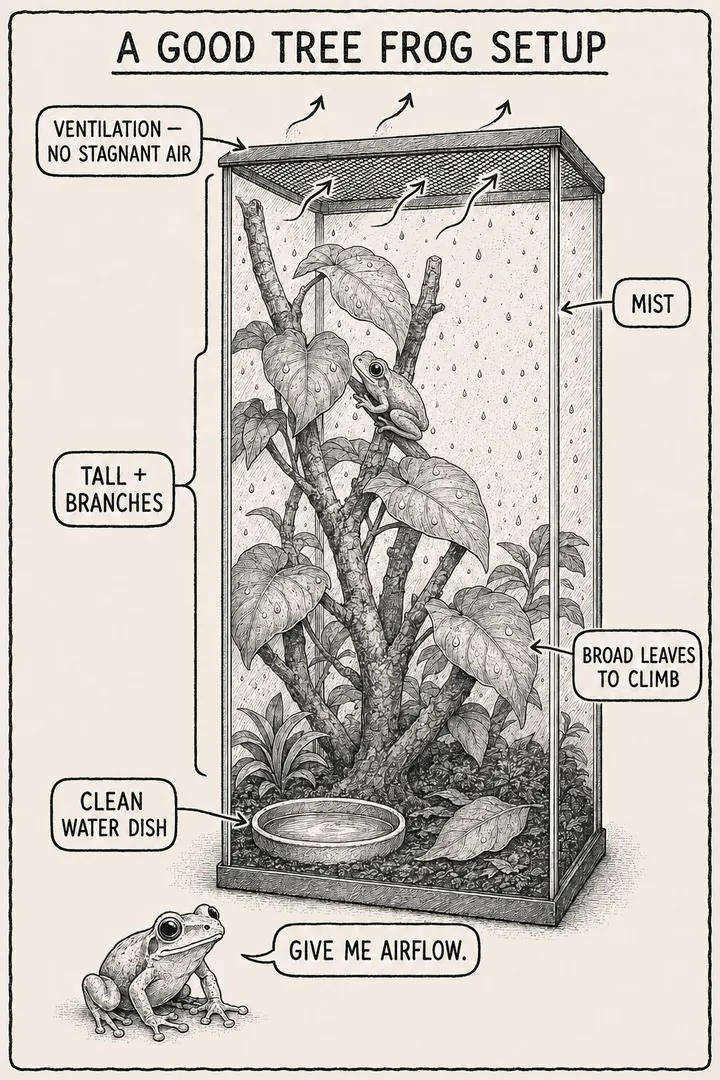
Tree frogs are the charming, big-eyed climbers of the amphibian world — nocturnal, arboreal, and endlessly watchable at night as they stalk around their vivarium. But “tree frog” covers everything from a bulletproof beginner frog to a delicate specialist, so the single most important decision is which species you pick. This guide walks a first-time keeper through all of it.
🔧 Planning a tree-frog home? Size it right with the free tree-frog planner.
The 30-second version
- Best beginner: the White’s tree frog — hardy, calm, and forgiving. (Red-eyed tree frogs are advanced — not a first frog.)
- Think tall: an arboreal vivarium with branches and broad-leaved plants; height beats floor space.
- Humidity depends on species: ~50–70% for White’s, 60–80% for red-eyed.
- They’re insectivores: gut-loaded, calcium-dusted crickets, and don’t overfeed — obesity is common in White’s.
- They’re a long commitment — White’s live 15–20 years — and handling should be minimal.
Is a tree frog right for you?
Tree frogs make a wonderful first amphibian for the right person — but be honest about the commitment:
- Lifespan: White’s tree frogs commonly live 15–20+ years. That’s a long relationship for a “starter” pet.
- They’re nocturnal. Most of the personality comes out after dark; by day they often sit tucked up and still.
- They’re for watching, not holding. Brief handling is possible with White’s, but these are display animals.
- Live feeders forever. You’ll always have crickets or roaches on the go.
If a calm, long-lived, night-active climber sounds appealing, read on.
Match the species to your experience
Get this right and everything else is easier:
- White’s tree frog (Litoria caerulea) — the best beginner frog. Chunky, docile, hardy, and forgiving of small mistakes, which earned it the “dumpy” nickname. Tolerant of a wide temperature/humidity range. Its one weakness: it will happily eat itself overweight.
- American green tree frog (Hyla cinerea) — small, active, hardy, and native to the US. A lovely, inexpensive starter; a little more skittish than White’s but easy to keep.
- Red-eyed tree frog (Agalychnis callidryas) — stunning, but advanced: steady humidity with strong airflow, heat-sensitive (never above 80°F), dense planting, and precise conditions. Beautiful goal frog once you have experience — not a first frog.
Never mix species in one vivarium — different needs, plus stress and disease risk.
The setup: think tall
Tree frogs climb, so vertical space and things to climb on matter more than floor area.
- Enclosure: a tall/arboreal vivarium — about 18×18×24 in for one or two White’s (bigger for red-eyed or groups), front-opening if possible.
- Furnishings: lots of sturdy branches, cork bark, and broad-leaved plants (pothos, philodendron) for climbing and perching. Red-eyed frogs in particular sleep tucked under broad leaves, so plant densely for them.
- Substrate: a moisture-holding base like coco fibre or a bioactive soil mix with leaf litter; avoid loose gravel or anything small enough to be swallowed with prey (impaction risk).
- Water dish: a shallow dish of clean, dechlorinated water, easy to climb out of — and change it often, because frogs foul it.
Humidity, water & ventilation
This is where the species split matters most:
- White’s tree frog: ~50–70% humidity — they actually dislike being kept too wet, and constant sogginess causes skin problems.
- Red-eyed tree frog: ~60–80% (aim for about 70%), misted more — brief spikes after misting are fine, never stagnant.
- Mist daily (by hand or an automatic mister), use dechlorinated or RO water, and pair humidity with some ventilation — high humidity plus stagnant air breeds mould and bacteria. Aim for a fresh rainforest, not a stale swamp.
Temperature
- Daytime ~72–80°F (red-eyed: never above 80°F), with a slight drop at night.
- Provide gentle heat from the side or above if the room is cool — but never a hot basking spot they can press against and burn on. Frogs can get thermal burns from unguarded bulbs.
- Don’t overheat. Sustained high heat stresses tree frogs; a thermometer (and a thermostat on any heat source) is essential.
Lighting
A low-level UVB bulb is beneficial — it helps them process calcium — on a 10–12 hour day/night cycle. If you keep live plants, a plant light does double duty. Give them shaded, planted spots to retreat from the light, and make sure lighting doesn’t push the temperature past the safe range.
Feeding & supplementation
Tree frogs are insectivores:
- Staple: gut-loaded, calcium-dusted crickets, supported by dubia roaches, and the occasional hornworm.
- Supplement: dust feeders with calcium + D3 at most feedings and rotate in a multivitamin, so they don’t develop metabolic bone disease.
- Frequency: juveniles daily; adults every 2–3 days.
- Portion control matters — White’s tree frogs are famous for getting fat. Feed adults sensibly, keep fatty feeders (waxworms, pinkies) as rare treats, and judge by body shape: you want a slight taper, not a bulging dumpling with fat pads over the eyes.
Handling
Minimise it. Their permeable skin absorbs oils, salts, soaps, and lotions. White’s tolerate brief, occasional handling better than most frogs, but it should still be rare — wet, clean, well-rinsed hands only, and briefly. Watch, don’t play.
Health, buying & the golden rules
Keep the basics right — warm enough, correct humidity for the species, dusted feeders, and not overfed — and tree frogs are hardy and long-lived. When something looks off, the fixes usually trace back to those same levers; see our full guide to the warning signs a tree frog is sick (dehydration and obesity are two common ones to watch for).
- Buy captive-bred where possible, and quarantine new frogs before adding them to an established setup.
- Don’t mix species, and don’t house very different sizes together.
What it costs
- Vivarium + setup (tall viv, branches, plants, lighting, dish): roughly $150–350 to start.
- The frog: about $20–60, captive-bred.
- Ongoing: feeders + supplements, roughly $10–20/month.
💚 Pick the right species (start with a White’s), build tall, get the humidity right for that species, and keep meals sensible — and you’ll have a charming, long-lived companion for well over a decade.
Go deeper: White’s vs red-eyed tree frog — which is right for you? · warning signs your tree frog is sick · tree frog questions answered · the printable tree frog care sheet.
🎓 Ready to go further — the advanced tier. Can tree frogs live together? Keeping a group.
Sources & further reading
This guide was written and fact-checked against these authorities. It’s kind, general guidance — not a substitute for an exotics vet:
- Merck Veterinary Manual — Environment and Husbandry for Amphibians — amphibian husbandry, UVB and calcium; its Noninfectious Disorders page covers metabolic bone disease.
- Association of Reptilian & Amphibian Veterinarians (ARAV) — amphibian veterinary standards and a find-an-exotics-vet directory.
- Established White’s & red-eyed tree frog care references (e.g. Tree of Life Exotic Pet Medical Center — White’s tree frog care and PetMD — red-eyed tree frog care sheet (Melissa Witherell, DVM)) — species temperature, the humidity split, enclosure size, feeding and supplementation.
- Tree of Life Exotic Pet Medical Center — White’s Tree Frog Care — White’s obesity risk, handling, and common health concerns.
Written and fact-checked by The Bognook Team against veterinarian-authored sources — if a frog seems unwell, see an exotics vet.
Common questions
What is the best beginner tree frog?
The best starter is the White's tree frog (Litoria caerulea) — chunky, calm, hardy, long-lived, and forgiving of small mistakes, which is why it's nicknamed the "dumpy" tree frog. The American green tree frog (Hyla cinerea) is another good, hardy beginner. Avoid the red-eyed tree frog (Agalychnis callidryas) as a first frog: it's stunning but needs high humidity, cool nights, and precise conditions.
What size tank does a tree frog need?
Tree frogs climb, so height matters more than floor space. A tall, arboreal vivarium of about 18x18x24 inches suits one or two White's tree frogs, furnished with sturdy branches, cork bark, and broad-leaved plants to climb and perch on. Bigger is better, and species that like to hide on leaves (like red-eyed) especially need dense planting.
Can you handle tree frogs?
Keep handling to a minimum. Tree frogs have permeable skin that absorbs the oils, salts, soaps, and lotions on your hands, which can harm them. White's tree frogs tolerate brief, occasional handling better than most species, but it should still be rare, with freshly washed, well-rinsed, wet hands, and never for long. They are animals to watch, not to play with.
What do tree frogs eat?
Tree frogs are insectivores. The staple is gut-loaded, calcium-dusted crickets, supported by dubia roaches, and the occasional hornworm or treat. Juveniles are fed daily; adults every two to three days. Because White's tree frogs are prone to obesity, portion control matters — feed adults sensibly and go easy on fatty feeders like waxworms.
How long do tree frogs live?
It depends on the species, but many live a surprisingly long time. White's tree frogs commonly reach 15 years and can live past 20 with good care, so keeping one is a genuine long-term commitment. American green and red-eyed tree frogs generally live around 5 to 10 years.

Join the Bognook burrow
Cozy amphibian care tips, aesthetic freebies, and the occasional frog fact — straight to your inbox. No spam, just good bog vibes.
Free amphibian care cheat-sheet when you join. No spam — pinky-promise. Unsubscribe anytime. See how we handle your data in our privacy notice.