Is My Tree Frog Sick? 8 Warning Signs Every Keeper Should Know
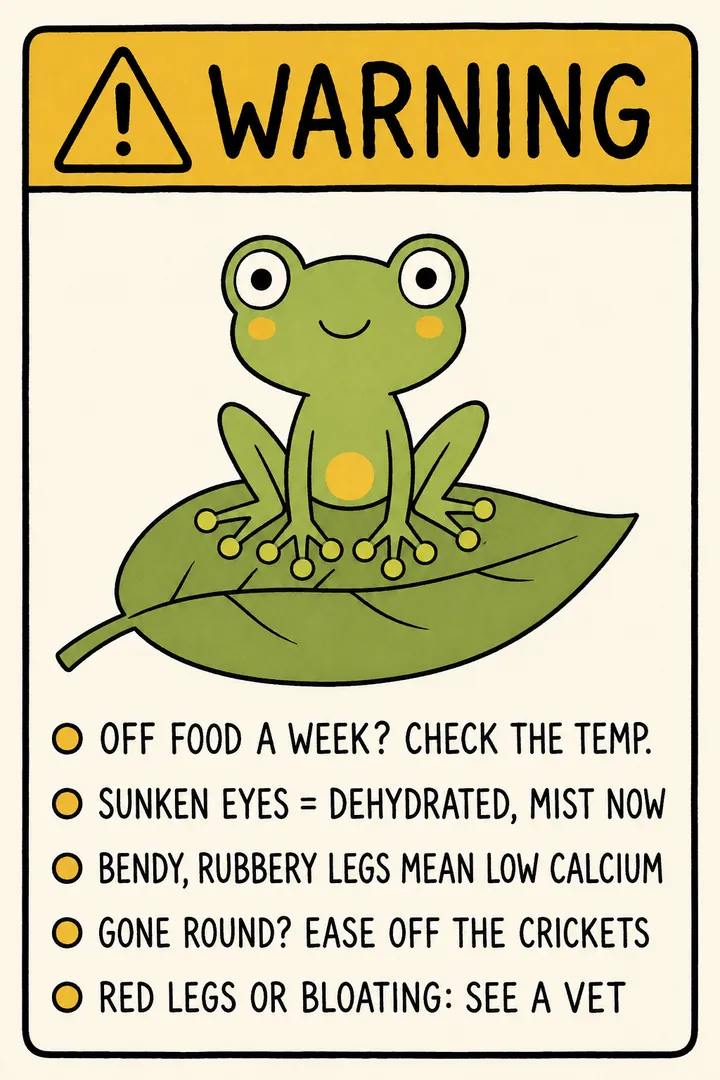
First: if you’re reading this because something looks off, take a breath. Tree frogs are hardy and long-lived when their basics are right, most problems are caught in time, and the fact that you’re paying attention makes you a good keeper. Here’s the honest checklist.
The 30-second version
A healthy tree frog has full, bright eyes, smooth moist skin, a good grip, active hunting at night, and a body that tapers slightly toward the waist (not bulging with fat, not bony). If something looks wrong, don’t panic — check these three things first, because they fix many tree frog problems:
- Temperature — warm enough to digest and stay active. Roughly 70–80°F for White’s tree frogs, 75–80°F daytime for red-eyed (never above 80°F; slightly cooler at night). Too cold and they stop eating.
- Humidity & hydration — species-appropriate (~50–70% White’s, 60–80% red-eyed), lightly misted, with a clean shallow dish of dechlorinated water. Skin should look moist; eyes should look full.
- Supplementation & feeding — gut-loaded feeders dusted with calcium/D3, correctly sized — and don’t overfeed. Obesity is a real risk here too — White’s tree frogs tend toward it.
Now the signs, roughly from “monitor” to “act now.”
The 8 warning signs
1. Not eating for over a week 🟡
A well-fed adult skipping a night or two is normal. A week-plus usually means the vivarium is too cold to digest, the frog is stressed from a recent move, or the prey is too big. Do: check the temperature first, offer correctly sized dusted feeders at night, and give a new frog quiet time to settle.
2. Getting noticeably fat (fatty pads over the eyes/head) 🟡
Especially in White’s tree frogs — thick pads bulging above the eyes and no waistline mean obesity, and overfeeding can lead to related problems such as fatty liver. Do: feed adults smaller portions every 2–3 days, use leaner feeders, and drop the fatty treats (waxworms, pinkies). Full guide: Is My Tree Frog Fat?, or check yours with the free weight checker.
3. Sunken eyes, dry or wrinkled skin 🟡→🔴
Classic dehydration — humidity is too low or there’s no clean water. Amphibian skin is their drinking system. Do: mist now, add a shallow dechlorinated water dish, raise humidity. Usually rebounds in hours; if the eyes stay sunken, see a vet.
4. Rubbing its nose raw on the glass (rostral abrasion) 🟡
Persistent “glass surfing” and a scraped snout mean stress — too few sightlines, a reflection it’s reacting to, or a too-open viv. Do: add dense planting and cover, check temperature, and reduce foot traffic near the tank.
5. Weak or bendy legs and jaw, trembling, trouble climbing 🔴
The hallmark of metabolic bone disease — a calcium/D3 deficiency. Do: dust and gut-load every feeding, add appropriate low-level UVB, and see an exotics vet if the jaw is soft or the legs are bowed. Early MBD can be turned around; advanced MBD needs professional care.
6. Weight loss / a thin, bony look 🔴
Rapid thinning points to not feeding, husbandry stress, or (especially in wild-caught animals) parasites. Do: confirm it’s actually eating dusted feeders, correct temp/humidity, and get a fecal test through an exotics vet if it keeps dropping weight.
7. A bloated, swollen, or puffy body (edema/bloat) 🔴
Fluid buildup can signal a kidney, organ, or bacterial issue, or over-supplementation. This is not a wait-and-see symptom. Do: review husbandry and contact an exotics vet — bloating needs a professional diagnosis.
8. Reddened legs or belly (“red leg”) 🔴
Reddening of the underside and limbs is the classic sign of a bacterial infection (septicemia) — serious and potentially fast-moving. Do: clean the water dish and correct husbandry immediately, and see an exotics vet right away. Don’t try to treat this one at home alone.
See a vet now if…
Reddened legs/belly · a bloated or swollen body · a soft jaw or bendy limbs (MBD) · sunken eyes that don’t recover after misting · open sores or wounds · seizures or twitching · any symptom that doesn’t improve after you’ve corrected temperature and humidity. A vet call is never the wrong move.
The pattern to remember
Notice how often the fix is the same handful of things — warm enough, humid enough, properly supplemented, and not overfed. That’s not a coincidence: many tree frog “illnesses” are really husbandry problems wearing a costume — with dehydration and obesity among the common ones to watch for. Get the vivarium right and keep meals sensible, and most of this list never appears.
One more thing: a tree frog’s skin absorbs whatever it touches, so only handle when necessary, with freshly washed, well-rinsed, lotion-free wet hands. Cleaning sprays and hand products are a hidden cause of sudden problems.
💚 You don’t have to figure this out alone or feel silly for asking. Correct the temperature and humidity, keep it clean, and reach out to an exotics vet or a kind keeper community. Most problems, caught early, are completely fixable.
Go deeper: the tree frog care basics · tree frog questions answered · White’s vs red-eyed for beginners · the printable tree frog care sheet · Is my amphibian okay? — the all-species check.
Sources & further reading
This checklist was written and fact-checked against these authorities. It’s kind, general guidance — not a diagnosis or a substitute for an exotics vet:
- Merck Veterinary Manual — Noninfectious Disorders of Amphibians — metabolic bone disease, dehydration and edema; its Infectious Diseases page covers bacterial “red-leg” syndrome (dermatosepticemia).
- Association of Reptilian & Amphibian Veterinarians (ARAV) — amphibian veterinary care and a find-an-exotics-vet directory.
- Tree of Life Exotic Pet Medical Center — White’s Tree Frog Care — common health concerns, including obesity and dehydration.
- Established tree frog care references (e.g. Tree of Life Exotic Pet Medical Center — White’s tree frog care, PetMD — red-eyed tree frog care sheet (Melissa Witherell, DVM), Chewy — red-eyed tree frog care sheet (vet-reviewed) and Josh’s Frogs — choosing lighting for reptiles & amphibians) — the temperature, humidity and supplementation targets these problems trace back to, and why UVB matters.
Written and fact-checked by The Bognook Team against veterinarian-authored sources — if your frog shows a red 🔴 sign, see an exotics vet promptly.
Common questions
How do I know if my tree frog is sick?
Watch for these warning signs: not eating for more than a week, sunken or cloudy eyes, dry or darkened skin, weak or bendy legs and jaw, difficulty climbing, a bloated body, reddened legs or belly, and lethargy with no night-time activity. Most problems trace back to temperature, humidity, or calcium supplementation, so check those first. Note the opposite problem too — many pet tree frogs, especially White's, are actually overweight from overfeeding.
Why won't my tree frog eat?
A likely reason is that the vivarium is too cold, since tree frogs need warmth to digest. Check that the temperature is in the species-appropriate range (roughly 70 to 80F for White's tree frogs, 75 to 80F daytime for red-eyed, never above 80F). Other causes are the stress of being newly moved, prey that is too large, or simply that the frog is already well-fed. A healthy adult tree frog does not need to eat every day.
How do I know if my White's tree frog is overweight?
White's tree frogs are prone to obesity because keepers overfeed them. Signs of an overweight frog are thick fatty pads bulging above the eyes and behind the head, no visible taper toward the waist, and a generally bloated, dumpling-like look. Feed adults smaller portions two or three times a week rather than daily, use leaner feeders, and cut back on waxworms and other fatty treats.
What is metabolic bone disease in tree frogs?
Metabolic bone disease (MBD) is weakening of the bones from a calcium or vitamin D3 deficiency. Signs include a soft or rubbery lower jaw, bendy or bowed legs, trembling, and trouble climbing or gripping. It is caused by feeders that were not dusted or gut-loaded, and a lack of low-level UVB. Prevent it by dusting feeders with calcium and D3, gut-loading them, and providing appropriate UVB lighting; advanced MBD needs an exotics vet.
Why does my tree frog look dry or have sunken eyes?
Sunken eyes, dry or wrinkled skin, and lethargy are classic signs of dehydration, almost always from humidity that is too low or a lack of clean water. Mist the vivarium, provide a shallow dish of dechlorinated water, and raise the humidity to the species range. A mildly dehydrated frog usually rebounds within hours; sunken eyes that do not recover need a vet.

Join the Bognook burrow
Cozy amphibian care tips, aesthetic freebies, and the occasional frog fact — straight to your inbox. No spam, just good bog vibes.
Free amphibian care cheat-sheet when you join. No spam — pinky-promise. Unsubscribe anytime. See how we handle your data in our privacy notice.