Is My Tree Frog Fat? White's Tree Frog Obesity Signs & How to Fix It
“Is he overweight?” “I love him — is he obese??” “Is she fat or just large?” These questions come up again and again about pet tree frogs — and asking them makes you a good keeper, because overfeeding can lead to obesity and related health problems. Here’s the honest, no-shame answer, for White’s, green, and red-eyed tree frogs.
🐸 Want the quick version? Our free Is My Tree Frog Fat? checker walks you through it in 30 seconds — tick what you see and it tells you where your frog sits. This guide is the deeper “why” behind it.
The 30-second answer (the White’s eye-ridge test)
For a White’s tree frog — the “dumpy” frog everyone worries about — there’s a simple test. Look at the fatty ridges just above the eardrum:
- No noticeable ridges → likely underweight.
- Ridges present, but not drooping → healthy. Some ridge is completely normal on an adult White’s.
- Ridges bulging and sagging down over the eyes → obese.
That’s the tell most people miss: a little brow ridge is normal, but ridges that hood or droop over the eyes are fat, not features. For green and red-eyed tree frogs, which are naturally slim and don’t develop those dramatic pads, judge instead by the waist and the bones (below).
How to actually read your frog’s body
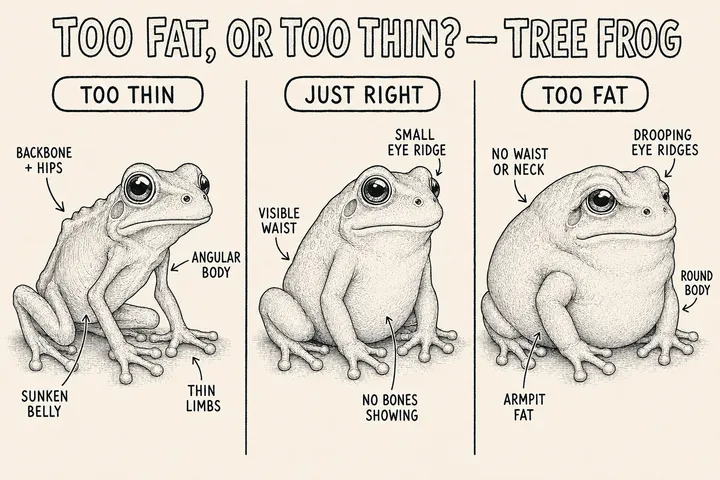
Weight runs on a scale in both directions — too heavy and too thin are both problems. Here’s what each looks like.
Overweight / obese — the signs:
- Fatty ridges above the eyes that bulge or droop over the eyes (White’s especially).
- Fat pockets bulging at the armpits and over the eardrums.
- No distinct neck — the head blends into a round body with no step.
- No visible waist — rounded all over, dumpling-shaped, with rolls.
- Often less active and slower than usual.
A healthy weight — what “good” looks like:
- A distinct neck — the head isn’t a smooth continuation of the body.
- A soft, slight waist; gently curved, not rectangular and not ball-round.
- No bones (spine, hips, shoulders) visibly sticking out.
- On a White’s: some ridge above the eardrum — it just shouldn’t sag over the eyes.
Underweight / too thin — the signs:
- The backbone, hips, or shoulder-blade bones are visible or sticking out.
- An angular, rectangular body — flat back and belly, not softly curved.
- Thin limbs that stand out sharply from the trunk.
- A sunken, shrunken look.
If you’re not sure which bucket your frog falls in, that’s exactly what the body-condition checker is for — it turns these signs into a clear answer.
“Is he bloated, or just fat?” (this one matters)
This comes up constantly — “do we think my frog is bloated or just fat?” — and the difference is important, because one is a diet issue and the other can be an emergency.
- Fat builds up gradually and evenly over weeks. It’s firm, and it follows the pattern above (ridges, rolls, no waist).
- Bloat is a sudden, balloon-like, fluid swelling, often with lethargy or a frog that seems generally unwell. That can be dropsy (edema) — a sign of a kidney, heart, or infection problem — and it is not something to fix with a diet.
Rule of thumb: if the swelling came on fast, or your frog seems off, treat it as possible bloat and call an exotics vet — don’t just cut back food. (Full cross-species breakdown: Is My Frog Bloated, or Just Fat?; our warning-signs guide covers the other red flags.)
Why a fat frog is a real problem
It’s tempting to think a chunky frog is just a well-loved frog. But obesity genuinely harms them:
- Fatty liver and related problems — overfeeding, especially fatty foods like pinky mice and waxworms, can lead to obesity and related health problems such as fatty liver, kidney failure and gout.
- Fatty deposits in the eyes — a build-up of cholesterol and fat in the cornea (corneal lipidosis) is likely caused by overfeeding and too much cholesterol in the diet, though the exact cause is unknown.
- A long life to protect — White’s tree frogs live about 16 years on average, and one is recorded to have lived 21 years in human care.
The good news: caught early, weight is very fixable.
How to slim a frog down (safely)
Don’t crash-diet an amphibian — go slow and steady.
- Cut portions and frequency. Adults are usually fed every 2–3 days; an overweight frog should simply be eating less, so offer smaller meals at the longer end of that gap.
- Switch to lean feeders — crickets and dubia roaches — and drop the fatty treats: waxworms, mealworms, and pinky mice are the usual culprits.
- Feed to a schedule, not to their begging. A tree frog will always act starving. That face is not data.
- Add climbing — more branches and cover means more movement.
- Weigh weekly on a small kitchen scale so you’re tracking the real trend, not guessing. Expect it to take weeks.
If your frog is very obese, loop in an exotics vet for a safe slimming plan.
And if your frog is too thin
The opposite fix: check the temperature first — a frog that’s too cool can’t digest or feel hungry, so it wastes even when fed. Then offer more appropriately-sized, gut-loaded and dusted feeders, and if it stays bony, rule out parasites with a fecal test (common in new or wild-caught frogs). Clearly visible bones warrant an exotics-vet exam.
Does this apply to all tree frogs?
The principle — don’t overfeed, judge by body condition — applies to every tree frog. What differs is the tell:
- White’s tree frog — the obesity-prone one; use the eye-ridge test.
- American green tree frog — lean and active; judge by waist and visible bones.
- Red-eyed tree frog — naturally slender; same, judge by waist and bones (a chunky red-eyed is unusual and worth a closer look).
New to which species you have, or choosing one? See White’s vs Red-Eyed Tree Frog and the full Tree Frog Care Guide.
When to see a vet
- Sudden, balloon-like swelling (possible bloat/dropsy) — vet, don’t diet.
- Visible bones or a frog that stays thin despite correct feeding — vet.
- Obesity that isn’t improving with a careful diet, or a frog that seems unwell — vet.
Whatever the answer turns out to be, you’ve already done the right thing by looking closely. A tree frog at a healthy weight is a tree frog that gets to live its full, long life — and a few small feeding tweaks usually get you there.
🐸 Check your frog now: the free Is My Tree Frog Fat? tool gives you an honest read in under a minute. More tree-frog help lives in the tree frog guides.
Sources & further reading
This guide was written and fact-checked against these authorities. It’s kind, general guidance — not a substitute for an exotics vet:
- Peer-reviewed amphibian body-condition research (PLOS ONE and related literature) — the body-condition-scoring approach behind “read the whole body, not one feature,” including validated BCS work in Xenopus frogs.
- Herpetological-vet and keeper references on White’s tree frogs — the eye-ridge (brow / fatty-pad) scale used to grade a White’s from underweight to obese.
- AZA Amphibian Husbandry Resource Guide, Edition 2.0 (2012), pp. 30, 36 & 39 — sedentary frogs including Litoria are prone to obesity; overfeeding fatty prey such as pinky mice and waxworms can lead to obesity and related problems such as fatty liver, kidney failure and gout.
- Merck Veterinary Manual — Noninfectious Disorders of Amphibians — overfeeding as the primary cause of amphibian obesity, cutting calories and fat to control weight, and corneal lipidosis (fatty eye deposits) linked to overfeeding.
- Avian & Exotic Animal Hospital of Louisiana — White’s Tree Frog Care Sheet — White’s tend toward obesity; adults fed every 2–3 days and juveniles daily; an obese frog should be eating less.
- PetMD — Green Tree Frog Care Sheet (Maria Zayas, DVM) — juveniles fed daily, adults every other day.
- Smithsonian’s National Zoo — White’s tree frog — lifespan: about 16 years on average, with one recorded at 21 years in human care.
- Established tree frog care guides (e.g. Josh’s Frogs) — lean feeder choice, portioning, and cutting fatty treats.
Written and fact-checked by The Bognook Team against veterinarian-authored sources — if your frog seems unwell or the swelling came on fast, see an exotics vet.
Common questions
How can I tell if my White's tree frog is overweight?
Look at the ridges above the eardrum: no ridges at all suggests the frog is underweight, ridges that are present but not drooping are healthy, and ridges that sag or fold down over the eyes mean it is obese. Other signs of an overweight frog are fat bulging at the armpits and over the eardrums, the loss of a distinct neck, and a round body with no visible waist.
Is my frog bloated or just fat?
They can look similar but are very different. Fat builds up gradually and evenly over weeks. Bloat is a sudden, balloon-like, fluid swelling — often with lethargy — and is a possible medical emergency (dropsy or edema), not a diet issue. If the swelling appeared quickly or your frog seems unwell, see an exotics vet rather than putting it on a diet.
How often should I feed my tree frog so it does not get fat?
Adult tree frogs are generally fed appropriately-sized meals every two to three days, and juveniles daily. Use lean feeders like crickets and roaches, dust them with calcium and D3 plus a multivitamin, and keep fatty treats such as waxworms, mealworms, and pinky mice occasional. Feed to a schedule, not to the frog's begging — they will always act hungry.
How do I help an overweight frog lose weight?
Slim it down slowly — never crash-diet an amphibian. Cut portion sizes and feed less often, switch to lean feeders, and drop the fatty treats. Add branches and cover so it moves and climbs more. Weigh the frog weekly on a small kitchen scale to track the real trend, and expect it to take weeks. If it is very obese, ask an exotics vet for a safe plan — overfeeding, especially fatty foods like pinky mice and waxworms, can lead to obesity and related problems such as fatty liver.
My tree frog looks too thin — is that bad?
Yes, underweight is a problem too. Warning signs are a visible backbone, hip, or shoulder-blade bones, an angular rectangular body, and thin limbs that stand out from the trunk. Check the temperature first (a cool frog cannot digest or feel hungry), offer more appropriately-sized dusted feeders, and rule out parasites with a fecal test. See an exotics vet if bones are clearly visible.
📚 More tree frogs guides
- White's vs Red-Eyed Tree Frog: Which Should a Beginner Get?
- Tree Frog Questions, Answered (Beginner FAQ)
- How Do I Raise the Humidity in a Tree Frog (or Frog) Tank?
- My Tree Frog Escaped! How to Find It (and Escape-Proof the Tank)
- Why Does My Tree Frog Croak So Much? (What It Means)
- Is My Tree Frog Sick? 8 Warning Signs Every Keeper Should Know
🎓 Ready to go deeper?
Past the basics — same plain voice, no ceiling:

Join the Bognook burrow
Cozy amphibian care tips, aesthetic freebies, and the occasional frog fact — straight to your inbox. No spam, just good bog vibes.
Free amphibian care cheat-sheet when you join. No spam — pinky-promise. Unsubscribe anytime. See how we handle your data in our privacy notice.