How Do I Raise the Humidity in a Tree Frog (or Frog) Tank?
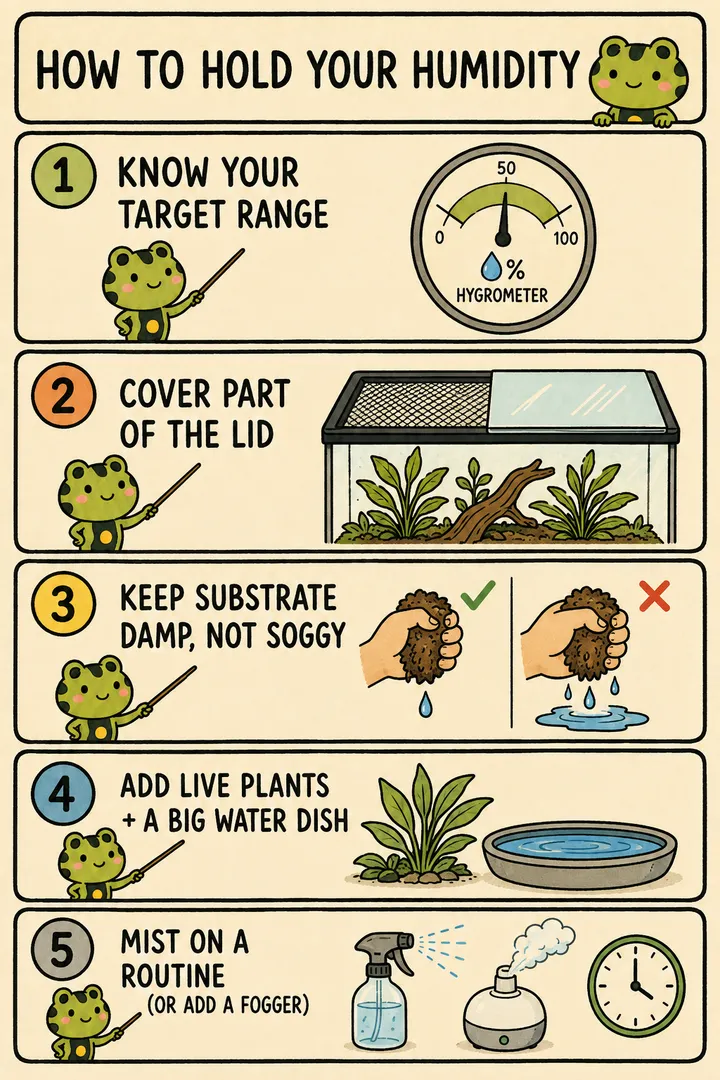
Low humidity is a familiar frog-keeping frustration — you mist, and twenty minutes later the gauge has crashed again. The good news: it’s almost always fixable, and usually the fix isn’t “mist more.” Here’s what actually works.
🐸 Not sure of your target? The free Tree Frog Planner gives you the exact temperature and humidity range for your species, so you know what you’re aiming for.
First: know your target
Humidity isn’t “as high as possible” — it’s species-specific, and some frogs dislike being too wet:
- White’s tree frog: 50–70% (they actively dislike constant sogginess).
- Red-eyed tree frog: 60–80% (aim for about 70%); brief spikes after misting are fine, but never stagnant.
- Poison dart frogs: 80–100%.
Aim for a stable range, not a swamp. And always pair humidity with some airflow — high humidity plus stagnant air breeds mould and bacteria. You want a fresh rainforest, not a stale one.
The fixes that actually work
Stack a few of these rather than relying on any one:
- Cover part of the lid. A full mesh/screen top means lots of ventilation, and reducing ventilation is one of the recognised ways to raise humidity — alongside misting, live plants and more water surface. Cover part of it with glass, acrylic, or even foil and watch the gauge finally hold.
- Use a moisture-holding substrate. Coco fibre (kept lightly damp, not soggy) or a bioactive soil mix releases humidity slowly. Avoid dry, non-absorbent substrates.
- Increase the water surface. A larger, shallow water dish — or a bigger water area — gives more evaporation. Placing it near (not on) a gentle heat source raises output.
- Mist daily with dechlorinated or RO water, by hand or an automatic mister. Misting is a top-up, not the whole strategy.
- Add live plants. Pothos, philodendron, and ferns transpire moisture and hold it around the leaves (and look great).
- Mind the room. A very dry or air-conditioned room fights you — a partially covered, well-planted tank buffers against it.
The mistake to avoid
Don’t try to win with misting alone. Drowning a leaky, over-ventilated tank in water just gives you soggy substrate and skin problems for the frog. Fix the tank so it holds humidity — moisture-retaining substrate, more water surface, a partially covered lid, live plants — and then mist to top it up. Stable beats spiky.
Check it, don’t guess
Use a hygrometer (ideally a digital one, placed at frog height) so you’re tuning to real numbers, not hoping. Once the tank holds a steady range on its own, the daily routine gets much easier.
💚 If you’re battling the gauge every day, the answer usually isn’t more effort — it’s covering that screen top and letting a damp substrate and some plants do the work. Get the tank holding humidity on its own, and the rest is a light daily mist.
Go deeper: What humidity does my amphibian need? (all species, too dry vs too wet) · tree frog care basics · Is my tree frog sick? · the free Tree Frog Planner.
Common questions
How do I raise the humidity in a frog tank?
Combine several fixes: mist daily with dechlorinated water, use a moisture-holding substrate like coco fibre kept lightly damp, add a larger water surface, cover part of a mesh lid to trap moisture, and add live plants. Ventilation matters too: reducing it is one of the recognised ways to raise humidity, so partially covering a full screen top helps hold moisture in (one suggested compromise is a lid about one-third glass, two-thirds mesh). Do not seal it completely, though — frogs still need fresh air to stay healthy.
What humidity does a tree frog need?
It depends on the species. White's tree frogs want a moderate 50 to 70% and actually dislike being kept too wet, while red-eyed tree frogs need a higher 60 to 80%, with strong airflow. Poison dart frogs need 80 to 100%. Always pair humidity with some airflow — high humidity plus stagnant air breeds mould and bacteria — and check the exact range for your species rather than assuming wetter is better.
Why won't my frog tank hold humidity?
The usual culprit is too much ventilation, especially a full mesh or screen top that lets moisture escape as fast as you mist. Other causes are a substrate that does not hold moisture, too little water surface, and a very dry room. Partially covering the screen (with glass, acrylic, or foil), switching to coco fibre, and adding a larger water dish usually solves it.
Should I just keep misting to raise humidity?
Misting helps, but do not rely on it alone — constant heavy misting to fight a leaky, over-ventilated tank leads to soggy substrate and skin problems. It is better to fix the tank so it holds humidity (moisture-retaining substrate, more water surface, partially covered lid, live plants) and then mist to top it up. Aim for a stable range, not a swamp.

Join the Bognook burrow
Cozy amphibian care tips, aesthetic freebies, and the occasional frog fact — straight to your inbox. No spam, just good bog vibes.
Free amphibian care cheat-sheet when you join. No spam — pinky-promise. Unsubscribe anytime. See how we handle your data in our privacy notice.