What Humidity Does My Amphibian Need? (Too Dry, Too Wet, and Just Right)
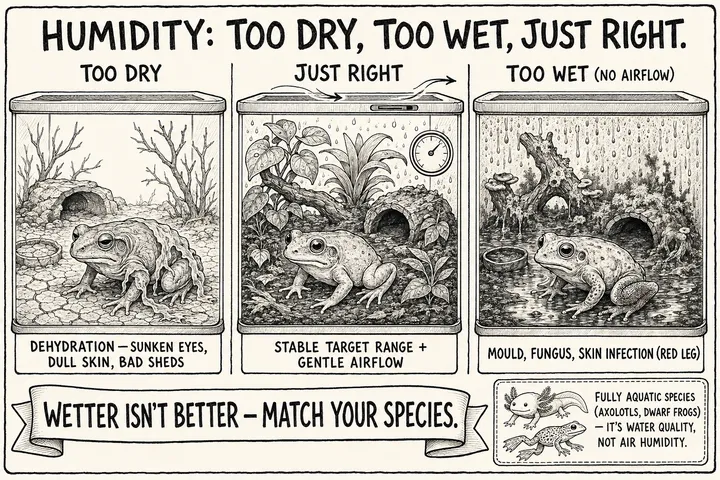
There’s one myth worth killing before anything else: wetter is not better. Humidity is a species-specific target range, and both ends — too dry and too wet — cause real problems. This is the cross-species reference: what each group actually needs, what happens when it’s wrong in either direction, and how to hold a steady range without fighting the gauge every day.
💧 The 30-second answer: match humidity to your species, not to “as high as possible.” Rough targets — White’s tree frog 50–70%, red-eyed 60–80%, dart frogs 80–100%, ground frogs & toads 50–70% (damp substrate), Pacman/horned frogs 60–80%, terrestrial salamanders & newts 70–100%. Fully aquatic species live in water, so tank humidity doesn’t apply — water quality does. Too low = dehydration; too high with no airflow = mould, fungus and skin infection. Aim for a stable range with gentle ventilation.
Targets by group
Find your animal and aim for its range — then read why both extremes matter.
| Group | Target humidity | Note |
|---|---|---|
| 🐸 White’s tree frog | 50–70% | Dislikes constant sogginess; keep it moderate. |
| 🐸 Red-eyed tree frog | 60–80% | Rainforest species; misted, brief spikes are fine — always with airflow. |
| 🐸 Poison dart frogs | 80–100% | The wettest kept frogs; needs airflow to avoid stagnation. |
| 🐸 Pacman / horned frogs | 60–80% | Damp substrate to burrow into; not a swamp. |
| 🐸 Ground frogs & toads | 50–70% | Moisture comes mostly from a damp substrate and water dish. |
| 🦎 Terrestrial salamanders & newts | 70–100% | Consistently damp; they breathe partly through their skin. |
| 🐟 Axolotls, African dwarf & clawed frogs, caecilians | N/A — aquatic | They live in water; tune water quality, not air humidity. |
Always confirm the exact figure for your species — these are working ranges, and a few species sit at the edges.
Too low: dehydration
Amphibian skin is their drinking and (partly) breathing system, so dry air hits them fast. The signs of chronically-low humidity:
- Sunken eyes, dull, dry, or wrinkled skin.
- Lethargy and hiding.
- Difficulty shedding cleanly.
A mildly dehydrated amphibian often rebounds within hours once you mist and add clean water — but persistent low humidity is a slow killer. If the eyes stay sunken after correcting it, that’s a vet sign (see is my amphibian okay?). If your tank simply won’t hold moisture, the fixes are in the full raise-humidity guide.
Too high: the direction most guides skip
This is the half people rarely warn about. Constantly saturated air with poor airflow is its own problem:
- 🦠 Mould, fungus and bacteria thrive in warm, wet, stagnant air — on the substrate, the décor, and the animal’s skin.
- 🩹 Skin infections, including bacterial “red leg”, are more likely in a soggy, dirty, stagnant enclosure.
- 💧 Soggy substrate stays wet, sours, and grows things you don’t want.
- 😣 Some species hate it — White’s tree frogs kept too wet get stressed and prone to skin problems.
The rule: high humidity must always be paired with gentle ventilation. You want a fresh rainforest, not a stale, mouldy one. If your dart frog viv or planted tank smells musty or grows mould, the answer is usually more airflow, not less water.
The balance: humidity + airflow
The two aren’t opposites you trade off — you need both. A well-set-up enclosure holds a stable humidity range and exchanges air:
- Cross-ventilation (front vents + a partly-screened top) lets stale air out without dumping all your moisture.
- Live plants transpire moisture and help keep the air fresh.
- A partly-covered lid holds humidity; the uncovered part provides the airflow. Tuning that ratio is how you dial a species in.
For the planted, high-humidity groups (dart frogs especially), the Vivarium Builder helps you get the drainage-and-airflow layout right so high humidity stays healthy.
Fogger, mister, or hand-mist?
You usually don’t need automation to start:
- Substrate + water dish + partly-covered lid + live plants hold the baseline passively — fix this first.
- A daily hand-mist with dechlorinated or RO water tops it up.
- Automatic misters / foggers help with very high-humidity species or large enclosures — but they can push a tank into too wet and stagnant if ventilation isn’t right. Add them only after the passive setup holds a stable range.
Measure it — don’t guess
Put a hygrometer (ideally digital) at the animal’s height, not up near the lid. Guessing is how tanks end up chronically too dry or silently too wet. Once the setup holds a steady range on its own, misting becomes a light daily top-up instead of a daily battle. For tree frogs and dart frogs, the Tree Frog Planner gives you the exact temperature and humidity target to tune toward.
💚 Humidity isn’t a number to maximise — it’s a range to hold steady, with fresh air moving through. Match your species, fix the tank so it holds moisture on its own, keep some airflow, and check it with a real gauge. Get that right and most of the day-to-day fuss disappears.
Go deeper: How do I raise the humidity in a frog tank? · Is my amphibian okay — or does it need a vet? · the Tree Frog Planner and Vivarium Builder · more real questions in the Bognook Q&A.
Sources & further reading
This guide was written and fact-checked against these authorities. It’s kind, general husbandry guidance — not a substitute for an exotics vet:
- Merck Veterinary Manual — Noninfectious Disorders of Amphibians — dehydration; its Infectious Diseases page covers bacterial skin infections (“red-leg” syndrome).
- AmphibiaWeb — Meet the Amphibians & AmphibiaWeb — Amphibian Facts — amphibian skin function (soft, permeable, mucus-covered skin that also takes in oxygen).
- Established husbandry references (e.g. Josh’s Frogs — smooth-sided toad and fire-bellied toad care sheets, and Caudata Culture — Housing FAQ) — species-by-species temperature and humidity targets and ventilation guidance.
Written and fact-checked by The Bognook Team against veterinarian-authored sources — persistent skin problems or dehydration that doesn’t resolve need an exotics vet.
Common questions
What humidity does my amphibian need?
It depends on the species, and higher is not automatically better. Rough targets: White's tree frogs 50 to 70%, red-eyed tree frogs 60 to 80%, poison dart frogs 80 to 100%, ground frogs and toads a moderate 50 to 70% with a damp substrate, Pacman and horned frogs 60 to 80%, and terrestrial salamanders and newts a high, consistently damp 70 to 100%. Fully aquatic species (axolotls, African dwarf frogs, clawed frogs) live in water, so tank humidity does not apply — water quality is what matters. Always check the exact range for your species.
Can humidity be too high for a frog?
Yes. Constantly saturated air with poor airflow is a real problem — it breeds mould, fungus and bacteria, keeps the substrate soggy, and contributes to skin infections like bacterial "red leg." Some species, especially White's tree frogs, actively dislike being kept too wet. The goal is a stable target range with fresh air, not the highest possible number. High humidity should always be paired with gentle ventilation.
Why won't my tank hold humidity?
The usual cause is too much ventilation — a full mesh or screen top lets moisture escape as fast as you mist. Other causes are a substrate that does not hold moisture, too little water surface, and a dry room. Partially covering the screen, switching to coco fibre kept lightly damp, adding a larger water dish, and adding live plants usually solves it. Our full guide to raising humidity walks through each fix.
Do I need a fogger or automatic mister?
Usually not to start. Most keepers hold the right humidity with a moisture-retaining substrate, a partly-covered lid, a good water dish, live plants, and a daily hand-mist. Foggers and automatic misters help with very high-humidity species (like dart frogs) or large enclosures, but they can also make a tank too wet and stagnant if the ventilation is not right. Fix the tank to hold humidity passively first, then add automation if you still need it.
How do I measure humidity in a vivarium?
Use a hygrometer, ideally a digital one, placed at the animal's height rather than at the top of the tank. Guessing leads to tanks that are chronically too dry or silently too wet. Once you can see real numbers, tune the setup until it holds a stable range on its own, then use daily misting only to top it up rather than to fight a leaky tank.

Join the Bognook burrow
Cozy amphibian care tips, aesthetic freebies, and the occasional frog fact — straight to your inbox. No spam, just good bog vibes.
Free amphibian care cheat-sheet when you join. No spam — pinky-promise. Unsubscribe anytime. See how we handle your data in our privacy notice.