Poison Dart Frog Care: The Complete Beginner's Guide (Bioactive Setup)
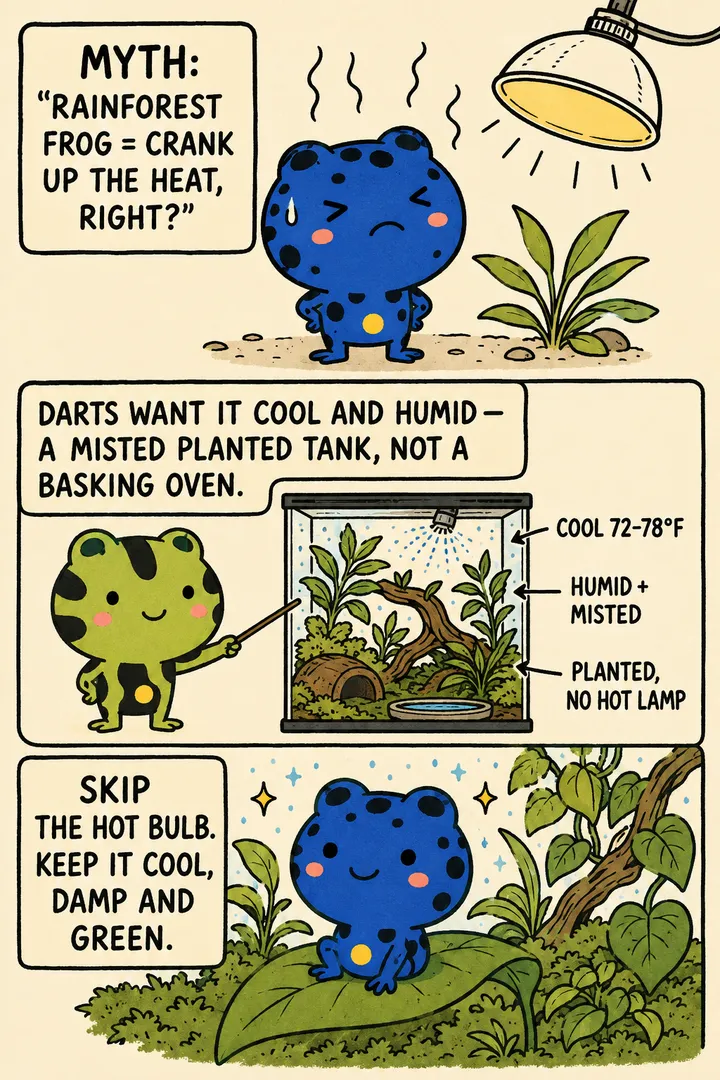
Poison dart frogs are living jewels — tiny, jaw-droppingly colourful, active by day (unlike most amphibians), and, despite the scary name, completely safe to keep. A planted dart frog vivarium is one of the most beautiful, low-footprint displays in the whole hobby: a slice of rainforest on a shelf. This guide walks you through everything a first-time keeper needs to do it right.
The 30-second version
- They’re not dangerous. Captive-bred darts are non-toxic — their poison comes from a wild diet they never eat in captivity.
- They need a bioactive, planted vivarium with high humidity (80–100%) and cool temperatures (72–78°F, kept under ~80°F).
- They eat small live feeders — flightless fruit flies + springtails, dusted with calcium/D3.
- Don’t handle them (delicate skin) and buy captive-bred only.
- They’re a long commitment — 10–15+ years — and the setup costs more than the frogs.
Is a dart frog right for you?
Dart frogs are a fantastic display animal and a rewarding first amphibian for someone who enjoys the plants-and-terrarium side of the hobby. But be honest about the commitment:
- Lifespan: 10–15 years is common, and some live 20+. This is a decade-plus relationship.
- They’re for watching, not holding. If you want a pet to handle, a dart frog isn’t it.
- The vivarium is the hobby. You’re really keeping a tiny ecosystem — plants, cleanup crew, and frogs together. Many keepers love this; some find it more upkeep than expected.
- Live feeders forever. You’ll always have fruit-fly cultures going on a shelf.
If that sounds appealing rather than off-putting, you’ll likely love them.
Best beginner species
Start with the larger, bold, terrestrial darts — they’re hardy, outgoing, and forgiving:
- Dendrobates tinctorius (“tincs”) — bold, hardy, and gorgeous, with endless colour morphs. Note: females can be territorial, so many keepers keep a proven pair rather than several females.
- Dendrobates leucomelas (“leucs”) — the black-and-yellow “bumblebee frog”; sociable, outgoing, and one of the most forgiving starters. Tolerant of small groups.
- Dendrobates auratus — the classic green-and-black; a little more secretive but a great, robust starter.
Avoid for now: thumbnail species (Ranitomeya) — they’re tiny, more delicate, and need more precise conditions. Come back to them once you’ve kept standard darts successfully. And never mix species in one vivarium.
The setup: a bioactive vivarium, layer by layer
“Bioactive” means the vivarium is a small living ecosystem: live plants plus a cleanup crew of microfauna that eat frog waste and mould, so it largely self-cleans. Built from the bottom up:
- Enclosure — a planted, front-opening glass vivarium. About 18×18×18 in is plenty for one to a small group of standard darts; bigger is always better. Front-opening doors reduce stress (no looming from above) and make maintenance easy.
- Drainage layer — 1–2 in of hydroballs/LECA or a false-bottom at the base, so excess water drains below the roots instead of stagnating.
- Substrate barrier — a layer of mesh/screen over the drainage layer to keep soil from washing down into it.
- Substrate — a few inches of a rainforest mix (an “ABG”-style blend of tree-fern, peat/coco, sphagnum, charcoal and bark). It holds moisture and supports plant roots and microfauna.
- Leaf litter — a generous top layer of dried magnolia/oak/almond leaves. This is not optional: it’s cover for shy frogs, breeding habitat for your cleanup crew, and a hunting ground.
- Cleanup crew — springtails and dwarf isopods, added a few weeks before the frogs so their populations establish. They eat waste and mould — and double as food.
- Plants — live tropical plants: bromeliads (darts love to sit and breed in them), pothos, ferns, mosses, vines. Let them grow in before adding frogs.
- Background — a planted or cork-bark back wall adds climbing surface and hides equipment.
Let the vivarium settle for 2–4 weeks (plants rooting, cleanup crew booming) before the frogs move in.
Humidity, water & ventilation
- Humidity: 80–100%. Achieve it with a glass viv, a partial screen or vented top, and daily misting (or an automatic misting system for consistency).
- Use clean water for misting — dechlorinated or reverse-osmosis/distilled water avoids mineral spots on the glass and is gentler on the frogs.
- Balance humidity with airflow. High humidity plus stagnant air breeds mould and disease. A little ventilation (a vented strip, or a small computer fan on a cycle) keeps the air fresh. You want a rainforest, not a swamp.
- A shallow water feature is optional and must be shallow with an easy exit — darts are poor swimmers and can tire.
Temperature: keep them cool
This is the rule new keepers get wrong most:
- Ideal: 72–78°F (22–25°C). Cool and stable.
- Keep it under ~80°F — a few hours near 85°F can kill a frog, and they can’t cool themselves.
- Usually no heat source is needed at normal room temperature. The real challenge is cooling in summer — fans across the surface, a cooler room, AC, or moving the viv away from windows and electronics.
- Never use a hot basking lamp. Dart frogs are not baskers.
Lighting
Light is mainly for the plants — an LED or plant grow light on a 10–12 hour timer. Dart frogs don’t need intense heat/UVB the way reptiles do (you supplement D3 through their food), but a low-level UVB bulb is a reasonable, beneficial addition many keepers use. Watch that lights don’t heat the enclosure past the safe range.
Feeding & supplementation
Dart frogs eat tiny live prey, and because their whole diet is small feeders, supplementation isn’t optional — it’s what prevents deficiency diseases.
- Staple: flightless fruit flies — Drosophila melanogaster (smaller) and hydei (larger). Keep 2–3 cultures rotating so you never run out — our free Feeder-Culture Tracker tells you exactly when to start the next one.
- For froglets & variety: springtails and dwarf isopods from the vivarium; froglets depend on these tiny feeders.
- Dust nearly every feeding with a quality calcium + vitamin D3 supplement, and rotate in a multivitamin (a vitamin-A source matters — its lack causes “short-tongue syndrome,” where frogs can’t catch prey).
- Frequency: adults every 1–2 days; froglets daily. Offer what they’ll eat in a few minutes.
Group dynamics
- Leucs and auratus generally do well in small groups.
- Tincs are best as a proven pair — females can bully other females.
- Sexing is easiest in mature frogs (females often larger/rounder; males may call and have broader toe pads).
- One species per vivarium — always. Mixing species causes stress, hybridising, and disease spread.
Health, handling & the golden rules
Keep the cool-humid-dusted triangle right and darts are hardy, long-lived gems. When something does look off, the fixes almost always come back to those same three levers — see our full guide on the warning signs a dart frog is sick.
- Don’t handle them. They’re non-toxic, but their skin absorbs oils, soaps, and residues. Watch, don’t hold.
- Captive-bred only. Never buy wild-caught — it’s bad for conservation, and WC frogs carry parasites, disease, and (from the wild) real toxins.
- Quarantine new frogs in a simple separate setup before adding them to an established vivarium, to avoid importing disease like chytrid.
What it costs
Set expectations before you buy:
- Vivarium + bioactive build (glass viv, drainage, substrate, leaf litter, plants, misting, lighting, cleanup crew): roughly $300–600+ to start.
- The frogs: about $40–100 each, captive-bred.
- Ongoing: fruit-fly cultures + supplements, a modest ~$15–30/month.
The setup genuinely costs more than the animals — budget for the habitat, not just the frogs.
💚 Get the humidity high, the temperature cool, and the feeders dusted, and dart frogs are one of the most rewarding displays you can keep. Take your time on the vivarium — a well-built bioactive viv makes everything else easy.
Go deeper: warning signs your dart frog is sick · dart frog questions answered · the printable dart frog care sheet · free keeper tools & printables.
🎓 Ready to go further — the advanced tier. Once the basics click (same plain voice, no ceiling): the advanced bioactive vivarium · breeding & raising tadpoles.
Sources & further reading
This guide was written and fact-checked against these authorities. It’s kind, general guidance — not a substitute for an exotics vet:
- Josh’s Frogs — Bioactive substrate in your dart frog vivarium, fruit fly culture tips, frog supplementation: the next step and 3 starter dart frogs — bioactive vivarium build, fruit-fly culturing, calcium/D3 + vitamin-A supplementation, and beginner species.
- Peer-reviewed research on dart frog toxicity (Daly et al. 1994, Toxicon) and Smithsonian’s National Zoo — toxins come from a wild diet of alkaloid-bearing invertebrates, which is why captive-bred darts raised on fruit flies are non-toxic.
- Merck Veterinary Manual — Noninfectious Disorders of Amphibians — hypovitaminosis A (“short tongue syndrome”) and metabolic bone disease; its Infectious Diseases page covers bacterial “red-leg” syndrome.
- AmphibiaWeb — Chytridiomycosis & Amphibian Ark — Chytrid prevention strategies — chytrid (Bd), how the pet trade spreads it, and why quarantine matters.
- Association of Reptilian & Amphibian Veterinarians (ARAV) — a find-an-exotics-vet directory.
Written and fact-checked by The Bognook Team against veterinarian-authored sources — if a frog seems unwell, see an exotics vet.
Common questions
Are poison dart frogs dangerous to keep as pets?
No. A dart frog's toxicity comes from its wild diet of specific ants, mites, and other small invertebrates. Captive-bred dart frogs raised on fruit flies and springtails never develop toxins, so they are non-toxic and safe to keep. You still should not handle them, but only because their delicate skin absorbs oils and residues from your hands, not because they are poisonous.
What is the best beginner poison dart frog?
The best starter species are the larger, bold, terrestrial dart frogs: Dendrobates tinctorius (tincs), Dendrobates leucomelas (leucs, the bumblebee frog), and Dendrobates auratus. They are hardy, forgiving of small mistakes, active by day, and easy to feed. Avoid thumbnail species (Ranitomeya) until you have experience, as they are tiny, more delicate, and need more precise conditions.
What size tank do poison dart frogs need?
A planted, front-opening glass vivarium of about 18x18x18 inches (roughly 30–40 litres) suits one to a small group of standard dart frogs. Bigger is better, and it should be bioactive and heavily planted rather than bare. Because darts are small and stay near the ground and low plants, floor space and cover matter more than height.
What temperature do poison dart frogs need?
Dart frogs are cool tropical animals. Aim for about 72 to 78F (22 to 25C), and keep it under about 80F — a few hours near 85F can kill a frog. They usually need no heat source at normal room temperature — the bigger challenge is keeping them cool in summer with fans, a cooler room, or air conditioning.
What do poison dart frogs eat?
Their staple is flightless fruit flies (Drosophila melanogaster and the larger hydei), dusted with a calcium and vitamin D3 supplement at nearly every feeding, plus springtails and dwarf isopods that live in the vivarium (and are essential food for froglets). Feed adults every one to two days. Because their whole diet is small feeders, supplementation is not optional — it prevents deficiency diseases.

Join the Bognook burrow
Cozy amphibian care tips, aesthetic freebies, and the occasional frog fact — straight to your inbox. No spam, just good bog vibes.
Free amphibian care cheat-sheet when you join. No spam — pinky-promise. Unsubscribe anytime. See how we handle your data in our privacy notice.