Newt Care: The Complete Beginner's Guide (Water, Land & Feeding)
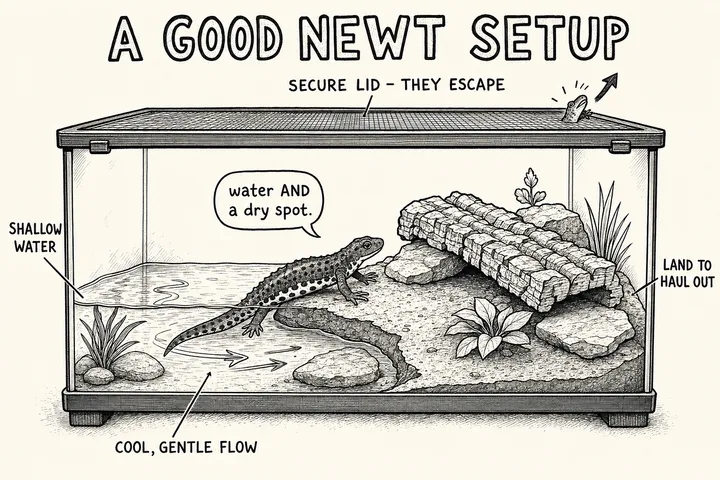
Newts are the semi-aquatic cousins of salamanders — a foot in the water and a foot on land — and that dual nature is the key to keeping them. Get the water-and-land balance right for your species and they’re hardy, fascinating, long-lived little animals. This guide covers everything a first-time keeper needs.
🔧 Planning the tank? Build your list with the free aquatic setup planner so nothing essential gets missed.
The 30-second version
- Best beginner: the fire-belly newt (mostly aquatic, hardy, affordable).
- They’re semi-aquatic: a setup with both clean water and an accessible land area.
- Keep them cool: 60–68°F, no heater — overheating can kill.
- Cycled water: the aquatic part needs to be cycled and dechlorinated, ammonia/nitrite 0.
- Escape artists: a secure lid is non-negotiable.
- Mild-to-real toxins: don’t handle much, wash your hands, and no bitey tankmates.
Is a newt right for you?
Newts are rewarding, but know what you’re signing up for:
- Lifespan: commonly 10–15+ years with good care.
- They’re semi-aquatic, so you’re maintaining a small aquarium and a land area — including keeping the water clean and cycled.
- They’re watch-not-hold animals — minimal handling, and they secrete toxins.
- They’re escape artists. A gap-free lid is part of the deal.
Best beginner species
- Fire-belly newt (Cynops orientalis) — the classic starter: small, hardy, widely available, and mostly aquatic with a small haul-out. Its bright belly warns that it’s toxic if ingested — safe to keep with clean-hands hygiene.
- Paddle-tail newt (Pachytriton) — another commonly kept, mostly aquatic option (prefers cooler, well-oxygenated water).
A quick note on names: all newts are salamanders, but “newt” is the more semi-aquatic subgroup — so newts usually need water and land, where many other salamanders are land animals. (See our salamander care guide if that’s what you actually have.)
The setup: water + land
Most pet newts need a semi-aquatic setup — a water area plus dry land they can climb onto.
- Enclosure: a low, long aquarium/terrarium works well — floor area and easy water access matter more than height.
- Water area: clean, cycled, dechlorinated water with a gentle filter (newts dislike strong flow). Keep it on the shallower side for weaker swimmers, and test that ammonia and nitrite read 0.
- Land area: an accessible dock or haul-out — sloped cork bark, a raised platform, or floating plants — so a newt can always rest out of the water. This prevents the exhaustion-drowning that a steep, exit-less tank causes.
- No small gravel that could be swallowed; use sand, larger stones, or bare-bottom with plants.
- A secure lid — newts will escape any gap, and a dried-out newt dies fast.
The exact water-to-land ratio depends on your species and its current phase — some newts spend most of their time in water, others go through more terrestrial stretches.
Temperature & water quality
- Temperature: 60–68°F (15–20°C), and never warm. No heater; in summer you may need a surface fan, a cooler room, or cool water changes. Overheating can cause a sudden decline.
- Water quality: treat the aquatic side like any aquarium — cycle it before the newt moves in, dechlorinate, keep ammonia and nitrite at 0, and do regular partial water changes. Most newt “illnesses” are really water problems.
Feeding
Newts are carnivores:
- Good foods: bloodworms, blackworms, chopped earthworms, and appropriately sized sinking pellets.
- How: feed aquatic newts in the water, offer small amounts, and remove uneaten food so it doesn’t foul the tank.
- Don’t overfeed — aim for a rounded, not bloated, body. Newts don’t need to eat every day as adults.
Handling & safety
- Minimise handling. Newt skin absorbs oils, soaps, and salts — and many newts, fire-bellies especially, secrete real toxins.
- Wash and rinse your hands before and after, never touch your eyes or mouth in between, and never house newts with animals that might bite them.
Health, buying & the golden rules
- Buy captive-bred where possible, and quarantine new newts before mixing.
- Keep it cool, clean-watered, and escape-proof, and newts are hardy. When something looks off, the fixes usually trace back to temperature and water quality — see our full guide to the warning signs a newt is sick.
- Don’t take a wild newt — many are protected, and wild animals carry parasites and disease.
What it costs
- Tank + setup (aquarium, filter, land area, plants, lid): roughly $100–250 to start.
- The newt: about $15–40, captive-bred (fire-bellies are inexpensive).
- Ongoing: food + dechlorinator, roughly $10–15/month.
💚 The whole trick with newts is matching the water-and-land setup to your species and keeping it cool and clean. Get that right, cover the tank properly, and you’ve got a hardy, fascinating little companion for well over a decade.
Go deeper: aquatic or terrestrial? setup by life stage · warning signs your newt is sick · newt questions answered · the printable newt care sheet · salamander care guide.
🎓 Ready to go further — the advanced tier. Cohabitation, breeding & the biosecurity rule (salamanders & newts).
Sources & further reading
This guide was written and fact-checked against these authorities. It’s kind, general guidance — not a substitute for an exotics vet:
- Caudata Culture — fire-belly newt caresheet — the long-standing newt & salamander keeper reference: species care for the fire-belly newt, the water-and-land balance, and cool temperatures; its Water Quality article covers cycled water.
- AmphibiaWeb — Cynops orientalis, AmphibiaWeb — Cynops glaucus & AmphibiaWeb — Taricha granulosa — species natural history and the tetrodotoxin defence in fire-belly newts and their relatives.
- Merck Veterinary Manual — Environment and Husbandry for Amphibians — amphibian husbandry, and water that must be free of chlorine, ammonia and nitrite.
- Association of Reptilian & Amphibian Veterinarians (ARAV) — a find-an-exotics-vet directory.
Written and fact-checked by The Bognook Team against veterinarian-authored sources — if a newt seems unwell, see an exotics vet.
Common questions
Do newts need land and water?
Most pet newts are semi-aquatic and need both: an area of clean, cycled, dechlorinated water and an accessible land area or dock to climb out onto. The exact balance depends on the species and its life phase, so confirm whether yours is more aquatic or terrestrial. Always provide both plus an easy exit from the water so a newt can never get stuck and tire.
What is the best beginner newt?
The fire-belly newt (Cynops orientalis) is the most popular and forgiving beginner newt — hardy, widely available, affordable, and mostly aquatic with a small land area. Just remember it secretes a genuine toxin, so wash your hands after any contact and never house it with animals that might bite it. Paddle-tail newts are another commonly kept option.
What temperature do newts need?
Newts are cool-loving animals, best kept around 60 to 68F (15 to 20C). They dislike heat and cannot cool themselves, so use no heater, keep the tank out of direct sun, and be ready to cool the water in summer with a fan across the surface, a cooler room, or cool water changes. Overheating can cause a sudden decline.
Do I need a lid on a newt tank?
Yes, absolutely. Newts are determined climbers and escape artists that will find any gap, and an escaped newt dries out and dies quickly. Use a secure, well-fitted lid with no gaps around filters or cords, and always include an easy exit from the water to the land area.
What do newts eat?
Newts are carnivores. Good foods are bloodworms, blackworms, chopped earthworms, and appropriately sized sinking pellets, with aquatic newts fed in the water. Feed small amounts, remove anything uneaten so it doesn't foul the water, and don't overfeed — a rounded but not bloated body is the goal.

Join the Bognook burrow
Cozy amphibian care tips, aesthetic freebies, and the occasional frog fact — straight to your inbox. No spam, just good bog vibes.
Free amphibian care cheat-sheet when you join. No spam — pinky-promise. Unsubscribe anytime. See how we handle your data in our privacy notice.