Salamander Care: The Complete Beginner's Guide (Setup, Feeding & Species)
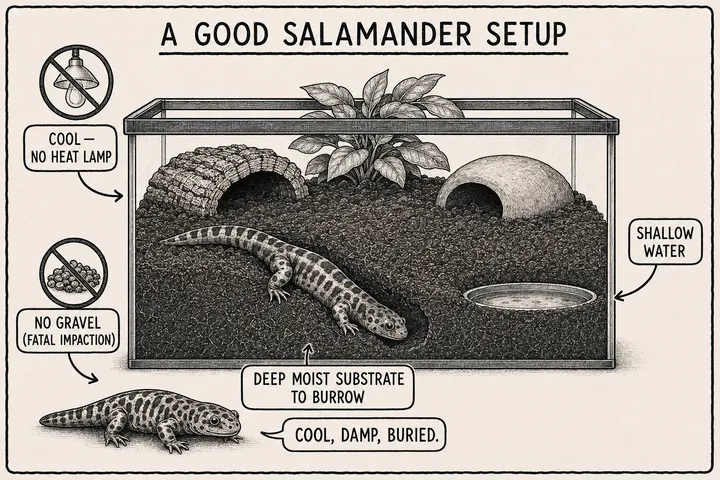
Salamanders are cool-loving little “dragons” — hardy, long-lived, and full of character. But “salamander” covers a huge range of very different animals, so successful care starts with one question: what kind is yours? This guide walks a first-time keeper through that, then through the setup, feeding, and care.
🔧 Setting up for a salamander? Plan it with the free salamander setup tool.
The 30-second version
- Identify your species first — is it aquatic, terrestrial, or semi-aquatic? The setups are completely different.
- Best beginner: the tiger salamander (a hardy terrestrial burrower).
- Keep them cool: 60–68°F, no heater, no basking lamp — heat kills.
- Terrestrial species need deep moist substrate to burrow, hides, and a shallow water dish.
- They’re carnivores: earthworms are an excellent staple.
- Hiding by day is normal — judge health by body condition, not visibility.
First: aquatic or terrestrial?
This is the decision everything else hangs on. Some salamanders are terrestrial burrowers that need moist land; some are fully aquatic and need cycled water (the axolotl is actually an aquatic salamander — see the axolotl care guide); some are semi-aquatic and need both. Identify your exact species before you build anything — a setup that’s right for one type can be fatal for another. When in doubt, ask a keeper community with a clear photo before you buy or build.
The rest of this guide focuses on the common terrestrial case (like the tiger salamander), with notes for aquatic species where it matters.
Is a salamander right for you?
- Lifespan: many live 10–20+ years — a long commitment.
- They’re secretive. A healthy salamander often spends the day underground; the payoff is watching it hunt at dusk.
- They’re watch-not-hold animals — their skin is delicate and absorbent.
- They need to stay cool, which can mean planning for summer.
Best beginner species
- Tiger salamander (Ambystoma tigrinum) — the classic hardy, forgiving starter: a robust terrestrial burrower that eats enthusiastically and tolerates cool room conditions.
- Fire salamander (Salamandra salamandra) — striking and popular, terrestrial, but a step up in care and notably toxic — a good second salamander.
- Axolotl — technically an aquatic salamander, but different enough to have its own setup: see the complete axolotl care guide.
Don’t take a wild salamander — many are legally protected, they’re extremely sensitive to the oils and chemicals on our skin, and they can spread disease. Buy captive-bred.
The setup: a cool, moist burrow (terrestrial species)
- Enclosure: a terrestrial terrarium with plenty of floor space and a secure lid. Ground area beats height — these are diggers, not climbers.
- Substrate: several inches of deep, moist (not soggy) substrate — coco fibre, organic topsoil, or a bioactive mix with leaf litter — deep enough to burrow into and vanish.
- Hides & cover: cork bark, half-logs, and plants so the salamander feels secure by day.
- Water dish: a shallow dish of clean, dechlorinated water to soak in (they hydrate through their skin), cleaned often.
(Aquatic species instead need a cool, cycled, dechlorinated aquarium with a gentle filter and an accessible resting spot — treat it like the newt/axolotl water setup.)
Temperature & moisture
- Temperature: 60–68°F (15–20°C), and never hot. No basking lamp, no heater — keep them in the coolest part of your home, away from sun and electronics. Overheating can kill.
- Moisture: keep the substrate damp but not waterlogged, mist as needed, and maintain the soak dish. Terrestrial salamanders want humid, not swampy.
Feeding
Salamanders are carnivores:
- Staple: earthworms are excellent and nutritious for most species.
- Variety: appropriately sized crickets, dubia roaches, and other insects for terrestrial species (dusted with calcium), or aquatic prey for aquatic ones.
- How: offer prey on a dish or with tongs so the salamander doesn’t swallow loose substrate (impaction risk), feed correctly sized prey, and don’t overfeed.
- Body-condition tip: a salamander stores fat in its tail — a suddenly thin tail is a sign it’s underweight or not eating well.
Handling & safety
- Minimise handling. Their skin is delicate and absorbs oils, soaps, and salts, and many species (fire salamanders especially) secrete defensive toxins.
- Wash and rinse your hands before and after, never touch your eyes or mouth in between, and keep salamanders away from dogs, cats, and young children.
Health & the golden rules
Keep it cool, moist, and clean, feed sensibly, and salamanders are famously long-lived and trouble-free. When something looks off, the fixes usually come back to temperature and moisture — see our full guide to the warning signs a salamander is sick (including heat, dehydration, and impaction). Quarantine any new arrival.
What it costs
- Terrarium + setup (tank, substrate, hides, dish): roughly $100–250 to start.
- The salamander: about $20–50, captive-bred.
- Ongoing: feeders + supplements, roughly $10–15/month.
💚 The kindest first step with any salamander is to identify exactly what you have and match its setup — aquatic or terrestrial. Get that right, keep it cool and damp, and you’ve got a fascinating companion that can share a decade or two with you.
Go deeper: aquatic or terrestrial? setup by life stage · warning signs your salamander is sick · salamander questions answered · the printable salamander care sheet · newt care guide.
🎓 Ready to go further — the advanced tier. Cohabitation, breeding & the biosecurity rule.
Sources & further reading
This guide was written and fact-checked against these authorities. It’s kind, general guidance — not a substitute for an exotics vet:
- Caudata Culture — Housing FAQ — the long-standing newt & salamander keeper reference: matching the setup to aquatic vs terrestrial species; its Tiger Salamander 101 guide covers cool burrowing setups and feeding, and its Water Quality article covers cycled water.
- AmphibiaWeb — Salamandra salamandra & AmphibiaWeb — Salamandridae — species natural history and the defensive skin toxins (e.g. fire salamanders’ poisonous skin secretions).
- Merck Veterinary Manual — Environment and Husbandry for Amphibians — amphibian husbandry, calcium supplementation, and the gravel rule (too large to swallow, or small enough to pass).
- Association of Reptilian & Amphibian Veterinarians (ARAV) — a find-an-exotics-vet directory.
Written and fact-checked by The Bognook Team against veterinarian-authored sources — if a salamander seems unwell, see an exotics vet.
Common questions
Is my salamander aquatic or terrestrial?
It depends entirely on the species, and this is the first thing to establish because the setups are completely different. Some salamanders are terrestrial burrowers that need moist land and hides (like tiger and fire salamanders), some are fully aquatic and need cycled water (like axolotls), and some are semi-aquatic and need both. Identify your exact species before you build anything, because guessing can be fatal.
What is the best beginner salamander?
The tiger salamander (Ambystoma tigrinum) is the classic hardy, forgiving beginner — a terrestrial burrower that eats readily and tolerates ordinary cool room conditions. Care varies enormously across salamanders, though, so always identify your exact species and confirm whether it is terrestrial or aquatic before setting up.
What temperature do salamanders need?
Salamanders are cool-climate animals, best kept around 60 to 68F (15 to 20C). They are very sensitive to heat and cannot cool themselves, so use no basking lamp or heater, keep them in the coolest part of the home away from windows and electronics, and be ready to cool things down in a summer heatwave.
Why does my salamander hide all day?
That is completely normal. Most salamanders are nocturnal and fossorial, meaning they naturally burrow and hide during the day and become active at night. A salamander that stays hidden by day and eats after dark is behaving exactly as it should — judge its health by body condition and feeding response, not by how often you see it.
What do salamanders eat?
Salamanders are carnivores. Earthworms are an excellent staple for most species, supported by appropriately sized insects such as crickets and dubia roaches (dusted with calcium) for terrestrial species, or aquatic prey for aquatic ones. Feed correctly sized prey, offer it on a dish to avoid substrate being swallowed, and don't overfeed.

Join the Bognook burrow
Cozy amphibian care tips, aesthetic freebies, and the occasional frog fact — straight to your inbox. No spam, just good bog vibes.
Free amphibian care cheat-sheet when you join. No spam — pinky-promise. Unsubscribe anytime. See how we handle your data in our privacy notice.