Aquatic or Terrestrial? Salamander & Newt Setup by Life Stage
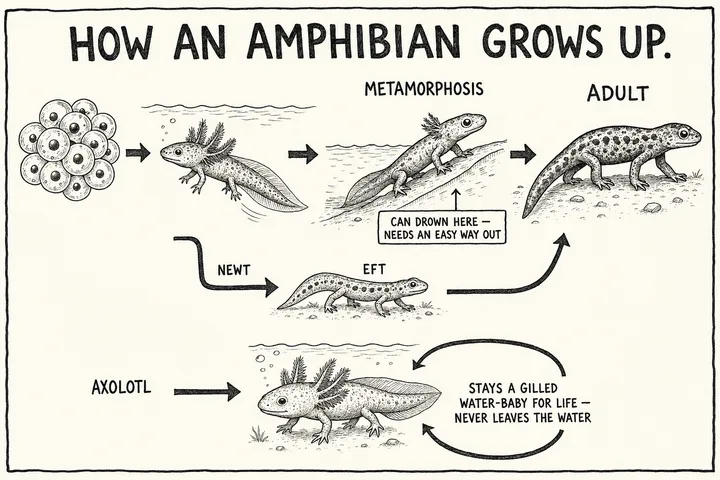
Here’s the single most useful thing to understand about salamanders and newts: whether your animal needs water or land isn’t fixed — it flips by species and by life stage. That’s the whole source of the confusion, and getting it wrong is genuinely dangerous: deep water drowns a land adult, and a dry tank kills an aquatic one. So before you build anything, let’s answer the water-or-land question properly.
🦎 Want a direct answer for your exact animal? The free Aquatic or Terrestrial? tool asks your species and life stage and tells you precisely which setup to build.
First: which stage are you looking at?
You can usually tell the stage at a glance:
- Feathery external gills + living in water → an aquatic larva (or a neotenic axolotl, which keeps its gills and stays aquatic for life).
- Dry-skinned, walking on land, often bright orange → a terrestrial “eft” juvenile (newts).
- Adult colours, no external gills → an adult: most salamanders live on land; most newts live in water with a haul-out, but some species differ, so check yours.
Now match that to your species.
Land salamanders (tiger, spotted, fire): water → land
These are the classic “why did my setup need to change?” animals. Tiger and spotted salamanders are mole salamanders; the fire salamander belongs to a different family (Salamandridae, the newt family), but its adults are land animals too. Fire salamanders don’t lay eggs: most mothers give birth to larvae in water, and a couple of subspecies give birth to fully formed young that skip the water stage entirely.
- Larva: aquatic, with feathery gills. A few inches of cool, dechlorinated water (~65–70°F, never above ~72°F), gentle filtration, and tiny live foods.
- Metamorphosis: as it grows legs and its tail fin shrinks, it’s about to leave the water. Lower the water so it barely covers the animal, and add an easy-exit ramp or island — a metamorphosing larva can drown if it can’t climb out.
- Adult: fully terrestrial. A land setup — 3–4+ inches of damp (not wet) substrate to burrow into, hides, cool temperatures (~60–68°F), and a shallow soaking dish only.
⚠️ Deep water drowns a land salamander. An adult land salamander needs a shallow dish to soak in — never a deep water area.
Many newts: water → land → water (four stages)
Newts like the eastern newt are the ones that catch people out, because they change twice.
- Larva: aquatic, gilled — like a tiny salamander larva in the water.
- Eft: after metamorphosis it leaves the water entirely and lives on land as a bright, dry-skinned juvenile — the famous “red eft.” This land phase can last 2–3 years. Keep it terrestrial and humid; it’ll want the water again only when it matures.
- Adult: semi-aquatic — a large, cool, cycled water area it can swim in, plus a reliable land ledge or island to haul out and rest on, and a secure lid (newts climb and escape).
⚠️ Even aquatic newts drown without a haul-out. Always give an adult newt easy land access.
Not every newt follows this path. Spanish ribbed and paddletail newts are kept in mostly or fully aquatic tanks as adults (still give them a float or plants to rest on at the surface: see our Spanish ribbed newt and paddletail newt care sheets), and some alpine newt populations never fully grow up: they stay in the water as adults that keep their larval gills while still breeding. Check your exact species before you plan its setup.
Axolotls: aquatic for life (the exception)
The axolotl is neotenic — it keeps its gills and stays fully aquatic for its entire life. It never metamorphoses onto land.
- Setup: cool water (16–18°C / 60–64°F), cycled and dechlorinated, with fine sand or a bare bottom — never gravel.
- It will not, and must not, be “moved to land.” Putting an axolotl on land would kill it.
(Because axolotls are all about water quality, they have their own tools: the Water Interpreter and cycling guide.)
The rule that keeps them alive
If you take one thing from this: match the water depth to the animal, and always provide an easy exit. Larvae and axolotls need water; efts and adult land salamanders need land with a shallow dish; most adult newts need water plus a haul-out. Get the water-vs-land question right and you’ve solved most of what goes wrong with these animals.
💚 Working out water-vs-land is most of the battle with salamanders and newts — and asking the question puts you ahead of most keepers. Match the setup to the species and stage, give an easy exit from any water, and you’re set.
Go deeper: the salamander care guide · the newt care guide · the free Aquatic or Terrestrial? tool.
Sources & further reading
This guide was written and fact-checked against these authorities. It’s kind, general guidance — not a substitute for an exotics vet:
- Caudata Culture — Raising Newt and Salamander Eggs — the long-standing newt & salamander reference: care by life stage (with per-species notes for juveniles) and metamorphosis; its Semi-aquatic Setups gallery shows haul-out (land-area) setups.
- AmphibiaWeb — Amphibian Facts & AmphibiaWeb — Salamandridae — salamander and newt natural history and life cycles.
- Wikipedia — Fire salamander & Wikipedia — Alpine newt — how fire salamanders give birth (larvae into water; fully formed young in the two subspecies fastuosa and bernardezi), and the alpine newt populations that keep their gills as breeding adults.
- Eastern newt life-cycle references (Chesapeake Bay Program, state wildlife/Audubon resources) — the aquatic larva → red eft → aquatic adult sequence.
- Association of Reptilian & Amphibian Veterinarians (ARAV) — a find-an-exotics-vet directory.
Written and fact-checked by The Bognook Team against veterinarian-authored sources — for a struggling metamorph or an animal that seems unwell, see an exotics vet.
Common questions
Does my salamander need water or land?
It depends on both the species and its life stage, and getting it wrong can be fatal, so establish this before you build anything. Mole salamanders (tiger, spotted) start as aquatic gilled larvae but become fully terrestrial adults that need land and only a shallow soaking dish; the fire salamander is not a mole salamander, but its adults are land animals too. Many newts, like the eastern newt, go through an aquatic larva, then a land-dwelling "eft" stage, then a semi-aquatic adult that needs water plus a haul-out, but some newts stay aquatic as adults. Axolotls are the exception — they stay aquatic for life. Identify your exact species and stage first.
Why is my aquatic larva suddenly trying to climb out of the water?
That is metamorphosis — the larva is losing its gills, growing stronger legs, and becoming a land animal. It is a critical, vulnerable moment: a metamorphosing larva can drown if it cannot get out of the water. Lower the water level so it barely covers the animal, add an easy-exit ramp or island, and be ready to move it to a land setup as it completes the change. This is normal and exciting, not a problem — it just needs the right support.
Can a salamander drown?
Yes. A terrestrial adult salamander (like an adult tiger, fire, or spotted salamander) can drown in deep water, which is why land species should only ever have a shallow dish to soak in, not a deep water area. Even strongly aquatic animals like adult newts can tire and drown without a reliable haul-out to rest on. Always match the water depth to the animal, and always provide an easy exit.
What is a red eft?
A red eft is the bright orange, land-dwelling juvenile stage of the eastern newt. After its aquatic larval stage, the young newt leaves the water and spends roughly 2 to 3 years on land as an eft before maturing and returning to the water as a semi-aquatic adult. During the eft stage it needs a terrestrial, humid setup — not a water tank.
Is an axolotl the same as other salamanders?
No. An axolotl is a neotenic salamander, meaning it keeps its feathery gills and stays fully aquatic for its entire life — it never metamorphoses into a land animal the way tiger salamanders do. An axolotl must live in water always; putting one on land would kill it. So the "aquatic or terrestrial?" question has a simple answer for axolotls: always aquatic.

Join the Bognook burrow
Cozy amphibian care tips, aesthetic freebies, and the occasional frog fact — straight to your inbox. No spam, just good bog vibes.
Free amphibian care cheat-sheet when you join. No spam — pinky-promise. Unsubscribe anytime. See how we handle your data in our privacy notice.