How to Cycle an Axolotl Tank: A Beginner-Proof Step-by-Step Guide
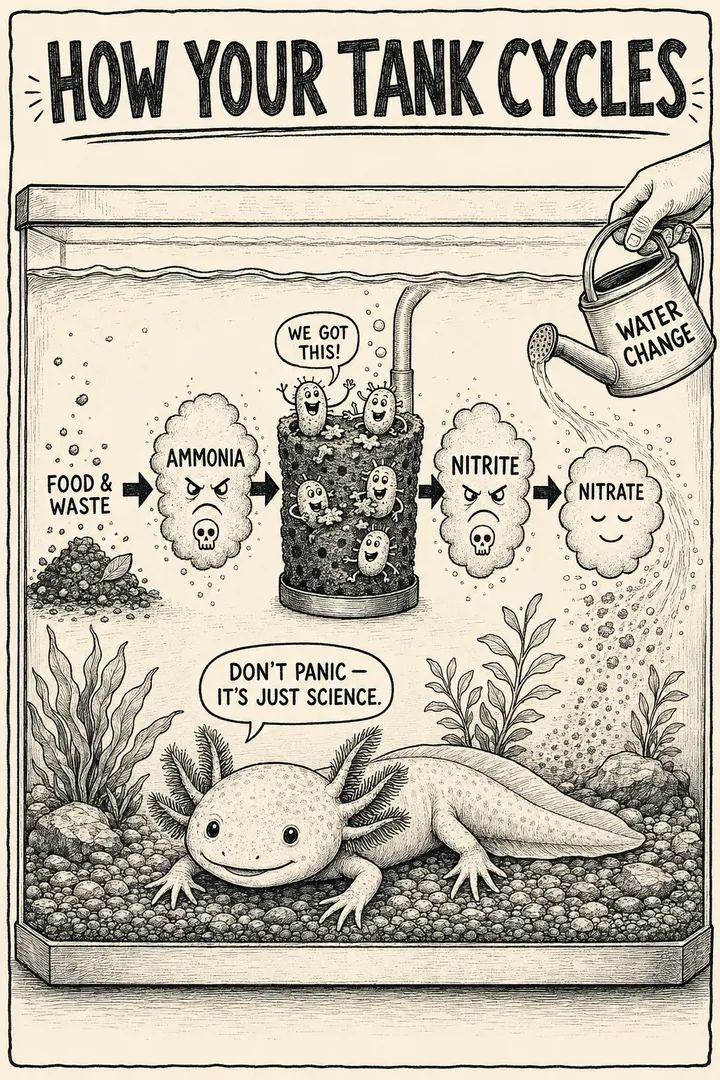
If you do one thing right in axolotl keeping, make it this. Cycling your tank before the axolotl goes in is one of the biggest things that separates a thriving axolotl from a sick one — and skipping it is an easy beginner mistake to make. Good news: it’s simple, it just takes patience.
🔧 Not sure if the water’s the problem? Paste your readings into the free water interpreter — most axolotl trouble is really water trouble.
What “cycling” actually means (in plain English)
Your axolotl produces waste, which becomes ammonia — and ammonia is toxic. In a healthy tank, colonies of beneficial bacteria live in your filter and eat that ammonia, turning it into nitrite (also toxic), which a second bacteria turns into nitrate (mostly harmless in small amounts, removed by water changes).
Cycling is just growing those bacteria colonies before your axolotl arrives, so day one there’s a living filter ready to keep the water safe. No cycle = ammonia poisoning, which shows up as refusing food, lethargy, gills that look ragged or damaged, and worse. As aquatic-medicine specialists Roy P. E. Yanong, VMD, and Ruth Francis-Floyd, DVM, DACZM state in the Merck Veterinary Manual’s guidance on aquatic systems, “Low dissolved oxygen and high ammonia are the two water quality parameters most likely to directly kill fish.“¹ The same water chemistry applies to a gilled, fully-aquatic axolotl — which is exactly why the cycle has to be finished before it moves in.
The step-by-step (fishless cycle)
1. Set the tank up completely — no axolotl
Fill with dechlorinated water, run the filter, add substrate (bare bottom or fine sand) and a hide. Everything should be running as if an axolotl lived there.
2. Add an ammonia source
The bacteria need food. Use one of:
- Pure ammonia (no additives/scents), dosed to about 2–4 ppm — the cleanest method, and
- or a pinch of fish food left to decay (messier, less precise).
3. Test regularly and wait
Using a liquid test kit (not strips), test every day or two. At first ammonia climbs. Then, over days to weeks, the first bacteria appear and ammonia starts to fall while nitrite rises.
4. Wait for nitrite to fall too
The second bacteria colony takes longer. Eventually nitrite drops and nitrate appears — this is the finish line coming into view. Keep topping the ammonia back up to ~2–4 ppm so the bacteria don’t starve.
5. Confirm the cycle is complete
The tank is cycled when you dose ammonia to ~2–4 ppm and, 24 hours later, both ammonia and nitrite read 0, with nitrate present. It must do this consistently.
6. Big water change, then add your axolotl
Do a large (50%+) water change to bring nitrate down, cool the water to 16–18°C (60–64°F), and now — finally — your axolotl can move in to a safe, living tank.
How to speed it up
- Seed it: add filter media, a cup of substrate, or a filter squeezing from an established, healthy tank — this transplants ready-made bacteria and can cut weeks to days.
- Bottled bacteria: a reputable nitrifying-bacteria product gives it a head start.
- Keep it warmer during the cycle (normal room temp) — bacteria multiply faster in warmth — then cool it down before the axolotl.
Timeline
Expect 4–8 weeks from scratch, or 1–2 weeks if you seed it. It’s the slowest part of setup and the most worth the wait.
Common mistakes to avoid
- ❌ Adding the axolotl before it’s cycled — ammonia and nitrite build up and can kill it.
- ❌ Rinsing your filter in tap water — chlorine kills your bacteria. Rinse in old tank water only.
- ❌ Using test strips — unreliable. Use a liquid kit.
- ❌ Forgetting to dechlorinate.
- ❌ A “fish-in” cycle with the axolotl — stressful and harmful; tub them instead if you’re mid-cycle.
The payoff
A cycled tank is a self-cleaning safety net. Nail this one slow, boring step and you’ve prevented most of the health scares in our warning-signs guide before they can happen.
💚 Cycling feels like forever when you’ve got an exciting new tank and no axolotl yet — but every experienced keeper will tell you it’s the best gift you can give them. You’re doing it right.
Go deeper: Do I need to cycle my aquatic tank? (all aquatic species) · the complete Axolotl Care Guide · how to tub & fridge an axolotl · axolotl questions answered · the printable care sheet.
Sources & further reading
This guide was written and fact-checked against these authorities. It’s kind, general guidance — not a substitute for an exotics vet:
- Standard aquarium water-quality science — the nitrogen cycle (ammonia → nitrite → nitrate via nitrifying bacteria) and the fishless-cycle method.
- Agave Veterinary Care — Axolotl care sheet (an exotic animal hospital) — ammonia 0 ppm and nitrate under 10 ppm as the ideal for an axolotl, and pH 6.5–8 (ideal 7.4–7.6).
- Tree of Life Exotic Pet Medical Center — Axolotl care (an exotic-animal vet clinic) — ammonia and nitrite 0 ppm, nitrate under 40 ppm: the ceiling.
- Axolotl Central — Axolotl care guide (a keeper community) — nitrate between 5 and 20 ppm: the range keeper guides allow, above the under-10 level vets recommend.
- Caudata Culture — Cycling an Aquarium for Aquatic Animals — ammonia and nitrite 0 in a cycled tank and 40 ppm as the ceiling for nitrate, and the ammonia risk of cycling with animals inside; its axolotl care sheet gives the cool temperature range axolotls need.
- ¹ Merck Veterinary Manual, “Environmental Diseases of Aquatic Animals in Aquatic Systems” — by Ruth Francis-Floyd, DVM, DACZM, Roy P. E. Yanong, VMD, and Barbara D. Petty, DVM. Ammonia and nitrite toxicity, and “new tank syndrome.”
- Merck Veterinary Manual — Environment and Husbandry for Amphibians — water must be clean and free of chlorine, ammonia and nitrite; its Infectious Diseases page links poor water quality to infection.
Written and fact-checked by The Bognook Team against veterinarian-authored sources — if an axolotl in an uncycled tank looks unwell, see an exotics vet.
Common questions
How long does it take to cycle an axolotl tank?
A fishless cycle usually takes about 4 to 8 weeks. You can shorten it to 1 to 2 weeks by seeding the tank with filter media, substrate, or a filter squeezing from an established, healthy tank, or by using a quality bottled bacteria product.
How do I know when my axolotl tank is cycled?
The tank is cycled when you can add ammonia to about 2 to 4 ppm and, 24 hours later, both ammonia and nitrite read 0 while nitrate has risen. It must process a full dose to zero within a day, consistently, before you add an axolotl.
Can I cycle a tank with my axolotl already in it?
It is strongly discouraged. A fish-in (animal-in) cycle exposes the axolotl to toxic ammonia and nitrite and can make it seriously ill. If an axolotl is already in an uncycled tank, keep it safe with daily water tests and large water changes, or move it to a tub, while the tank cycles.
How do I speed up cycling a tank?
Seed the new filter with media, substrate, or a filter squeezing from an established healthy tank, or add a reputable bottled nitrifying bacteria. Keeping the water at normal room temperature during the cycle (bacteria grow faster in warmth) also helps, then cool it to 16 to 18C before the axolotl goes in.
What should ammonia, nitrite, and nitrate be for an axolotl?
Ammonia 0, nitrite 0, and nitrate ideally under 10 ppm (keeper guides allow up to 20; never above 40), with pH around 6.5 to 8. Always use a liquid test kit rather than strips, and always dechlorinate tap water.

Join the Bognook burrow
Cozy amphibian care tips, aesthetic freebies, and the occasional frog fact — straight to your inbox. No spam, just good bog vibes.
Free amphibian care cheat-sheet when you join. No spam — pinky-promise. Unsubscribe anytime. See how we handle your data in our privacy notice.