How to Tub and Fridge an Axolotl: Step-by-Step First Aid
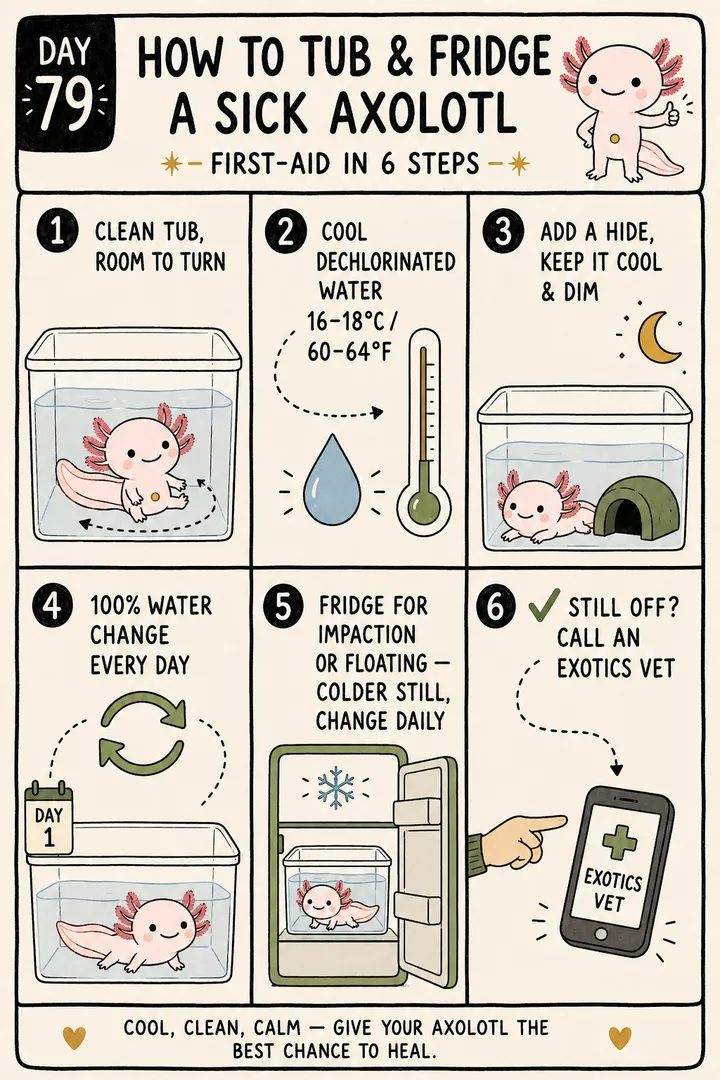
Two simple techniques handle the large majority of axolotl “what do I do right now?” moments: tubbing and fridging. Neither needs special gear, both are gentle when done right, and knowing them turns a panic into a plan. Here’s exactly how and when to use each.
🖤 Water looking off? Enter your test numbers into the free Water Interpreter — it tells you what’s safe, what’s not, and whether tubbing is the right call right now.
Tubbing: the everyday first-aid tool
What it is: temporarily housing your axolotl in a clean container of cool, dechlorinated water instead of the tank, with a 100% water change every day.
Why it works: it guarantees clean, safe water while you fix whatever’s wrong with the main tank — no filter, no cycle, no guesswork.
When to tub:
- During cycling, or any time ammonia or nitrite reads above 0 (both should always be 0).
- After a water emergency — a spike, an overheating tank, a treatment.
- Quarantine for a new axolotl before it joins an established tank.
- Minor issues like early fungus, alongside cooler, cleaner conditions.
How to tub, step by step:
- Use a clean, food-safe container big enough for the axolotl to turn around.
- Fill with cool, dechlorinated water — ideally water from the (safe) cycled tank, or fresh dechlorinated water at a similar cool temperature (16–18°C / 60–64°F).
- Add a hide or somewhere to feel secure, and keep it somewhere cool and dim.
- Do a 100% water change daily — gently move the axolotl into a fresh, same-temperature tub each day.
- Keep it up until the tank problem is resolved (e.g. the cycle finishes, or the tank tests clean).
Tubbing is genuinely low-stress and safe for long stretches when needed — many keepers tub for the whole duration of a fishless cycle.
Fridging: a stronger step, for specific problems
What it is: keeping the axolotl in a tub inside the fridge, so the cold slows its metabolism and helps it recover.
When to fridge (specific problems only):
- Impaction or constipation — the cold-plus-fast lets the gut clear.
- Persistent floating from trapped gas that won’t settle with tubbing.
- Stubborn fungus that hasn’t responded to normal tubbing and cooler water.
Fridging is not a routine measure, and because it’s used for genuine health problems, it’s best done with input from an exotics vet — especially if you’re not sure what’s wrong.
How to fridge, safely:
- Set up a tub as above, in dechlorinated water.
- Place it in the fridge at about 5–8°C (41–46°F) — cold, never freezing. Check your fridge with a thermometer.
- Do a 100% daily water change using fresh water at the same cold temperature (chill it first) so there’s no temperature shock.
- Withhold food (or offer very little) — cold slows digestion, and for impaction a short fast is the point.
- Keep it up for up to about 1–2 weeks. If there’s no improvement, it’s a vet visit, not more fridging.
- Warm it back up gradually to tank temperature when you’re done — never straight into warmer water.
Never put an axolotl in the freezer, use icy water, or change temperature suddenly.
A quick note on “tea baths”
You may see keepers mention black-tea baths (the tannins can soothe skin and help mild fungus) or salt baths for fungus. These can have a place, but they’re more involved and easy to overdo — start with clean, cool tubbing, and if a skin or fungal problem is spreading or not improving, go to a vet rather than escalating home treatments.
When to skip the home first-aid and call a vet
Tubbing and fridging buy time and fix husbandry — they don’t treat serious disease. See an exotics vet for open wounds or a “melting”/degrading look, spreading fungus, a badly swollen belly, impaction that fridging doesn’t clear, or anything that doesn’t improve. When in doubt, a vet call is never wrong.
💚 Tubbing and fridging are the axolotl equivalent of a first-aid kit: calm, simple, and enough for most scares. Keep clean dechlorinated water and a spare tub on hand, and you’ll always have a safe next step.
Go deeper: the complete Axolotl Care Guide · how to cycle an axolotl tank · Is my axolotl sick? · the free Water Interpreter.
Sources & further reading
This guide was written and fact-checked against these authorities. It’s kind, general guidance — not a substitute for an exotics vet:
- Axolotl Sanctuary (caudata.org) — Fridging Procedure — step-by-step fridging for a sick axolotl; Caudata Culture’s Caudate Illness article covers first-aid treatments like salt baths and refrigeration, and the University of Kentucky’s Ambystoma Genetic Stock Center Guide to Axolotl Husbandry covers keeping axolotls in plain bowls or tubs of cool, dechlorinated water with frequent full water changes (daily to every other day), and moving one with skin sores temporarily into a clean bowl.
- Standard aquarium water-quality science — the nitrogen cycle and why clean, cool, dechlorinated water is the basis of all of this.
- Merck Veterinary Manual — Infectious Diseases of Amphibians — fungal and bacterial infections; its Environment and Husbandry page gives the gravel rule (too large to swallow, or small enough to pass).
- Association of Reptilian & Amphibian Veterinarians (ARAV) — a find-an-exotics-vet directory.
Written and fact-checked by The Bognook Team against veterinarian-authored sources — if fridging doesn’’t resolve the problem, or your axolotl has wounds or spreading fungus, see an exotics vet.
Common questions
What does "tubbing" an axolotl mean?
Tubbing means temporarily housing your axolotl in a clean container of cool, dechlorinated water instead of the main tank, and doing a 100% water change every day. It gives the axolotl guaranteed clean water while you fix a problem — during cycling, after an ammonia or nitrite spike, for quarantine, or while treating a minor issue like early fungus. It is the single most useful first-aid tool in axolotl keeping and needs no special equipment.
When should I fridge my axolotl?
Fridging — keeping the axolotl in a tub inside the fridge — is a stronger step for specific problems: impaction or constipation, persistent floating from trapped gas, or stubborn fungus that has not responded to normal tubbing. The cold slows the animal's metabolism and can help it recover, but it is not a routine measure. Because fridging is used for genuine health problems, it is best done with input from an exotics vet, especially if you are unsure what is wrong.
How cold should the fridge be for an axolotl?
Aim for about 5 to 8C (41 to 46F) — cold but never freezing. Use a thermometer to check your fridge, keep the axolotl in dechlorinated water, and do a 100% water change every day using fresh water at the same cold temperature so the animal is not shocked by sudden temperature changes. Never put an axolotl in the freezer, and never use icy or near-freezing water.
How long can an axolotl stay fridged?
Fridging is usually done for up to about one to two weeks. If the problem it is treating (impaction, floating) has not improved in that time, the axolotl needs an exotics vet rather than more fridging. When you bring it back out, let it warm up gradually to tank temperature rather than moving it straight into warmer water.
Do I feed an axolotl while fridging it?
Little or nothing. Cold slows digestion right down, and if you are fridging for impaction or constipation, a short fast is part of the point — it lets the gut clear. For most fridging, withhold food or offer very little, and resume normal feeding gradually once the axolotl is back at tank temperature. If it refuses food for a long stretch after recovering, consult a vet.

Join the Bognook burrow
Cozy amphibian care tips, aesthetic freebies, and the occasional frog fact — straight to your inbox. No spam, just good bog vibes.
Free amphibian care cheat-sheet when you join. No spam — pinky-promise. Unsubscribe anytime. See how we handle your data in our privacy notice.