Do I Need to Cycle My Aquatic Amphibian's Tank? (Axolotls, Dwarf Frogs, Newts)
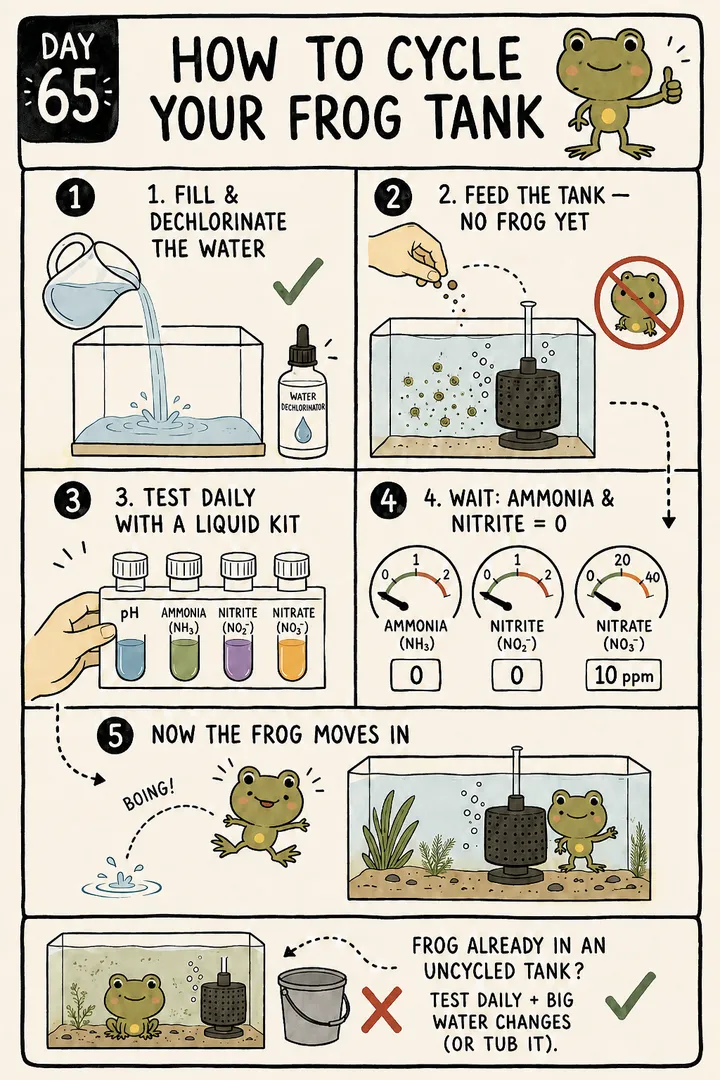
Here’s a pattern we see constantly: someone brings home an axolotl, African dwarf frog, or aquatic newt, and within days it’s off its food, lethargic, or worse — and the tank looks perfectly clean. The usual culprit isn’t visible at all. It’s the water chemistry, and the fix has a name: cycling. This is the cross-species guide to why every aquatic amphibian needs a cycled tank, and how the details differ between them.
💧 The 30-second answer: yes — every fully-aquatic amphibian needs a cycled tank. Cycling grows the bacteria that turn the animal’s toxic ammonia waste into safe nitrate, so an uncycled tank slowly poisons its occupant. The process is identical for axolotls, dwarf frogs, clawed frogs and aquatic newts — only the temperature target differs. If your animal is already in an uncycled tank, keep it safe with daily tests + big water changes (or tub it) while the tank catches up. Test with a liquid kit, keep ammonia and nitrite at 0, and always dechlorinate.
Why an invisible problem is the most dangerous one
Your animal produces waste, which becomes ammonia — and ammonia is toxic even at low levels. In a healthy tank, colonies of beneficial bacteria eat that ammonia and turn it into nitrite (also toxic), which a second bacteria turns into nitrate (much safer in small amounts, removed by water changes).
Cycling is simply growing those bacteria colonies before your animal arrives, so there’s a living filter ready to keep the water safe. No cycle means ammonia and nitrite climb invisibly until the animal is poisoned — which shows up as refusing food, lethargy, and (in axolotls) gills that start to look ragged or deteriorate. The water can look crystal clear the whole time.
For the full step-by-step fishless cycle — dosing ammonia, reading the test kit, knowing when it’s done — follow our detailed walkthrough: How to Cycle a Tank, Step by Step (written for axolotls, but the method is the same for any aquatic amphibian).
Which animals need this — and their water targets
The cycle is the same; the temperature and parameters are what change by species. Match yours:
| Aquatic amphibian | Temperature | Notes |
|---|---|---|
| 🦎 Axolotl | 16–18°C (60–64°F) — cold | Cool after cycling; warm water stresses them badly. |
| 🐟 African dwarf frog | 22–26°C (72–79°F) — tropical | Gentle filtration; they’re small and dislike strong current. |
| 🐸 African clawed frog | 18–24°C (65–75°F) — tolerates a wide range | Hardy and messy — good filtration and regular changes. |
| 🦎 Aquatic newts (e.g. Spanish ribbed, paddletail) | 16–22°C (60–72°F) — cool | No heater needed in most rooms; sustained warm water stresses newts and leaves them prone to illness. |
| 🪱 Aquatic caecilian | 26–30°C (79–86°F) — warmer than the frogs | Specialist; stable, well-filtered water — and guard the heater (they wrap around it and get burned). |
Across all of them: ammonia 0, nitrite 0, nitrate ideally under 10 ppm (keeper guides allow up to 20; never above 40), dechlorinated water, and a liquid test kit (not strips). The Water Interpreter reads your numbers and tells you what to do about them, and the Aquatic Setup planner covers the tank build for each species.
“But my animal is already in an uncycled tank!”
This happens all the time — a pet-shop impulse buy, a gift, or advice that skipped the step. Don’t panic; keep the animal safe while the tank catches up (a “fish-in” cycle):
- Test daily with a liquid kit.
- Do a large dechlorinated water change whenever ammonia or nitrite reads above 0 — this dilutes the toxin while the bacteria establish.
- Or tub the animal in a clean container with daily 100% dechlorinated water changes (the safest option for a sick axolotl — see how to tub & fridge an axolotl).
- Feed lightly to reduce waste, and don’t add more animals.
- If the animal shows poisoning signs (refusing food, lethargy, or ragged, damaged-looking gills in an axolotl), correct the water and consult an exotics vet.
An animal-in cycle is stressful and risky, which is exactly why cycling first is worth the wait.
Cycling isn’t a one-time job
A cycled tank isn’t “set and forget.” The bacteria handle ammonia and nitrite, but nitrate still accumulates — so you keep the water safe with regular partial water changes (dechlorinated, temperature-matched). And a few things can crash an established cycle:
- ❌ Rinsing the filter in tap water — chlorine kills your bacteria. Rinse in old tank water only.
- ❌ Deep-cleaning everything at once — you can wipe out the colony. Clean in stages.
- ❌ Adding a lot of new animals suddenly — waste outpaces the bacteria.
The payoff
Get this one slow, boring step right and you prevent many aquatic-amphibian health scares before they can start. A cycled, temperature-correct, regularly-changed tank is a self-cleaning safety net — the best gift you can give a water-dwelling pet.
💚 Cycling feels like a lot when you’re excited about a new animal and just want to add it — but every experienced keeper will tell you it’s the difference between a thriving aquatic pet and a mysteriously sick one. Test the water, be patient, and you’re doing it right.
Go deeper: How to cycle a tank, step by step · the Water Interpreter · the Aquatic Setup planner · Is my amphibian okay? · more real questions in the Bognook Q&A.
Sources & further reading
This guide was written and fact-checked against these authorities. It’s kind, general guidance — not a substitute for an exotics vet:
- Standard aquarium water-quality science — the nitrogen cycle (ammonia → nitrite → nitrate via nitrifying bacteria) and the fishless-cycle method.
- Agave Veterinary Care — Axolotl care sheet (an exotic animal hospital) — ammonia 0 ppm and nitrate under 10 ppm as the ideal, with 30–50% water changes based on test results. Our nitrate target (under 10 ppm) comes from this axolotl vet guidance; we use it as the safe target for every fully aquatic amphibian here, since lower nitrate harms none of them.
- Tree of Life Exotic Pet Medical Center — Axolotl care (an exotic-animal vet clinic) — ammonia and nitrite 0 ppm, nitrate under 40 ppm: the ceiling.
- Axolotl Central — Axolotl care guide (a keeper community) — nitrate between 5 and 20 ppm: the range keeper guides allow, above the under-10 level vets recommend.
- Caudata Culture — Cycling an Aquarium — ammonia and nitrite 0 in an established tank and 40 ppm as the ceiling for nitrate, and why cycling with animals in exposes them to ammonia; its axolotl caresheet and Housing FAQ cover their cool-water needs.
- Merck Veterinary Manual — Environment and Husbandry for Amphibians — water must be clean and free of chlorine, ammonia and nitrite; its Infectious Diseases page links poor water quality to infection.
- Established husbandry references (e.g. Josh’s Frogs — African dwarf frog care sheet and Josh’s Frogs — marbled newt care sheet) — species temperature targets for African dwarf frogs and newts.
Written and fact-checked by The Bognook Team against veterinarian-authored sources — if an animal in an uncycled tank looks unwell, correct the water and see an exotics vet.
Common questions
Do all aquatic amphibians need a cycled tank?
Yes. Axolotls, African dwarf frogs, African clawed frogs, aquatic newts and aquatic caecilians all live in water full-time, so they all need a tank that has been through the nitrogen cycle before they move in. Cycling grows the beneficial bacteria that convert the animal's toxic ammonia waste into far safer nitrate. Without it, ammonia and nitrite build up and poison the animal.
What does cycling a tank actually mean?
Your animal produces waste that becomes ammonia, which is toxic. Cycling grows two colonies of beneficial bacteria (in the filter and surfaces) that turn ammonia into nitrite, then nitrite into much less harmful nitrate, which you remove with water changes. A fishless cycle grows those colonies before the animal arrives so the water stays safe from day one. It usually takes about 4 to 8 weeks, or 1 to 2 weeks if you seed the tank from an established one.
My aquatic amphibian is already in an uncycled tank — what do I do?
Keep it safe while the tank catches up. Test the water daily with a liquid kit and do large dechlorinated water changes whenever ammonia or nitrite rises above 0, or move the animal to a clean tub with daily 100% water changes while the main tank cycles. Do not add more animals, feed lightly to reduce waste, and never rinse the filter in tap water. If the animal shows ammonia-poisoning signs (refusing food, lethargy, or ragged, damaged-looking gills in an axolotl), correct the water and consult an exotics vet.
Is the cycle the same for an axolotl as for a dwarf frog?
The nitrogen cycle itself is identical — the difference is temperature. Axolotls need cold water (16 to 18C), so cool the tank after cycling. African dwarf and clawed frogs are tropical and want 22 to 26C. Aquatic newts want cool water, roughly 16 to 22C and never warm. The bacteria establish faster in warmth, so many keepers cycle at room temperature and then adjust to the species' target before the animal goes in.
What should the water read for an aquatic amphibian?
Ammonia 0 and nitrite 0 at all times — any reading above 0 is harmful. Nitrate should stay low (ideally under 10 ppm, the level vets recommend; keeper guides allow up to 20; never above 40), controlled by regular partial water changes. Use a liquid test kit rather than strips, always dechlorinate tap water before it touches the animal, and match the temperature to the species. Bad water quality can kill aquatic amphibians, so testing is not optional.

Join the Bognook burrow
Cozy amphibian care tips, aesthetic freebies, and the occasional frog fact — straight to your inbox. No spam, just good bog vibes.
Free amphibian care cheat-sheet when you join. No spam — pinky-promise. Unsubscribe anytime. See how we handle your data in our privacy notice.