Help! My Kid Wants a Frog for Their Birthday — Which One?
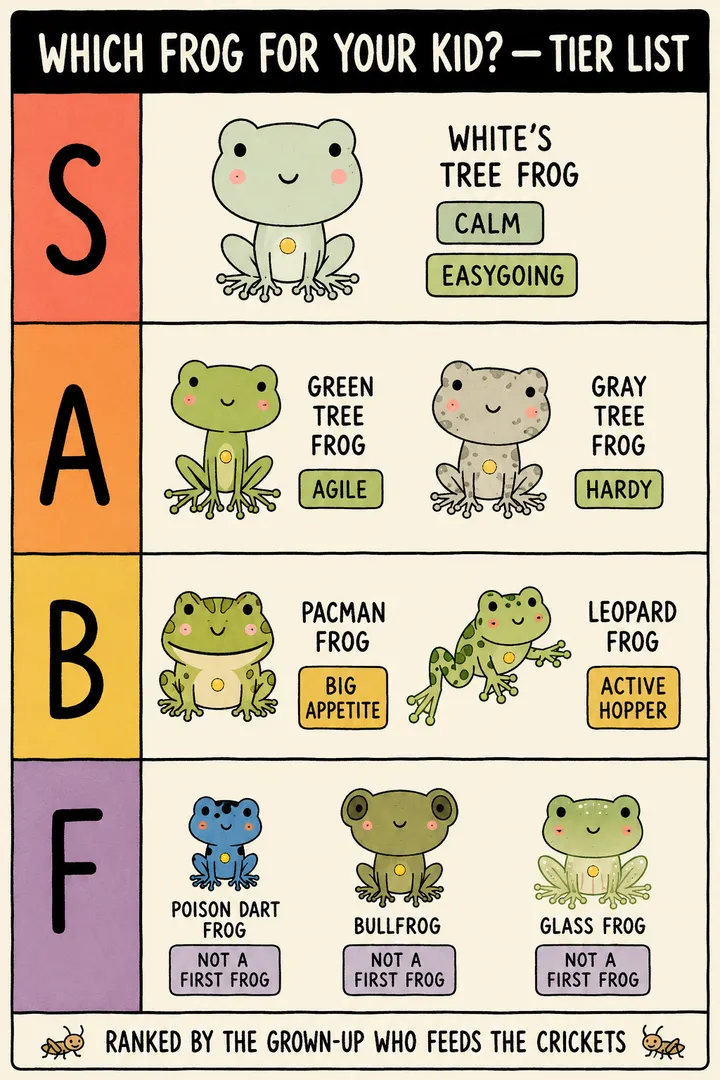
So your child has decided, with total certainty, that they need a frog. Before you say yes (or no), here’s an honest, no-pressure guide to what you’d actually be signing up for — and which frog makes the happiest first pet for a family.
🐸 Weighing it up? Our honest best beginner amphibian and which amphibian is right for you? guides compare the options in plain language.
🔧 Still deciding? Weigh the options side by side in the free species compare tool.
First, the honest bit
Frogs make genuinely lovely family pets — fascinating, characterful, and lower-fuss than a dog. But three things are worth knowing before the birthday:
- They’re for watching, not holding. Frogs are display animals with delicate, absorbent skin. A child hoping to carry a pet around will be disappointed; a child who loves watching an animal will be enchanted.
- They eat live bugs. Crickets or roaches, forever. If that’s a dealbreaker in your house, a frog isn’t the pet.
- They live a long time. Many frogs live 10–20+ years — this is not a one-summer commitment.
And the honest truth every reptile-keeper knows: the parent ends up backstopping the care. A child can absolutely help — feeding, misting, learning — but an adult needs to own the temperature, humidity, and consistency the frog’s health depends on.
The best first frogs for a family
- White’s tree frog — the top pick. Chunky, calm, hardy, forgiving, long-lived, and the most tolerant of brief, gentle, occasional handling. The “dumpy” charm kids love.
- American green tree frog — small, hardy, inexpensive, and native to the US. A lovely, low-cost starter (a touch more skittish than White’s).
- A pet toad — hardy, undramatic, cheap, long-lived, and happy at room temperature. Underrated as a kid’s first amphibian.
The ones to save for later
- Poison dart frogs — beautiful, but a costly, precise bioactive setup. (They’re non-toxic when captive-bred, but still not a starter.)
- Red-eyed tree frogs — stunning and advanced: humidity with strong airflow, never above 80°F, easily stressed.
- African bullfrogs — get huge and bite hard.
- Axolotls — charming and popular, but they need chilled water year-round — a bigger commitment than they appear.
A gentle way to say yes
If you go for it, frame it as a shared project: the child helps feed and learn, you own the setup and the safety net. Build the tank before the birthday so it’s cycled/ready, and lean on a hardy species that forgives the learning curve. Done that way, a first frog can be a brilliant, years-long window into the natural world for a curious kid.
💚 There’s no wrong answer here — only a good match between a species, your child’s expectations, and your family’s willingness to feed bugs for a decade. Start hardy, share the care, and enjoy watching something genuinely wild up close.
Go deeper: the best beginner amphibian, compared · which amphibian is right for you? · White’s tree frog care · toad care basics.
Common questions
What is the best pet frog for a child?
The White's tree frog is usually the best first frog for a family — it is chunky, calm, hardy, forgiving of small mistakes, long-lived, and tolerates brief, occasional gentle handling better than most frogs. American green tree frogs and hardy pet toads are also good, low-cost choices. Whichever you pick, an adult keeps the routine care, because all frogs need live insects, precise conditions, and are watch-not-hold animals.
Are frogs good pets for kids?
They can be wonderful, but with realistic expectations. Frogs are fascinating to watch and lower-maintenance than a dog, but they are not cuddly — they are display animals that dislike handling, they need live feeder insects, and many live 10 to 20+ years. They suit a child who loves watching and learning about an animal more than one who wants to hold and carry a pet around.
Which frogs should a beginner or child avoid?
Skip the delicate or demanding species as a first pet: poison dart frogs (a costly, precise bioactive setup), red-eyed tree frogs (humid but well-ventilated, heat-sensitive, easily stressed), and African bullfrogs (they get huge and have a powerful bite). Axolotls are popular and charming but need chilled water year-round, so they are a bigger commitment than they look. Start with a hardy, forgiving species instead.
Who should look after a child's frog?
A parent should own the core care, with the child helping. Frogs need consistent temperature and humidity, live feeders, clean water, and years of commitment — more than most children can reliably manage alone. Framing it as a shared project the adult ultimately backstops keeps the frog healthy and keeps it from becoming a forgotten chore.

Join the Bognook burrow
Cozy amphibian care tips, aesthetic freebies, and the occasional frog fact — straight to your inbox. No spam, just good bog vibes.
Free amphibian care cheat-sheet when you join. No spam — pinky-promise. Unsubscribe anytime. See how we handle your data in our privacy notice.