Axolotl Substrate: Sand vs Bare-Bottom vs Bioactive (and Why Not Gravel)
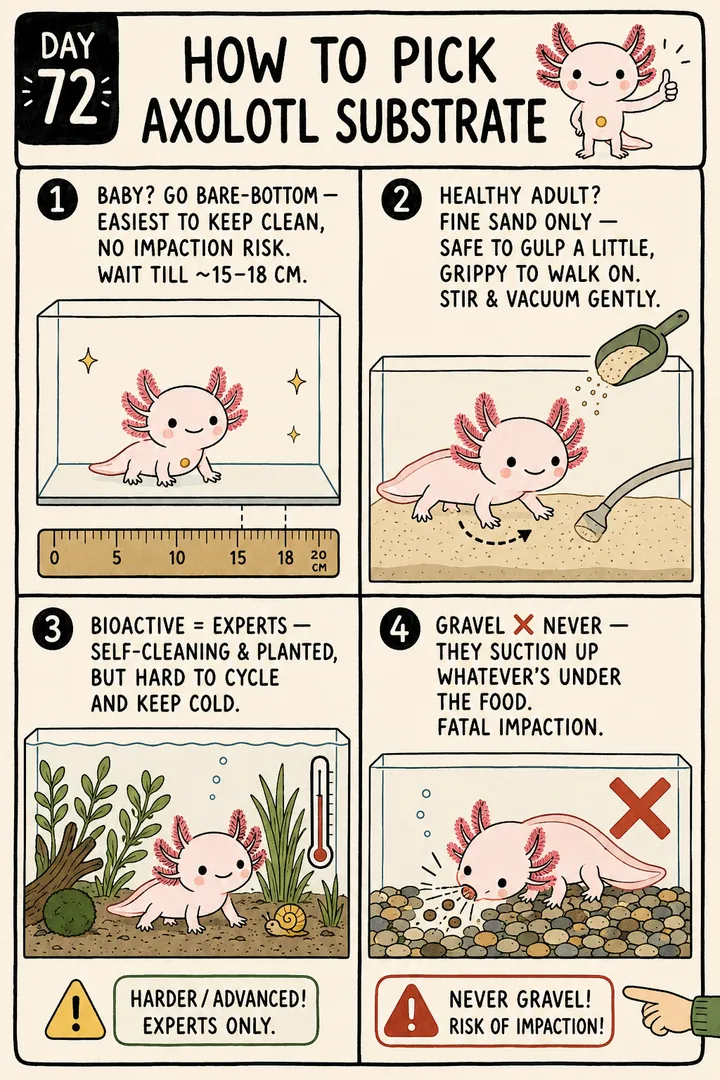
Substrate is a genuine welfare decision for axolotls, and it’s simpler than the debates suggest. Here are your three safe options — and the one to never use.
🔧 Planning the tank? Build your list with the free aquatic setup planner so nothing essential gets missed.
The comparison
| Option | Best for | Pros | Cons |
|---|---|---|---|
| Bare-bottom | Juveniles · quarantine · sick axolotls | Easiest to keep spotless; zero impaction risk; cheap | Less natural; can be slippery; shows waste (which is also handy) |
| Fine sand | Healthy adults · display tanks | Safe to swallow in small amounts; lets them grip & walk; natural look | Needs gentle stirring/vacuuming; must be fine grain |
| Bioactive | Experienced keepers | Self-cleaning cleanup crew; natural, planted | Advanced; harder to cycle & keep cold; not beginner-friendly |
| Gravel ❌ | Never | — | Fatal impaction risk — do not use |
Why gravel is a hard no
Axolotls hunt by suction and routinely swallow whatever sits under their food. Gravel is just big enough to lodge in the gut and cause an impaction that can be fatal — and many axolotls will swallow small stones if given the chance. This isn’t caution; it’s the single clearest rule in axolotl keeping.
How to choose
- Getting a young axolotl? Start bare-bottom until it’s ~15–18 cm. Easiest to keep clean while it grows, and no substrate risk at the size when they’re clumsiest.
- Healthy adult, display tank? Fine sand is the sweet spot — natural, lets them grip (bare glass can stress them), and safe in the small amounts they’ll swallow.
- Experienced and want a planted, self-cleaning tank? Bioactive can be beautiful — but master standard care first; it’s harder to keep cold and stable.
If you use sand
Use genuinely fine sand (fine aquarium sand or washed play sand), keep the layer shallow, and gently stir/vacuum it during water changes so waste doesn’t build up underneath.
💚 The substrate question causes a lot of beginner anxiety, but the answer is refreshingly clear: bare-bottom while they’re small, fine sand when they’re grown, never gravel. Get that right and you’ve dodged a serious, avoidable axolotl risk.
Go deeper: the complete Axolotl Care Guide · how to cycle a tank · the printable care sheet.
Sources & further reading
This guide was written and fact-checked against these authorities. It’s kind, general guidance — not a substitute for an exotics vet:
- Caudata Culture — Aquarium Substrates — axolotl substrate guidance: why a bare bottom is safest (a common choice for young larvae) and why gravel should never be used; its axolotl care sheet backs sand as the safe alternative.
- Merck Veterinary Manual — Environment and Husbandry for Amphibians — gravel should be either too large to swallow or small enough to pass in the feces.
- LafeberVet — Basic Information Sheet: Axolotl (vet-reviewed) — many axolotls swallow small stones, and gravel blockages can cause serious illness, including death.
- Association of Reptilian & Amphibian Veterinarians (ARAV) — a find-an-exotics-vet directory.
Written and fact-checked by The Bognook Team against veterinarian-authored sources — a bloated axolotl that has swallowed gravel needs an exotics vet.
Common questions
What is the best substrate for an axolotl?
Fine sand is the best all-round substrate for adult axolotls: it is safe to swallow in small amounts, lets them grip and walk, and looks natural. Bare-bottom is best for juveniles, quarantine, or sick axolotls because it is the easiest to keep clean. Gravel is never safe.
Is sand safe for axolotls?
Yes, fine aquarium or play sand is safe for axolotls over about 15 to 18cm long. Grains are small enough to pass harmlessly if swallowed, unlike gravel. Very young axolotls are better on a bare bottom until they grow, since even sand can cause issues in tiny ones.
Why can't axolotls have gravel?
Axolotls feed by suction and often swallow whatever is under their food. Gravel pieces can lodge in the gut and cause an impaction (blockage) that can be fatal. Use bare-bottom or fine sand instead.
Can axolotls have a bioactive tank?
Yes, an axolotl bioactive setup is possible but advanced. It uses fine sand over a soil or clay layer with live plants and a cold-tolerant cleanup crew. It is harder to cycle and maintain and is not recommended for beginners, who are better served by fine sand or bare-bottom.
Bare-bottom or sand for an axolotl?
Choose bare-bottom for juveniles, quarantine, or an unwell axolotl because it is easiest to keep spotless. Choose fine sand for a healthy adult in a display tank because it is more natural and lets them grip. Both are safe; gravel is not.

Join the Bognook burrow
Cozy amphibian care tips, aesthetic freebies, and the occasional frog fact — straight to your inbox. No spam, just good bog vibes.
Free amphibian care cheat-sheet when you join. No spam — pinky-promise. Unsubscribe anytime. See how we handle your data in our privacy notice.