How to Build a Wildlife Pond for Frogs (Step-by-Step)
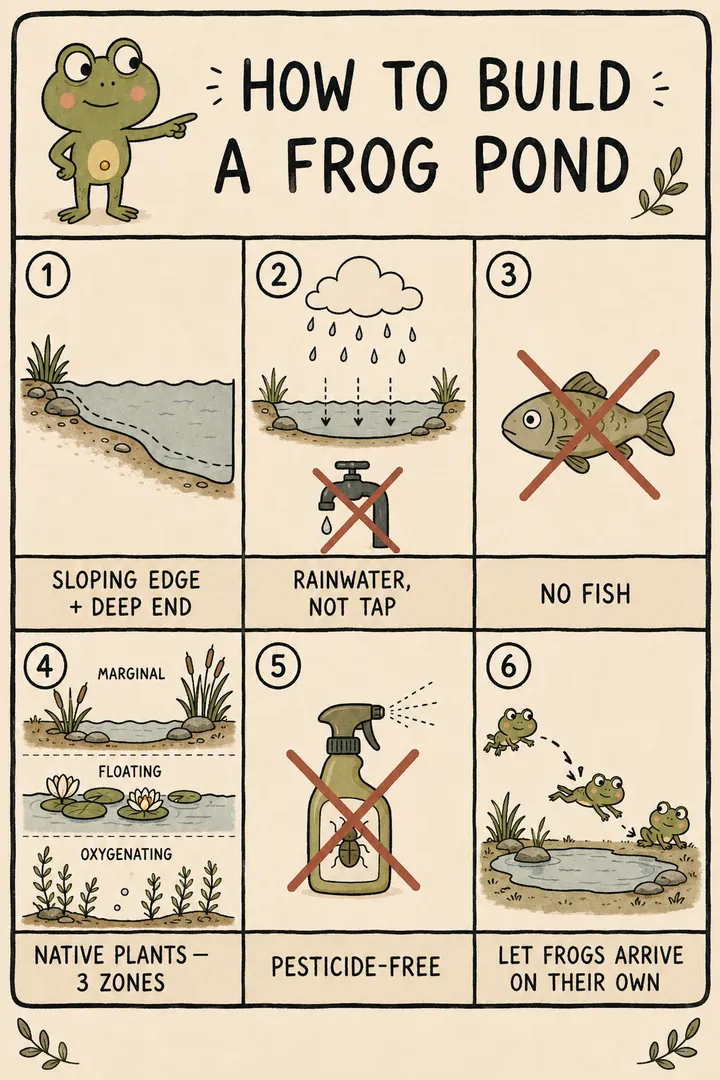
Ask any amphibian conservationist for the single most powerful thing an ordinary person can do, and the answer is almost always the same: build a pond. A small, fish-free wildlife pond is a lifeline for local frogs, toads, and newts — and it’s far easier and cheaper than most people think. You don’t need a digger, a pump, or a big garden. You need a hole, a liner, some native plants, and a little patience.
Here’s how to do it right.
The 30-second version
- No fish. Fish eat eggs and tadpoles — a frog pond is fish-free.
- Sloping edges. At least one gentle “beach” so animals can climb in and out.
- Varied depth. Shallow shelves plus a deeper area (~60cm/2ft).
- Native plants, in three zones (submerged, floating, marginal).
- Rainwater where possible — tap water feeds algae.
- Let it colonise naturally — don’t move frogspawn from other ponds.
Before you dig: the golden rules
Get these right and the rest is just digging:
- Never add fish. This is the big one. Fish and breeding amphibians don’t mix.
- Always include a shallow, sloping exit. Steep, walled ponds trap and drown wildlife (and hedgehogs). A gently sloping “beach” edge is non-negotiable.
- Use native plants, and never invasive non-natives (like New Zealand pygmyweed) — they escape and choke waterways.
- Don’t move spawn or tadpoles between ponds — it spreads disease. Let frogs arrive on their own.
- Keep it pesticide-free. The whole point is a healthy little ecosystem.
Step 1 — Pick the spot
- Partial sun. Some sun warms the water for tadpoles and helps plants; some shade stops it overheating and going green. Dappled or half-and-half is ideal.
- Away from heavy leaf-fall. A pond right under a deciduous tree fills with rotting leaves each autumn.
- Level ground, away from where rainwater runoff (carrying fertiliser or road pollution) would drain in.
Step 2 — Decide size and shape
- Any size helps — bigger ponds are more stable, but even a small one is valuable.
- Vary the depth: shallow shelves around the edges (great for tadpoles and marginal plants) and a deeper zone of about 60cm (2ft) in the middle so part of the pond stays cool in summer and doesn’t freeze solid in winter.
- Give it at least one long, gently sloping edge — the “beach.” This is the most important shape feature.
Step 3 — Dig and line
- Dig your shape with the depth shelves and the sloping beach edge built in.
- Remove sharp stones and roots, then lay an underlay (pond underlay, old carpet, or a thick layer of sand) to protect the liner.
- Fit a flexible pond liner (EPDM/butyl lasts longest), letting it settle into the contours. A preformed rigid liner or a container also works for small ponds.
- Trim the liner, leaving an overlap, and hide the edges under soil, turf, or stones.
Step 4 — Fill it
- Use rainwater if you can (from a water butt). Tap water is full of chlorine and nutrients that trigger algae blooms.
- If you must use tap water, let the pond stand for a few days to a week before adding plants, so the chlorine gasses off.
- Don’t line the bottom with rich garden soil — it feeds algae. Washed gravel or planting baskets are better.
Step 5 — Plant it (three zones)
Native plants do the work of oxygenating, shading, and providing cover:
- Submerged oxygenators (e.g. hornwort, water starwort) — keep the water healthy and give tadpoles cover.
- Floating plants (e.g. frogbit, a small native water lily) — shade the surface and fight algae.
- Marginal/emergent plants at the edges (e.g. marsh marigold, native rushes, flag iris) — cover for froglets leaving the water, and a ladder for emerging insects.
Buy from a reputable native-plant supplier, and rinse off any pond snails or hitchhikers you don’t want.
Step 6 — Make the edges wildlife-friendly
The land around the pond matters as much as the water:
- Pile up logs and rocks nearby for shelter, hunting, and winter hibernation.
- Let a patch of grass grow long at one edge.
- Make sure there’s an easy route from the pond into that cover, so froglets aren’t crossing bare, exposed ground.
Step 7 — Wait, and let it colonise
This is the hardest step: do nothing. Resist importing spawn. Frogs, toads, newts, dragonflies, water beetles, and pond snails will find a good pond surprisingly fast — often within weeks for insects, and a season or two for breeding amphibians. A pond that colonises naturally is healthier and disease-free.
No garden? Build a container pond
No lawn, no problem. A watertight tub, half-barrel, old butler sink, or large planter on a patio or balcony makes a genuine mini-habitat:
- Add bricks or stacked stones inside to create shallow ledges and, crucially, an exit ramp so anything that falls in can climb out.
- Plant one or two small native aquatics.
- Fill with rainwater, add no fish, and set it somewhere with part sun.
A little maintenance
Wildlife ponds are famously low-effort:
- Top up with rainwater in dry spells.
- Thin out excess blanketweed or overgrown plants (leave what you remove by the edge for a day so creatures can crawl back).
- Net or scoop autumn leaves so they don’t rot in the water.
- Otherwise — leave a wild corner and let it be.
What you’ll get
Within a year, a well-made pond becomes one of the liveliest spots in any garden: frogs and toads breeding in spring, newts hunting in the shallows, dragonflies and damselflies emerging, water beetles, pond skaters, and visiting birds coming to drink. You’ve built a genuine piece of amphibian conservation, right outside your door.
💚 A pond is the rare bit of conservation you can actually watch working. Dig it this season, plant it, and by next spring you may well have frogspawn — the froggiest sign of success there is.
Go deeper: a toad lives in my garden — how do I help it thrive? · why amphibians are disappearing (and how to help) · always buy captive-bred, never wild · free keeper tools & printables.
Common questions
Do I need fish in a wildlife pond?
No — a wildlife pond for frogs should be completely fish-free. Fish eat frog, toad, and newt eggs and tadpoles, and they compete for the same food, so a pond with fish will rarely support breeding amphibians. If you want frogs, skip the fish entirely; the pond will still fill with fascinating life like dragonflies, water beetles, and pond snails.
How deep should a wildlife pond be?
Aim for varied depth. Include shallow shelves and at least one gently sloping "beach" edge for animals to climb in and out, plus a deeper central area of around 60cm (2ft) so part of the pond stays cool in summer and does not freeze solid in winter. Varied depths suit the widest range of wildlife, from tadpoles in the warm shallows to creatures sheltering in the deep.
Should I add frogspawn to my new pond?
No. It is best to let frogs find the pond and lay their own spawn, which usually happens within a season or two. Moving spawn or tadpoles from another pond can spread diseases like chytrid and invasive plants, and in some places it is illegal. Build the pond well and be patient — the frogs will come.
How do I attract frogs to my pond?
Build it frog-friendly and they will find it on their own: keep it fish-free, give it a gently sloping edge so they can get in and out, plant native marginal and oxygenating plants for cover, and add log or rock piles and long grass nearby for shelter and hibernation. Avoid pesticides in the garden. Frogs travel surprisingly far to find good new breeding sites.
Can I make a wildlife pond without a garden?
Yes. A container pond — a watertight tub, half-barrel, or old sink on a patio or balcony — makes a real wildlife haven. Add bricks or stones inside to create shallow ledges and an exit ramp so creatures can climb out, plant a couple of small native aquatic plants, fill it with rainwater, and leave out the fish. Even a small container pond attracts insects and can support amphibians.

Join the Bognook burrow
Cozy amphibian care tips, aesthetic freebies, and the occasional frog fact — straight to your inbox. No spam, just good bog vibes.
Free amphibian care cheat-sheet when you join. No spam — pinky-promise. Unsubscribe anytime. See how we handle your data in our privacy notice.