Axolotl Tank Setup: The Beginner's Cold-Water Checklist
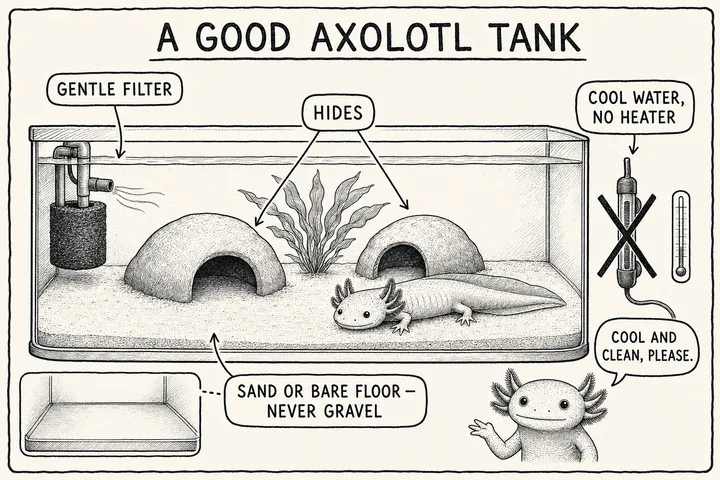
Axolotls are hardy, endlessly charming, and — despite the “starter pet” reputation — genuinely easy to get wrong if you set the tank up like a tropical fish tank. Here’s the short, honest checklist.
🔧 Planning the tank? Build your list with the free aquatic setup planner so nothing essential gets missed.
The non-negotiables
- Tank size: 20 gallons long for one adult. They’re messy; more water = more stable.
- Temperature: 16–18°C (60–64°F). Axolotls are cold-water animals. Above about 22–24°C they get stressed and sick. No heater — and in summer you may need a fan or chiller.
- Cycled tank: Never add an axolotl to a brand-new tank. Cycle it first (build up beneficial bacteria) so ammonia stays at zero. Skipping it lets ammonia build up to levels that can kill.
- Flooring: Bare bottom or fine sand only. Gravel is the classic mistake — axolotls gulp it and get fatal impactions.
- Gentle filtration: Strong currents exhaust them. A sponge filter or baffled flow is ideal.
Weekly rhythm
Test the water (ammonia, nitrite, nitrate). Do a 20–30% water change. Watch the gills — full and feathery is a good sign; held curled forward can mean stress (strong filter flow is one known cause).
The mindset
Get the water right and an axolotl will thrive for 10–15 years. Most “axolotl problems” are really water problems. Nail cycling and temperature, and the rest is easy.
New to the hobby? Grab our free axolotl + frog care cheat-sheet below — the whole checklist on one printable page.
Sources & further reading
This checklist was written and fact-checked against these authorities. It’s kind, general guidance — not a substitute for an exotics vet:
- Caudata Culture — Axolotl care sheet — axolotl tank size, cold-water needs, gentle filtration, and safe substrate.
- LafeberVet — Axolotl basic information sheet — keep the water below 24°C (75°F); warmer water can cause overheating, appetite loss and infections.
- Standard aquarium water-quality science — the nitrogen cycle behind “cycle before the axolotl.”
- Merck Veterinary Manual — Environment and Husbandry for Amphibians — the gravel rule (too large to swallow, or small enough to pass) and water quality (ammonia, nitrite).
Written and fact-checked by The Bognook Team against veterinarian-authored sources — if your axolotl seems unwell, see an exotics vet.
📚 More axolotls guides
- Axolotl Myths That Can Hurt Your Axolotl (With the Honest Facts)
- Axolotl vs Tiger Salamander: Will My Axolotl Turn Into a Salamander?
- What an Axolotl Setup Really Costs in 2026 (Full Breakdown)
- Axolotl Substrate: Sand vs Bare-Bottom vs Bioactive (and Why Not Gravel)
- Is Room-Temperature Water Fine for Axolotls? Fact-Checked
- Axolotl Morphs Explained: Leucistic, Albino, Melanoid, GFP & More
🎓 Ready to go deeper?
Past the basics — same plain voice, no ceiling:

Join the Bognook burrow
Cozy amphibian care tips, aesthetic freebies, and the occasional frog fact — straight to your inbox. No spam, just good bog vibes.
Free amphibian care cheat-sheet when you join. No spam — pinky-promise. Unsubscribe anytime. See how we handle your data in our privacy notice.