Axolotl Myths That Can Hurt Your Axolotl (With the Honest Facts)
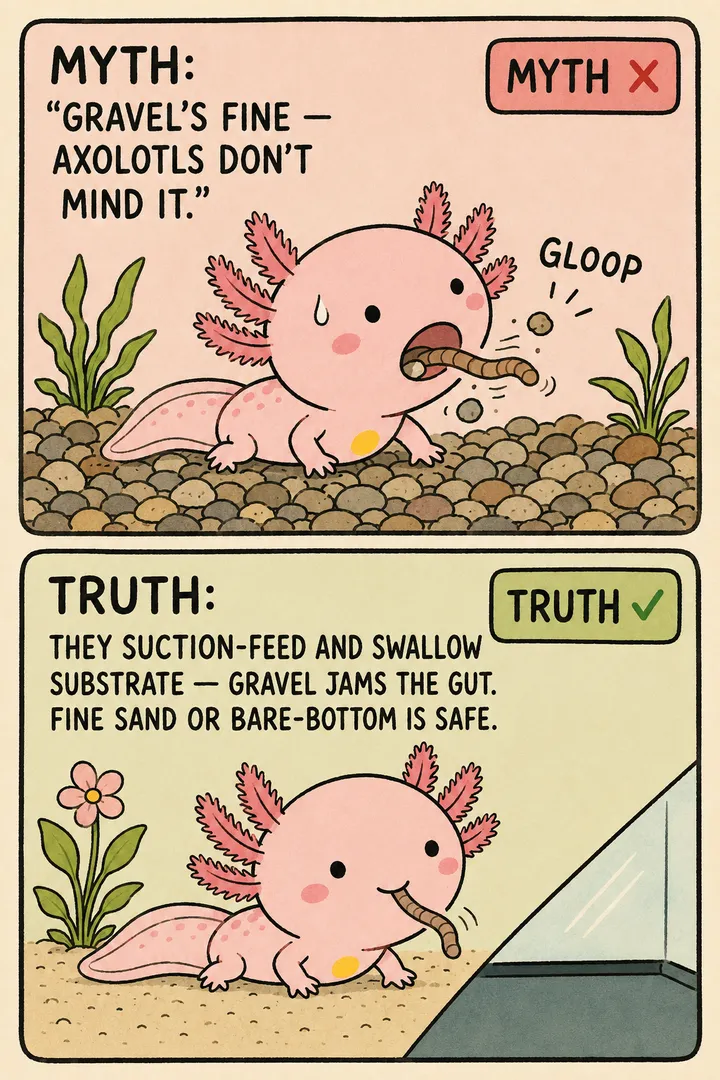
🔍 Fact check
“Gravel is a safe substrate for an axolotl tank.” — A common belief among new keepers
Verdict: False
Axolotls feed by suction and swallow substrate along with their food. Gravel is small enough to be ingested but too big to pass, making it a serious impaction and gut-blockage risk. Fine sand or a bare bottom is the safe choice.
The evidence:
- Axolotl care references consistently warn against gravel because axolotls hoover up food — and nearby substrate — by suction and cannot pass swallowed gravel, leading to impaction.
- Fine aquarium sand (which passes through the gut) or a bare-bottom tank are the widely recommended safe substrates for axolotls.
- Our own substrate guide and fact-checked care sheet specify sand or bare-bottom and flag gravel as an impaction hazard.
Axolotls are having a moment — which means a lot of new keepers arrive with advice from pet shops, old care sheets, and, honestly, a video game. Most of these myths aren’t anyone’s fault; they’re just repeated everywhere. But several of them can genuinely harm your axolotl. So here’s the honest list: the myths that do damage, each paired with the fact and where to read more. No shame — just what’s true.
🐸 The 30-second version: the myths that actually hurt axolotls are “room temperature is fine,” “a bowl/small tank is enough,” “you don’t need to cycle,” “gravel is okay,” “they live with fish,” “you can play with them,” “there’s a blue axolotl,” and “they regenerate so injuries don’t matter.” The through-line: axolotls need cold, clean, cycled, spacious, low-stress water — and most myths quietly take one of those away.
This gathers the corrections our care guides make into one extractable place; each myth links to the full detail.
❌ Myth 1: “Room temperature (or a heater) is fine”
✅ Truth: Warm water can kill an axolotl. Axolotls need cold water, ~16–18°C (60–64°F), and no heater — ever. Warm water stresses them and causes appetite loss and fungal infections. If your room runs warm, you need a cooling plan (a fan over the surface, or a chiller), not warmth. → Full detail: the room-temperature fact-check.
❌ Myth 2: “An axolotl can live in a bowl or a small tank”
✅ Truth: Axolotls need space and stable water — a rough minimum of a 20-gallon long for one, with more for each additional axolotl. A bowl or tiny tank can’t hold stable temperature or water quality, and small volumes foul fast. Floor space matters more than height for these bottom-dwellers.
❌ Myth 3: “You don’t need to cycle the tank first”
✅ Truth: You must cycle the tank before an axolotl goes in. An uncycled tank lets ammonia build up and chemically burn your axolotl — which can leave a new pet mysteriously sick. Cycle first, test your water, and keep it pristine. → how to cycle an axolotl tank and the water interpreter.
❌ Myth 4: “Gravel is a fine substrate”
✅ Truth: Gravel is a serious impaction risk. Axolotls feed by suction and swallow substrate with their food — gravel is big enough to be eaten but too big to pass. Use fine sand (which passes through) or a bare bottom. → substrate: sand vs bare vs bioactive.
❌ Myth 5: “Axolotls and fish get along”
✅ Truth: Never keep an axolotl with fish. The axolotl eats small fish (choking/impaction risk); fish nip its delicate gills; and the temperatures don’t match. The friendly axolotl-and-fish scene is Minecraft, not care advice. → can axolotls live together — and with fish?.
❌ Myth 6: “Two axolotls will keep each other company”
✅ Truth: Axolotls are fine alone and don’t need company. Two can cohabit only if they’re similar-sized, well-fed adults with space — and juveniles are cannibalistic, biting each other’s gills and limbs. Never mix sizes, and watch closely. One axolotl per tank is the safe default. → cohabitation & tankmates.
❌ Myth 7: “You can handle and play with your axolotl”
✅ Truth: Axolotls are aquatic and delicate — their bodies are largely soft cartilage and their skin is fragile, so they should stay in the water and be handled only when genuinely necessary (and then gently, with wet clean hands). You can’t “play” with an axolotl like a puppy; enjoy it as a fascinating tank pet, not a handling one.
❌ Myth 8: “There’s a blue axolotl you can buy”
✅ Truth: There is no naturally blue pet axolotl — that’s a Minecraft creature. Real colours are wild type, leucistic, albino, melanoid, axanthic and copper (plus GFP lines), and all need identical care. A “blue axolotl” for sale is a red flag — “blue” is a sales description, not a morph. → morphs explained: axolotl morphs; and why chasing novelty colours goes wrong: breeding axolotls responsibly.
❌ Myth 9: “They regenerate everything, so injuries don’t matter”
✅ Truth: Axolotls are astonishing regenerators — but a wound can still become infected (especially in warm or dirty water), and regeneration slows or fails in a stressed, poorly-kept animal. So it’s a reason to keep the water cold and pristine while it heals, not a reason to be careless. Spreading fungus or a serious wound still needs a vet. → the science + practicalities: how axolotl regeneration works.
❌ Myth 10: “Feeder fish are a good staple diet”
✅ Truth: Feeder fish are a poor, risky staple — they can carry parasites and disease, and some contain thiaminase (which destroys vitamin B1). Feed a staple of earthworms/nightcrawlers, with bloodworms and appropriate pellets — not a bowl of feeder fish.
The pattern underneath the myths
Look at what each myth removes: cold water, space, a cycle, safe substrate, solitude, clean healing conditions. Nearly every axolotl myth nudges you toward a warmer, smaller, dirtier, more crowded tank than your axolotl can cope with. The fix is simply the opposite — cold, clean, cycled, roomy, calm — and a keeper who cares enough to get the boring parts right. Believed a few of these? So did most of us. Updating once you know is exactly what a good keeper does.
💚 If you came in believing a couple of these — thanks to a shop, a care sheet, or a game — you’re in good company, and your axolotl doesn’t hold it against you. Swap the myths for the facts above and give your little guy the cold, clean, calm life it’s built for. Start with the complete Axolotl Care Guide.
Go deeper: room-temperature fact-check · how to cycle a tank · safe substrate · tankmates & cohabitation · regeneration explained · the most common amphibian-keeping mistakes, ranked.
Sources & further reading
This guide was written and fact-checked against these authorities. It’s honest general guidance — not a diagnosis:
- Axolotl-keeping and aquarist consensus (cold water, cycling, sand-not-gravel, no fish tankmates, minimal handling, feeder-fish risks) — long-established across the axolotl community; named here in plain text.
- Caudata Culture — Axolotl care sheet — husbandry, water temperature, substrate and keeping axolotls together for Ambystoma mexicanum; its Fish with Caudates article covers why fish don’t belong with axolotls.
- Our own fact-checked care sheet, room-temperature fact-check, and substrate guide.
Written and fact-checked by The Bognook Team against veterinarian-authored sources — if your axolotl has forward-curling gills, has stopped eating, is floating, or has open wounds or spreading fungus, check the water temperature, water quality and filter flow first and see an exotics vet.
Common questions
Can axolotls live at room temperature?
Usually no, and it's a dangerous myth. Axolotls need cold water, ideally around 16–18°C (60–64°F), and they must never be kept with an aquarium heater. Warm water stresses them and leads to loss of appetite and fungal infections. If your room gets warmer than the high teens, you need a cooling plan (a fan over the surface, or an aquarium chiller), not a heater.
Is gravel safe for an axolotl?
No. Axolotls feed by suction and will swallow substrate along with their food, and gravel is exactly the wrong size — big enough to be eaten but too big to pass — so it's a serious impaction and gut-blockage risk. Use fine aquarium sand (which passes through the gut) or a bare-bottom tank. It's an easily avoidable cause of a sick axolotl.
Can axolotls live with fish?
No — never keep an axolotl with fish. The axolotl will try to eat small fish (and can choke or become impacted), while fish like goldfish nip at an axolotl's delicate feathery gills, and the temperatures don't match. The axolotls-and-fish pairing people picture is from Minecraft, not real care. An axolotl tank is a single-species tank.
Is there really a blue axolotl?
No — there is no naturally blue pet axolotl. The blue axolotl is a Minecraft creature, not a real colour morph you can buy. Real axolotl colours include wild type, leucistic, albino, melanoid, axanthic and copper (plus GFP lines) — all of which need identical care. If a seller advertises a 'blue axolotl', treat it as a red flag — 'blue' is a sales description, not a morph — and never chase a colour that doesn't exist.
Axolotls regenerate, so do injuries really matter?
They matter. Axolotls are remarkable regenerators and a healthy one often regrows a lost limb or gill — but a wound can still become infected, especially in warm or dirty water, and regeneration slows or fails in a stressed or poorly-kept animal. So regeneration is a reason to keep the water pristine and cold while it heals, not a reason to be careless. Serious wounds, or fungus that spreads, still need an exotics vet.

Join the Bognook burrow
Cozy amphibian care tips, aesthetic freebies, and the occasional frog fact — straight to your inbox. No spam, just good bog vibes.
Free amphibian care cheat-sheet when you join. No spam — pinky-promise. Unsubscribe anytime. See how we handle your data in our privacy notice.