Axolotl Morphs Explained: Leucistic, Albino, Melanoid, GFP & More
🔍 Fact check
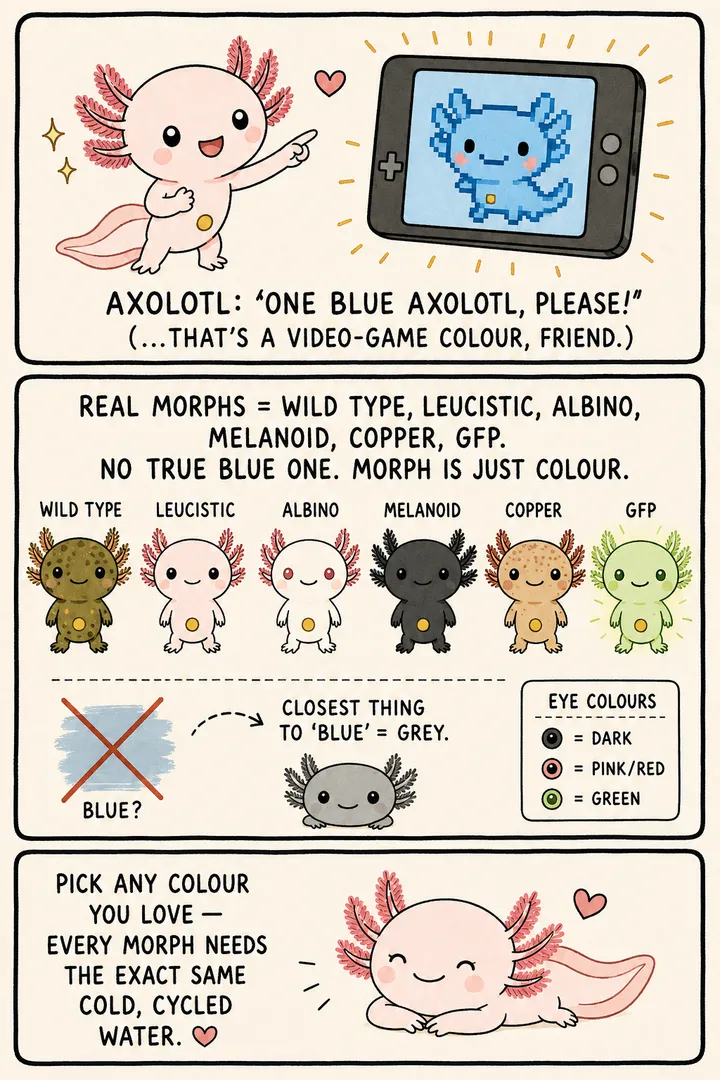
“There is a blue axolotl morph.” — A common belief, often from video games
Verdict: False
"Morph" just means an axolotl's colour and pattern — and the recognised colour mutants are white (leucistic), melanoid, albino (white or golden) and axanthic, alongside the wild type; the pet trade adds copper and GFP (glow) lines, and hobbyists name rare patterns like piebald, lavender and mosaic. None of them is blue: the "blue axolotl" is a video-game colour, not a real animal. Whatever the morph, the care is identical.
The evidence:
- The recognised colour mutants are pigment variants — none is blue. Research recognises four single-gene colour mutants (white, melanoid, albino and axanthic); the pet trade adds copper and transgenic (GFP) lines, and there is no blue one (Scientific Reports, 2024). Hobby names like piebald, lavender and mosaic describe rare patterns rather than recognised mutants.
- "Blue axolotl" is a video-game colour. The blue axolotl popularised by Minecraft has no real-world counterpart — it is the one Minecraft axolotl colour not based on a real morph (Minecraft Wiki).
- Morph is only colour — care never changes. Every morph needs the same cold, cycled water, tank size and diet, so colour should never change husbandry.
One of the joys of axolotls is that they come in gorgeous colours — but the names (leucistic, melanoid, GFP…) can be confusing, and pet shops don’t always get them right. Here’s the friendly version. The most important thing to know first: morph is just colour. Care is identical for every single one.
🔧 Not sure which morph you have? Try the free axolotl morph ID tool.
The common morphs
Wild type
The original: a mottled greenish-brown to grey-black body flecked with shiny gold speckles, dark eyes, and darker gills. Looks like a little river-bottom camouflage.
Leucistic (“lucy”)
The iconic one — pale pink or white body, dark eyes, and bright red/pink feathery gills. This is what most people picture. Note: leucistic is not albino (that’s the eyes — lucys have dark eyes).
White albino
Pale white body like a lucy, but with pink or red eyes and pink gills. Easy to mix up with leucistic — again, check the eyes.
Golden albino
A shiny yellow-to-gold body with iridescent flecks and pink/red eyes. Often peachy as babies, deepening to gold.
Melanoid
All-black or dark grey, with no shiny gold flecks and dark eyes and gills. The opposite end of the spectrum from a lucy — the “goth” axolotl.
Axanthic
One of the four single-gene colour mutants recognised in research, alongside white (leucistic), melanoid and albino. “Axanthic” means it lacks yellow pigment.
Copper
A lighter tan/brown with warm copper-coloured freckles and reddish eyes. Common in some regions, rarer in others.
GFP (glow)
Not a colour on its own — GFP (green fluorescent protein) makes the axolotl glow green under blue/UV light. It can be layered onto any morph (a GFP lucy, a GFP wild type, etc.). Purely cosmetic.
Rarer & one-of-a-kind
These are hobby names for rare patterns rather than recognised single-gene mutants:
- Piebald — patches of dark pigment on a pale body, often symmetrical.
- Lavender / silver dalmatian — grey-lilac with darker spots.
- Mosaic & chimera — genetic flukes (two cell lines) that produce split or patchwork colouring; they can’t be bred on purpose.
A quick word on ethics
The hobby has some heavily marketed “designer” morphs, and a few practices — like the lab-created “firefly” axolotls (made by grafting tissue between embryos) — are genuinely controversial among keepers. You don’t need any of that to have a wonderful axolotl. When buying, prioritise a healthy, captive-bred animal from a responsible breeder over chasing a rare colour.
The bottom line
Whatever the colour, an axolotl is an axolotl: cold, cycled, clean water; a 20-gallon-long tank; sand or bare bottom; earthworms. Pick the morph that makes you smile — the care doesn’t change.
💚 Not sure what morph you’ve got? That’s one of the most-asked and least-silly questions out there — check the eyes and gills, and when in doubt, a kind keeper community will happily help you ID your little guy.
Go deeper: the complete Axolotl Care Guide · axolotl questions answered · the printable care sheet.
Common questions
Is my axolotl leucistic or albino?
Look at the eyes. A leucistic ("lucy") axolotl is pale pink or white with dark eyes and red gills. An albino axolotl has pink or red eyes — white albinos are pale with pink eyes, golden albinos are yellow-gold with pink eyes. Dark eyes means leucistic, not albino.
Do different axolotl morphs need different care?
No. Morph is purely about colour and pattern — care is identical across all of them. Water quality, cold temperature (16 to 18C), tank size, and diet are the same whether your axolotl is wild type, leucistic, albino, melanoid, or GFP.
What is a GFP axolotl?
GFP stands for green fluorescent protein, a gene that makes the axolotl glow green under blue or UV light. It can be combined with any colour morph and is purely cosmetic — a GFP axolotl needs the same care as any other.
What is the rarest axolotl morph?
Rarer types include copper and axanthic, plus hobby-named patterns like lavender/silver dalmatian and piebald, while mosaic and chimera are one-off developmental flukes that cannot be bred on purpose. Rarity does not change care needs, and some heavily marketed "designer" morphs are controversial in the hobby.

Join the Bognook burrow
Cozy amphibian care tips, aesthetic freebies, and the occasional frog fact — straight to your inbox. No spam, just good bog vibes.
Free amphibian care cheat-sheet when you join. No spam — pinky-promise. Unsubscribe anytime. See how we handle your data in our privacy notice.