Can Axolotls Live Together — and Can They Live With Fish?
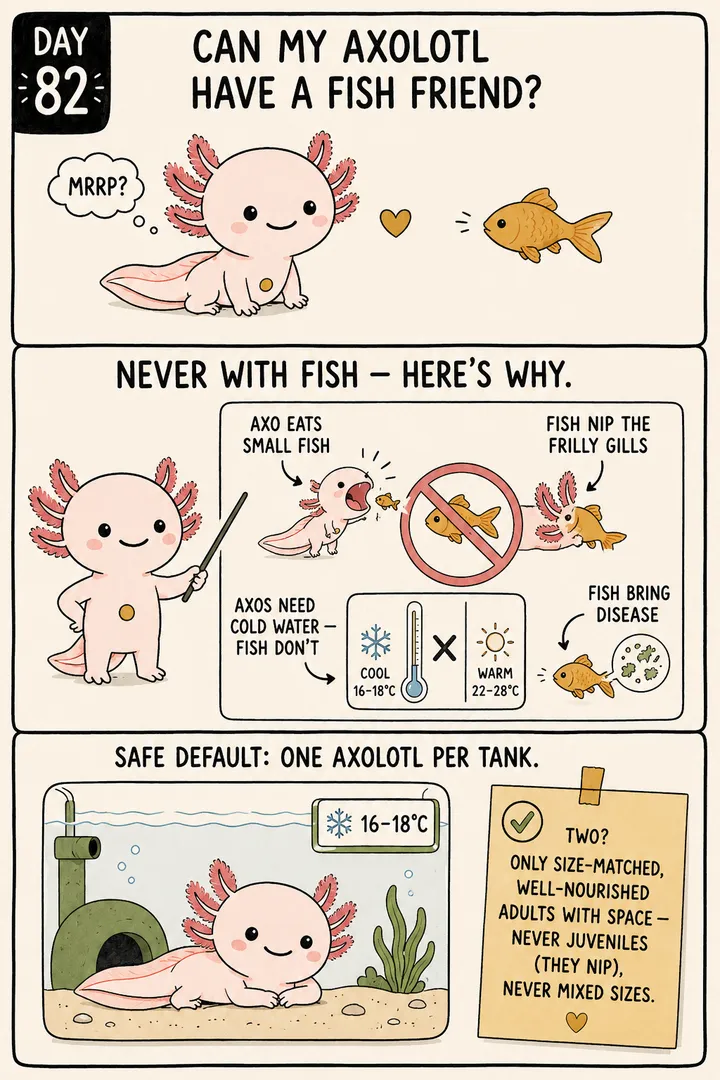
“Can my axolotl have a friend?” and “can it live with my fish?” are two of the most-asked axolotl questions — and they come from a caring place. So here’s the honest, welfare-first answer, written for a keeper ready for the real reasoning. This is the advanced companion to the complete Axolotl Care Guide — that covers keeping one axolotl beautifully; this is about what happens when you add a second animal.
🐸 The 30-second version: never keep an axolotl with fish — the axolotl eats small ones, fish nip its gills, the temperatures don’t match (axolotls need cold water), and fish bring disease. Shrimp, snails and plecos aren’t safe either. Two axolotls can sometimes cohabit — but only size-matched, well-fed adults with space, never juveniles (they bite), and never mixed sizes. The safe default is one axolotl per tank. (And the axolotl-with-fish thing you’ve seen is Minecraft, not care advice.)
Why this question matters so much
In our axolotl demand pull, tankmate questions are one of the biggest advanced clusters — does an axolotl eat fish, axolotl with goldfish, axolotl tank mate, can axolotls be kept together, would an axolotl eat a goldfish. A lot of that traffic is people who love the game, but the real-world stakes are high: the wrong tankmate is one of the fastest ways to injure or kill an axolotl. So let’s be clear and kind about it.
Axolotls and fish: a hard no
There’s no gentle version of this — axolotls and fish don’t mix, for at least four reasons:
- Axolotls eat fish. An axolotl is an ambush predator that snaps at anything moving and mouth-sized. It will try to eat a small fish — and a spiny or oversized fish can cause choking or impaction.
- Fish eat axolotls back. Goldfish, barbs, and most community fish nip and eat an axolotl’s feathery external gills and rasp at its soft slime coat. Those gills are delicate, exposed, and constantly waving — irresistible to a nippy fish.
- The temperatures are incompatible. Axolotls need cold water (16–18°C / 60–64°F) with no heater; most aquarium fish want it much warmer. You physically cannot keep both happy in one tank — and warm water is dangerous for axolotls (see the room-temperature myth).
- Disease and bioload. Fish carry parasites and pathogens axolotls have no resistance to, and add waste that fouls the pristine water an axolotl needs.
Even the “helpers” fail: plecos and suckermouth fish rasp at the axolotl’s skin and slime, and shrimp/snails are simply food (with a swallowed shell as a choking risk). An axolotl tank is a single-species tank.
Two axolotls: sometimes, with real caveats
Unlike fish, two axolotls can share a tank — but it’s an advanced, monitored choice, not a default:
- Adults only, size-matched. Never mix a big and a small axolotl — the bigger one will bite the smaller. Both should be well past the risky juvenile stage and a similar size.
- Well fed and spacious. Hunger and crowding make bites more likely, but adults can nip each other even with plenty of food and space; a cramped or underfed pair is a bite waiting to happen.
- Watch the gills and feet. At the first sign of nipped gills, missing toes, or a stressed, hiding animal, separate them. Damage usually regenerates in a healthy axolotl (see how axolotl regeneration works), but prevention beats regrowth every time.
- A mixed-sex pair means eggs. Two axolotls of opposite sex will breed — and that’s a much bigger commitment than people expect (see breeding axolotls responsibly).
Juveniles: never together
This is the firm one. Young axolotls are cannibalistic — they snap at their siblings’ gills, feet, and tails on instinct. It isn’t aggression you can train out; it’s how they’re wired. Larvae and juveniles must be raised separated by size, kept very well fed, and given space — the same rule that catches out anyone with a surprise clutch (accidental axolotl eggs).
The tank-size maths
If you do keep more than one adult:
- At least a 20-gallon long for the first axolotl, plus roughly another 10 gallons of space and floor area per additional axolotl — floor space matters more than height for a bottom-dweller.
- A fine sand or bare bottom (never gravel — impaction risk; see substrate: sand vs bare vs bioactive), pristine cycled water, and hides so each animal can get away from the other.
- Keep the water cold and cycled — check your numbers with the water interpreter.
Even with all that, one axolotl per tank is the lowest-stress, safest setup — and a solitary axolotl is a perfectly happy axolotl. They don’t need company; they need cold, clean water and you watching through the glass.
💚 Wanting your axolotl to have a friend is a sweet instinct — but the kindest tankmate for an axolotl is usually no tankmate at all. No fish, ever; other axolotls only as a careful, size-matched, well-watched choice. Give it cold clean water and its own space, and you’ve given it exactly what it wants.
Go deeper: the science of those regrowing gills → how axolotl regeneration works · thinking about a pair → breeding axolotls responsibly · surprise eggs → accidental axolotl eggs · substrate & impaction → sand vs bare vs bioactive · the full basics → complete Axolotl Care Guide.
Sources & further reading
This guide was written and fact-checked against these authorities. It’s honest general guidance — not a diagnosis:
- Axolotl-keeper and aquarist consensus on cohabitation and fish tankmates (predation, gill-nipping, temperature incompatibility) — long-established across the axolotl-keeping community; named here in plain text.
- Caudata Culture — Axolotl care sheet — husbandry, water temperature, and keeping axolotls together (space, hides, cannibalism) for Ambystoma mexicanum; its Fish with Caudates article explains why fish and axolotls shouldn’t share a tank.
- Cold-water and water-quality requirements — see our own fact-checked care sheet and room-temperature fact-check.
Written and fact-checked by The Bognook Team against veterinarian-authored sources — if a cohoused axolotl has nipped gills or limbs, an open wound, or spreading fungus, separate it and see an exotics vet.
Common questions
Can axolotls live with fish?
No — axolotls and fish should never share a tank. It goes wrong in both directions: axolotls are predators and will try to eat any fish small enough to fit in their mouth (and can choke or become impacted on one), while fish like goldfish, barbs and most community species nip and eat an axolotl's delicate feathery gills and slime coat. On top of that the temperatures don't match — axolotls need cold water (16–18°C / 60–64°F) and most aquarium fish want it much warmer — and fish add disease risk and bioload. The 'axolotls and fish' pairing you've seen is a Minecraft thing, not real husbandry.
Can two axolotls live together?
Sometimes, with real caveats, and never for beginners by default. Two axolotls can cohabit only if they're a similar, adult size, well fed, and in a tank big enough for each to have space — and even then there's a risk of nipping, competition, and stress. Juveniles must not be raised together (they're cannibalistic), and you should never mix sizes, because the bigger one will bite the smaller. If you keep a pair, watch closely and be ready to separate at the first sign of nipped gills or limbs.
Can axolotls live with shrimp, snails or a pleco?
Not safely. Small shrimp and snails are food — an axolotl will eat them, and a swallowed snail shell is a choking or impaction risk. Plecos and other suckermouth fish are especially bad: they rasp at an axolotl's slime coat and skin. There's no 'cleaner crew' that safely lives with an axolotl; the honest answer is that an axolotl tank is a single-species tank.
Why do my axolotls bite each other?
Because biting tank-mates is well-documented axolotl behaviour, and it's worst in the young: growing larvae snap at anything that moves, so toes, feet, limbs and tail tips get bitten — and it can still happen with plenty of food and space. That's why young axolotls are sorted by size and, from about 5 cm (2 in), often housed alone. Lost toes, limbs and gills can regrow, but severe or repeated bites can leave malformed limbs, so separating them and never mixing sizes is far kinder than relying on regrowth.
How big a tank do two axolotls need?
As a rule of thumb, at least a 20-gallon (long) tank for one adult axolotl, with roughly another 10 gallons of space and footprint per additional axolotl — floor space matters more than height because they're bottom-dwellers. But size alone doesn't make cohabitation safe: the animals still need to be size-matched, well fed, and monitored. If in doubt, one axolotl per tank is always the safe, low-stress default.

Join the Bognook burrow
Cozy amphibian care tips, aesthetic freebies, and the occasional frog fact — straight to your inbox. No spam, just good bog vibes.
Free amphibian care cheat-sheet when you join. No spam — pinky-promise. Unsubscribe anytime. See how we handle your data in our privacy notice.