What an Axolotl Setup Really Costs in 2026 (Full Breakdown)
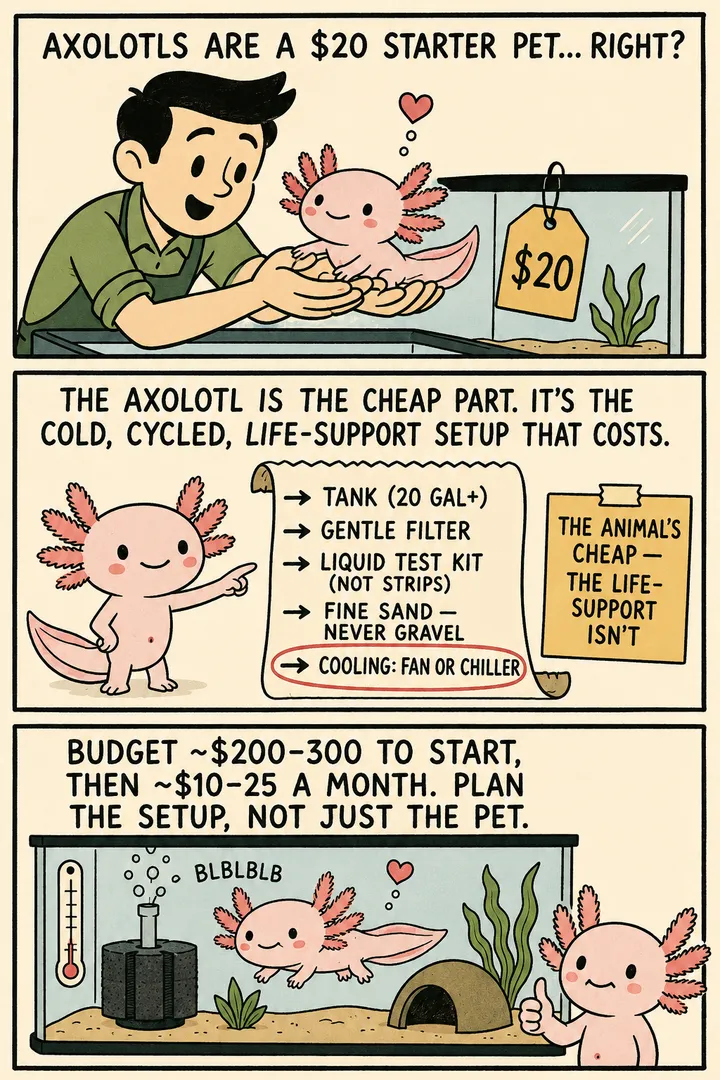
Axolotls have a reputation as a “cheap starter pet.” The animal is cheap — but the setup that keeps it alive is where the real money goes. Here’s an honest, itemized 2026 breakdown so there are no surprises.
Prices are typical 2026 USD ranges and vary by region and brand — treat them as planning estimates, not quotes.
🔧 Planning the tank? Build your list with the free aquatic setup planner so nothing essential gets missed.
Upfront costs
| Item | Budget | Comfortable | Notes |
|---|---|---|---|
| Tank (20 gal long / 30–40 gal) | $60 | $150 | Bigger = more stable water |
| Filter (sponge or baffled HOB) | $20 | $50 | Gentle flow only |
| Liquid test kit | $30 | $40 | Essential — not strips |
| Thermometer | $5 | $10 | Non-negotiable |
| Fine sand or bare-bottom | $0–15 | $25 | Never gravel |
| Hides / caves / plants | $15 | $50 | They need shade |
| Dechlorinator | $8 | $12 | Every water change |
| Cycling supplies (ammonia / bottled bacteria) | $10 | $20 | For the fishless cycle |
| Food starter (earthworms / pellets) | $10 | $20 | Earthworms = staple |
| The axolotl | $20 | $70 | Morph-dependent |
| Cooling (summer) | $15 (fan) | $100–300 (chiller) | Climate-dependent |
| Upfront total | ~$200–300 | ~$350–500 | +$100–300 if a chiller is needed |
Ongoing costs (monthly)
| Item | Typical |
|---|---|
| Food (earthworms / pellets) | $5–15 |
| Dechlorinator + test refills | $3–7 |
| Electricity (filter + cooling) | $2–10 |
| Monthly total | ~$10–25 |
Over a 10–15 year lifespan, the ongoing cost stays modest — the setup is the big number.
Where people under-budget
- Cooling. In a warm home, a fan may not be enough and a chiller is a real cost. Plan for your climate before buying the axolotl.
- A properly sized tank. Under-sizing to save money means less stable water and more problems — false economy.
- The test kit. Skipping it is the most expensive “saving” you can make, because it’s how you prevent illness.
The bottom line
Budget ~$250–500 to do it right, most of it one-time, plus ~$10–25/month. The axolotl is the cheapest part — the value is in the life-support system around it. Done properly, that system quietly keeps a fascinating animal healthy for over a decade.
💚 If the setup cost feels like a lot, that’s the honest picture — and knowing it now is exactly how you set your axolotl up to thrive instead of struggle. Budgeting for the tank, not just the animal, is what good keepers do.
Go deeper: the complete Axolotl Care Guide · how to cycle a tank · the printable care sheet.
Common questions
How much does an axolotl cost?
The axolotl itself typically costs about $20 to $70 depending on the morph, with common morphs like wild type and leucistic at the lower end and rarer ones like GFP or copper higher. The setup around it usually costs far more than the animal.
How much does a full axolotl setup cost?
A complete axolotl setup usually costs roughly $250 to $500 upfront in 2026. A budget build without a chiller lands around $200 to $300, and a comfortable build lands around $350 to $500. Adding an aquarium chiller for a warm climate can add $100 to $300 more.
Are axolotls expensive to keep?
Axolotls are cheap to feed but the upfront setup is the real cost. Ongoing monthly costs are low, roughly $10 to $25 for food, water treatment, and electricity, so the main expense is buying the tank, filter, cooling, and test kit correctly at the start.
What are the ongoing monthly costs of an axolotl?
Expect about $10 to $25 per month for earthworms or pellets, dechlorinator, test-kit refills, and the electricity to run a filter and any cooling. Cooling in summer is the main variable, especially if you use a chiller.
Why does an axolotl setup cost more than the axolotl?
Because keeping the water cold, cycled, and clean requires equipment: an adequately sized tank, gentle filtration, a liquid test kit, cooling for summer, and safe substrate and hides. The animal is inexpensive; the life-support system around it is where the money goes.

Join the Bognook burrow
Cozy amphibian care tips, aesthetic freebies, and the occasional frog fact — straight to your inbox. No spam, just good bog vibes.
Free amphibian care cheat-sheet when you join. No spam — pinky-promise. Unsubscribe anytime. See how we handle your data in our privacy notice.