Axolotl vs Tiger Salamander: Will My Axolotl Turn Into a Salamander?
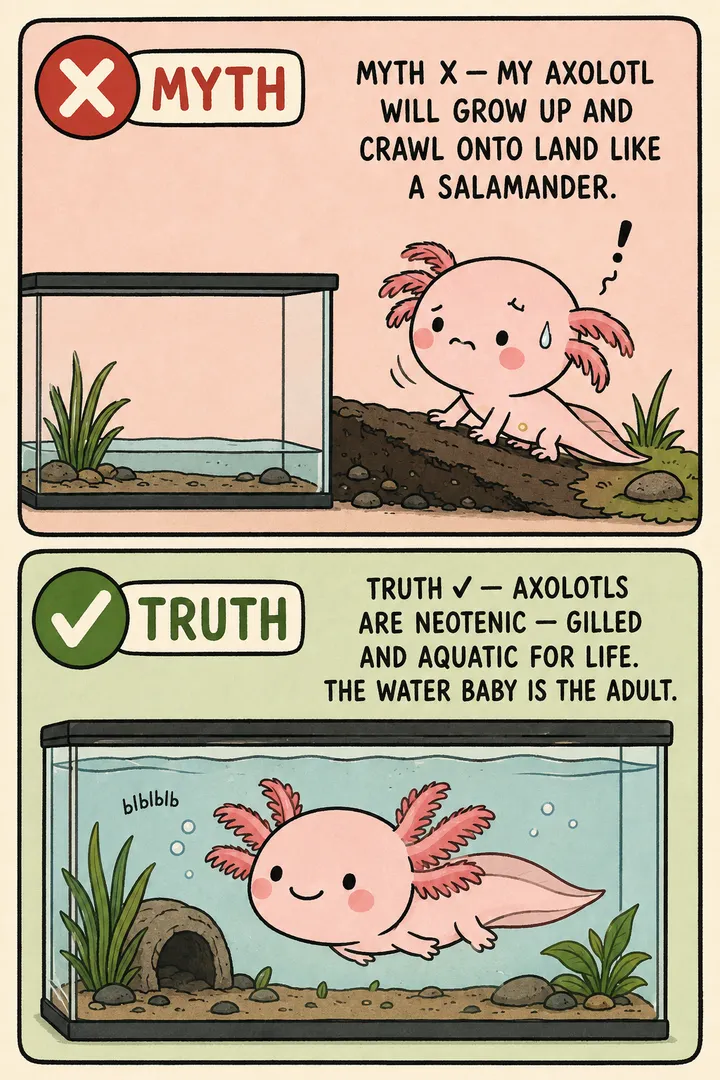
🔍 Fact check
“My axolotl will grow up and crawl onto land like a tiger salamander.” — A common beginner belief
Verdict: False
Axolotls are neotenic: they keep their gilled, aquatic body for their whole lives and even breed in it, so a healthy pet axolotl never metamorphoses onto land. Forcing a morph with thyroid hormone is an extreme stressor, and most laboratory axolotls die shortly after metamorphosis. A "morphing axolotl" is very often a mislabelled larval tiger salamander (a "waterdog"), which naturally does lose its gills and move onto land.
The evidence:
- Axolotls are neotenic (paedomorphic) — aquatic and gilled for life. The axolotl (Ambystoma mexicanum) retains its larval form and reproduces in it — documented natural history for the species (AmphibiaWeb).
- A tiger salamander does the opposite. It hatches as a gilled aquatic larva (a "waterdog"), then absorbs its gills and climbs onto land as a striped terrestrial adult — so a cheap "axolotl" that starts leaving the water is usually a mislabelled tiger salamander larva.
- Forcing metamorphosis is harmful, not a goal. Metamorphosis can be induced with thyroid hormone, but an exotic-vet hospital warns it "should never be encouraged, as it is an extreme stressor" (Chicago Exotics Animal Hospital), and most laboratory animals die shortly after metamorphosis (Animal Diversity Web). A spontaneously morphing axolotl is an emergency, not a milestone.
They’re close cousins — both mole salamanders (genus Ambystoma) — which is exactly why they get mixed up, and why one myth refuses to die: “will my axolotl grow up into a salamander?” The short answer is no. Here’s why, how to tell the two apart, and how their care differs.
At a glance
| Axolotl 💗 | Tiger salamander 🦎 | |
|---|---|---|
| Adult form | Stays aquatic + gilled for life | Grows up onto land (loses gills) |
| Gills | Keeps big feathery external gills | Gilled only as a larva, then none |
| Home | Fully aquatic (water for life) | Terrestrial adult, deep moist substrate |
| Difficulty | Intermediate (needs cold water) | Beginner (needs to stay cool) |
| Temperature | 16–18°C / 60–64°F, no heater | 65–72°F (above ~78°F is dangerous) |
| Diet | Earthworms, soft sinking pellets | Earthworms, crickets, ~2×/week |
| Lifespan | 10–15+ yrs | 10–16+ yrs |
Why your axolotl won’t “morph”
Axolotls are neotenic — they keep their juvenile, gilled, aquatic body their entire lives and even breed in it. Staying a “water baby” forever isn’t a stage they’re waiting to grow out of; it is the adult axolotl. A healthy pet axolotl will keep its feathery gills and live in water for life.
A tiger salamander does the opposite: it hatches as a gilled aquatic larva (sometimes sold as a “waterdog”), then metamorphoses — absorbing its gills, growing eyelids, and climbing out onto land as a striped terrestrial adult.
⚠️ Never try to force an axolotl to morph. You’ll see old advice about using hormones to “turn” an axolotl into a salamander. Don’t. An exotic-vet hospital calls it an extreme stressor, most lab animals die shortly after metamorphosis, and there’s no good reason to do it. A morphing axolotl is an emergency, not a goal.
Is your “axolotl” actually a waterdog?
Because larval tiger salamanders look a lot like axolotls, cheap “axolotls” (and bait-shop waterdogs) are sometimes mislabelled tiger salamander larvae. Time usually gives it away: a waterdog will gradually lose its gills, develop eyelids, and try to leave the water as it matures, though some tiger salamanders stay gilled and aquatic for life (neoteny). A true axolotl never does. If your animal is climbing out and losing its gills, don’t panic — start planning a terrestrial setup and ask a keeper community to confirm the ID.
The verdict
Set on that permanent-smile, gilled look and can keep water cold? Get an axolotl. Behaviour-wise it’s easy — the whole game is cold (60–64°F, no heater) fully-cycled water. In a warm room that means a fan or chiller, and the setup often costs more than the animal.
Can’t guarantee cold water, or you like the idea of a land salamander? The tiger salamander is the more forgiving pick. It’s a bold, food-motivated terrestrial burrower — just keep it cool (heat is the main killer) and don’t overfeed (obesity is the usual problem).
What they share
Both are hardy, long-lived (10–16+ years), cool-loving mole salamanders that hate heat, need deep clean living conditions, and should be look-don’t-handle animals. With either one, letting them get too warm is a serious mistake.
One thing to never do
Don’t force a morph, and don’t mix them. Let the axolotl stay the water baby it’s meant to be, house each animal in the setup its species and life stage needs, and never keep the two together.
💚 The axolotl staying a gilled “baby” forever isn’t a failure to grow up — it’s the whole charm, and it’s completely natural. Keep the water cold and clean and it’ll smile at you for a decade or more.
Compare them side by side in the amphibian comparison tool, or go deeper: the axolotl and tiger salamander pages · what morph is my axolotl? · axolotl questions answered.
Common questions
Will my axolotl turn into a tiger salamander?
No — not naturally, and you should never try to force it. Axolotls are neotenic: they stay in their gilled, aquatic 'larval' form for their whole lives and breed that way. A healthy pet axolotl keeps its feathery gills and lives in water for life. Forcing metamorphosis with thyroid hormone is an extreme stressor, and most lab animals die shortly afterwards.
How do I tell an axolotl from a tiger salamander?
A pet axolotl keeps big feathery EXTERNAL GILLS and lives fully in water for life, in a range of morphs (leucistic, wild, albino…). A tiger salamander is a land animal as an adult — no gills, dark with yellow tiger stripes. Confusingly, a YOUNG tiger salamander ('waterdog') is aquatic and gilled too, but it usually loses the gills and climbs onto land as it matures (a few stay gilled and aquatic for life). An axolotl never does.
Is my axolotl actually a waterdog (tiger salamander larva)?
Possibly — 'waterdogs' sold as bait or cheap 'axolotls' are often larval tiger salamanders. The tell is time: a waterdog will usually start to lose its gills, develop eyelids, and try to leave the water as it matures, while a true axolotl stays gilled and aquatic. If your 'axolotl' is climbing out and losing its gills, re-home the setup toward a terrestrial one and ask in a keeper community for an ID.
Which is easier to keep, an axolotl or a tiger salamander?
Both are hardy and long-lived, but in different ways. The tiger salamander is a bit more forgiving — a terrestrial burrower that just needs to stay cool (65–72°F) and not be overfed. The axolotl is easy behaviour-wise but demands COLD water (60–64°F, no heater) and a fully cycled tank. If you can't keep water cold, the salamander is the safer choice.
Can an axolotl and a tiger salamander live together?
No. One is fully aquatic and one is a land animal as an adult, so their setups are incompatible, and mixing amphibian species risks disease and stress. Keep them separately, each in the setup that suits its life stage and species.

Join the Bognook burrow
Cozy amphibian care tips, aesthetic freebies, and the occasional frog fact — straight to your inbox. No spam, just good bog vibes.
Free amphibian care cheat-sheet when you join. No spam — pinky-promise. Unsubscribe anytime. See how we handle your data in our privacy notice.