← All species · Frogs

Fire-Bellied Toad
Bombina orientalis · also called Oriental fire-bellied toad

Beginner Family Bombinatoridae

A hardy, active semi-aquatic "frog-toad" with a bright warning belly — a classic beginner.

⚠️ Before anything else: Skin secretions are irritating — wash hands; keep a secure lid.

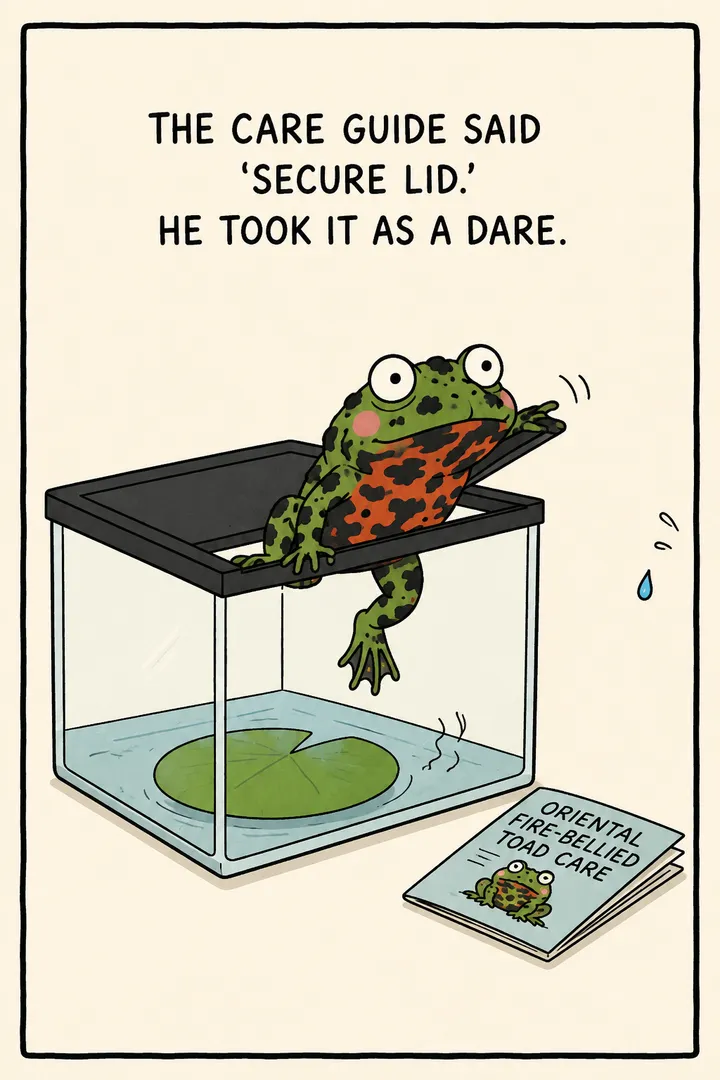
A fire-bellied toad treating 'secure lid' as a dare, mid-escape. The point: fire-bellied toads are agile escape artists, so their enclosure needs a genuinely secure lid.
Fire-bellied toads read 'secure lid' as a challenge — they are surprisingly good climbers and escape artists, so a tight, secure lid isn't optional.

✅ We have a full, fact-checked care sheet for the Fire-Bellied Toad.

Open the Fire-Bellied Toad care sheet →

📋 At a glance

Tank
Semi-aquatic 10–15 gal / 18×18×18 (2–3) — half land, half shallow water
Temp
75–78°F day · nights no lower than ~65°F · never above ~82°F · no hot basking bulb
Humidity
60–70%, with a shallow dechlorinated water area
Food
Gut-loaded, calcium-dusted crickets, worms, small roaches
Lifespan
10–15+ years (some over 20)
Light
Low-level UVB (a 2.0–5.0 bulb) 10–12 h a day + calcium dusting

✅ Bold, active and social — one of the few amphibians that is genuinely lively by day.

🛒 Before you buy

  • A semi-aquatic setup: sloped land + 1–2 in of dechlorinated water
  • A TIGHT lid — they climb and escape
  • Gentle filtration or a plan for frequent water changes
  • A calcium supplement

A healthy one: Plump and active · bright belly · clear eyes · smooth skin · using both land and water.

🚨 See a vet / act now if…

  • Bloating or floating
  • Red, raw skin (usually poor water quality)
  • Not eating, or weight loss
  • Cloudy eyes or persistent lethargy

⛔ Never

  • Skipping hand-washing (mild toxins — never touch eyes/mouth)
  • Housing with other species (toxins harm tankmates)
  • Chlorinated water

Common fire-bellied toad questions

How hard are Fire-Bellied Toads to keep — are they good for beginners?

Beginner. Hardy, active and cheap to keep — just wash your hands (mild skin toxins).

What do Fire-Bellied Toads eat?

Gut-loaded, calcium-dusted crickets, worms, small roaches

What size tank do Fire-Bellied Toads need?

Semi-aquatic 10–15 gal / 18×18×18 (2–3) — half land, half shallow water

What temperature do Fire-Bellied Toads need?

75–78°F day · nights no lower than ~65°F · never above ~82°F · no hot basking bulb

What humidity do Fire-Bellied Toads need?

60–70%, with a shallow dechlorinated water area

Do Fire-Bellied Toads need UVB lighting?

Low-level UVB (a 2.0–5.0 bulb) 10–12 h a day + calcium dusting

How long do Fire-Bellied Toads live?

10–15+ years (some over 20)

What are the signs Fire-Bellied Toads are sick?

See an exotics vet if you notice: Bloating or floating; Red, raw skin (usually poor water quality); Not eating, or weight loss; Cloudy eyes or persistent lethargy.

🧠 Myths, kindly busted

Common myths about the fire-bellied toad and its relatives, gently corrected — each one checked against a named source, never a pet-shop rumour.

“Fire-bellied toads can share a tank with fish, tree frogs or newts.”Mostly false

Vets advise against it: a veterinary paper warns their skin toxin can harm other animals, so they 'should not be housed with other species of frogs or other pets.' They'll eat anything that fits in their mouths, small fish included. A hobby book allows tree frogs in large planted tanks; vets say own kind only. — Seminars in Avian and Exotic Pet Medicine (2004) · Chicago Exotics Animal Hospital · Reptiles Magazine

“Fire-bellied toads need a heat lamp.”Mostly false

Not a hot basking lamp — these are room-temperature toads. Vet-written guides suggest about 75–78°F and never above 82°F, which can dry their skin. A thermostat-controlled heat pad can supply the warmth; one exotic-animal hospital calls basking lights 'contraindicated.' A low-level UVB light is recommended, though: in one study it raised their vitamin D3. — Chicago Exotics Animal Hospital · PetMD (Maria Zayas, DVM) · J. Animal Physiology & Animal Nutrition (2015)

“Toads give you warts.”

Happily false — warts are caused by a human virus, not by toads, and no amount of handling a toad will give you one. The bumps on a toad's skin that started the myth are just glands. — Forest Preserve District of Will County

“Toads are dry animals that don't need water or humidity.”

Toads stay hydrated by absorbing water through their skin, so they always need a shallow dish of clean, dechlorinated water to soak in plus the right humidity. Without moisture their skin dries out and they dehydrate. — PetMD

“A toad's skin secretion is harmless.”

Many toads have glands behind the eyes that release an irritating toxin as defense — a real hazard to a dog or cat that mouths one. Keep other pets away and wash your hands after any contact. — Merck Veterinary Manual

🐸 Did you know? — Fire-Bellied Toad fun facts

Little true delights about the fire-bellied toad — each one checked against a named source, no old-wives' trivia.

More amphibian fun facts →

Free tools for the fire-bellied toad

Calm, honest help — each one knows when to say "see a vet."

📚 More frogs guides

🎓 Ready to go deeper?

Past the basics — genetics & morphs, responsible breeding, tankmates, and advanced setups. Same plain voice, no ceiling:

Get the free Fire-Bellied Toad Starter Kit

A one-page setup-criteria checklist and a first-30-days plan for your first fire-bellied toad — what to get, what makes each thing matter, and the honest bits the pet shop skips. Join the burrow and we’ll send it over. Free sheets and tools always stay open, no gatekeeping.

Free amphibian care cheat-sheet when you join. No spam — pinky-promise. Unsubscribe anytime. See how we handle your data in our privacy notice.