Pacman Frog vs African Bullfrog: Which Big Frog Should You Get?
🔍 Fact check
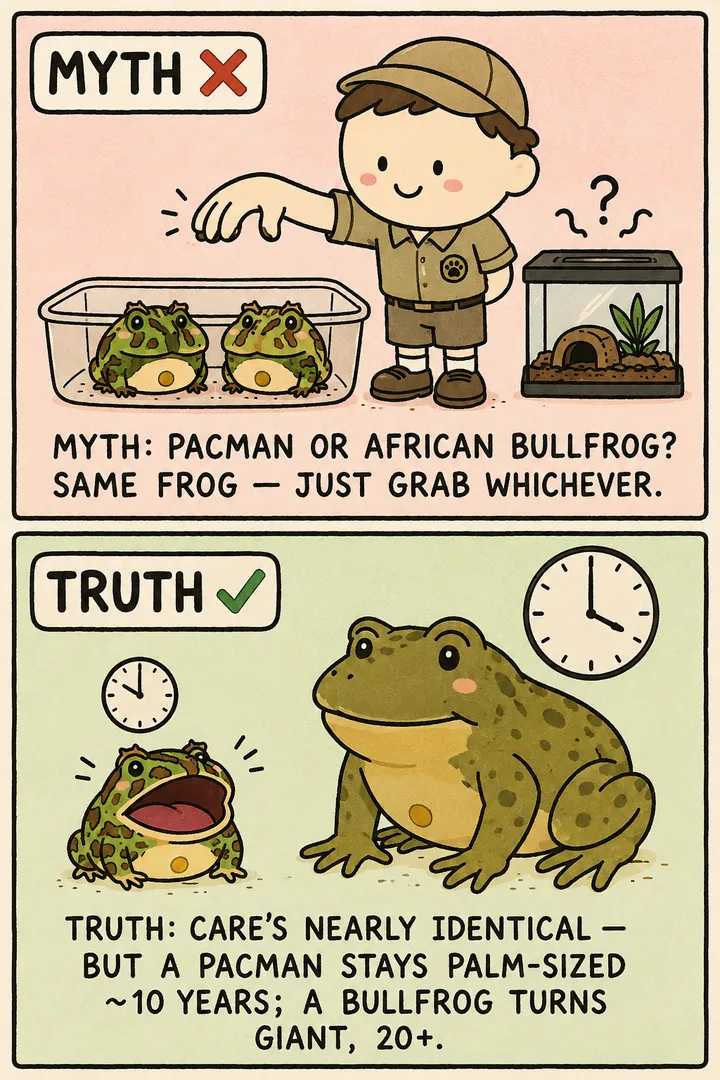
“Pacman frog or African bullfrog — they are basically the same frog, just grab whichever.” — A common beginner assumption
Verdict: Mostly False
Their day-to-day care philosophy really is nearly identical — both are low-drama "mouth with feet" ambush frogs. But the scale is not: a Pacman frog stays palm-sized (~4–7 in) and lives around 6–10 years, while an African bullfrog becomes a giant (males 8–10 in) and generally lives 15–25 years. Choosing "whichever" can mean accidentally signing up for a two-decade, much larger commitment.
The evidence:
- Size and lifespan differ enormously. A Pacman frog stays palm-sized and lives ~6–10+ years; an African bullfrog (Pyxicephalus adspersus) is one of the largest kept frogs and generally lives 15–25 years, with one documented at 45 (Chicago Exotics Animal Hospital; AmphibiaWeb).
- The bullfrog needs a much larger enclosure and long-term plan. Adults need roughly a 36×18×18 in setup versus a Pacman's 10–20 gal — the care recipe is the same, the commitment is not.
- Both are solitary cannibals. Neither can be housed together at any size, so "grab whichever" should be a deliberate choice about size and years, not an impulse.
Both are the classic “mouth with feet” frogs — calm, blobby ambush predators that spend most of their lives comfortably buried, waiting for dinner. Their care is almost identical, so choosing between them comes down to one thing: how big a commitment do you want?
At a glance
| Pacman frog 🐸 | African bullfrog (Pixie) 🐸 | |
|---|---|---|
| Adult size | Palm-sized (~4–7 in, ♀) | Giant — ♂ up to 8–10 in |
| Lifespan | 6–10+ yrs | 15–25 yrs (documented to 45) |
| Enclosure | Terrestrial 10–20 gal | Large ~36×18×18 in |
| Temperature | 78–82°F, never above ~85°F | 78–90°F with a night drop |
| Humidity | 60–80%, deep moist coco fibre | ~80–90% per an exotic vet (keeper guides often run lower), deep moist coco fibre |
| Diet | Dusted insects/worms, once or twice a week | Dusted insects/roaches, every 3–4 days |
| Care difficulty | Beginner | Beginner |
| Housing | One frog only (cannibal) | One frog only (cannibal) |
The verdict
Want the full “giant blobby ambush frog” experience in a modest tank, at a normal pet lifespan? Get a Pacman frog. It stays palm-sized, lives around a decade, and is genuinely one of the easiest amphibians to keep well — deep moist coco fibre to burrow in, warm humid air, and a dusted insect every few days.
Want the biggest frog in the lineup and you’re ready for a 20-year commitment? Get an African bullfrog. The care philosophy is identical, but you’re signing up for a much bigger animal, a much bigger enclosure, and a commitment that can outlast a dog several times over. Go easy on rodents: fed often, they make a bullfrog obese. Feed it like the insectivore it mostly is.
What they share
Almost everything: deep moist coco fibre to burrow in (never gravel — swallowed substrate can cause a fatal gut blockage in both), a shallow dish of dechlorinated water, warm humid conditions, gut-loaded, calcium-dusted prey, feeding tongs (both bite), and strictly solo housing (both are cannibals). Both are look-don’t-handle animals whose charm is watching them thrive, not cuddling them.
One thing to never do
Never keep two together, and never house either on gravel or loose swallowable substrate. Cannibalism and impaction are the two classic ways these easy frogs die — and both are completely avoidable.
💚 There’s no wrong answer here, only the right-sized commitment. Both are wonderful, low-drama frogs — just be honest about the tank and the years before you fall for the giant.
Compare them side by side in the amphibian comparison tool, or go deeper: the Pacman frog care sheet · the African bullfrog care sheet · the ground frog & toad setup planner · Pacman & bullfrog questions answered.
Common questions
Is a Pacman frog or an African bullfrog easier to keep?
They're about equally easy — both are genuinely low-effort 'sit, burrow and eat' frogs with almost identical care: deep moist coco fibre, warm humid conditions, dusted insects, and solo housing. The real difference isn't difficulty, it's scale: the African bullfrog gets much bigger and can live 20+ years, so it's a far larger long-term commitment.
How big do Pacman frogs and African bullfrogs get?
A Pacman frog stays palm-sized — females reach about 4–7 inches, males smaller. An African bullfrog (pixie) is one of the largest frogs kept: males can reach 8–10 inches and become true giants, while females stay around 5.5 inches. The bullfrog needs a much bigger enclosure as an adult.
How long do Pacman frogs and African bullfrogs live?
A Pacman frog typically lives 6–10+ years. An African bullfrog generally lives 15–25 years, and one was documented at 45 — so it's a multi-decade commitment closer to a parrot than a typical pet frog. Plan for the animal you'll still have in 20 years.
Can you house two Pacman frogs or two bullfrogs together?
No — both are cannibalistic ambush predators and will try to eat each other, whatever their size. Keep one frog per enclosure, always. Any photo of two 'cuddling' is a feeding accident waiting to happen.
Do Pacman frogs and African bullfrogs bite?
Yes, both can, and a big bullfrog's bite is genuinely powerful. They're ambush predators that strike at movement, so use feeding tongs, don't hand-feed, and treat them as look-don't-handle animals. Neither wants to be a cuddle pet — the appeal is the calm, blobby, watch-it-thrive kind.

Join the Bognook burrow
Cozy amphibian care tips, aesthetic freebies, and the occasional frog fact — straight to your inbox. No spam, just good bog vibes.
Free amphibian care cheat-sheet when you join. No spam — pinky-promise. Unsubscribe anytime. See how we handle your data in our privacy notice.