African Dwarf Frog vs African Clawed Frog: Which One Did I Actually Buy?
🔍 Fact check
“A dwarf frog and a clawed frog are the same little frog — grab either one.” — A common pet-store mix-up
Verdict: False
They are constantly confused in shop tanks, but they are different species with different care. An African dwarf frog stays tiny (~1.5 in), is peaceful, and lives ~5 years; an African clawed frog grows to 4–5+ in, is a predator that eats tankmates, lives 10–15+ years, and is banned or restricted in some regions as an invasive. The tells: dwarf frogs have fully webbed front feet and side-set eyes; clawed frogs have un-webbed front fingers, top-set eyes, and small claws on their hind toes.
The evidence:
- Front feet and eye position tell them apart. African dwarf frogs (Hymenochirus) have fully webbed front feet and eyes on the sides of the head; African clawed frogs (Xenopus laevis) have un-webbed front fingers and eyes on top of the head; their namesake claws are on the three inner hind toes (Smithsonian's National Zoo; USGS).
- Size and appetite are the tell that never lies. A true dwarf frog stays ~1.5 in for life; a "dwarf" steadily growing past 2–3 in and eating tankmates is a clawed frog.
- The clawed frog is an invasive predator, restricted in some regions. It is a hardy escape artist banned or restricted in several US states and countries — buy one on purpose, and never release it.
They look almost identical in a shop tank when they’re young — and they’re sold, mislabelled, and confused constantly. But you’re choosing between a tiny, peaceful, palm-sized frog and a big, long-lived predator that’s illegal in some places. Here’s how to tell which you’re looking at, and how their care differs.
At a glance
| African dwarf frog 🟢 | African clawed frog 🔴 | |
|---|---|---|
| Adult size | ~1.5 in (stays tiny) | 4–5+ in (much bigger) |
| Front feet | Fully webbed | Un-webbed toes with claws |
| Eyes | On the sides of the head | On top of the head |
| Temperament | Peaceful, social | Predatory — eats tankmates |
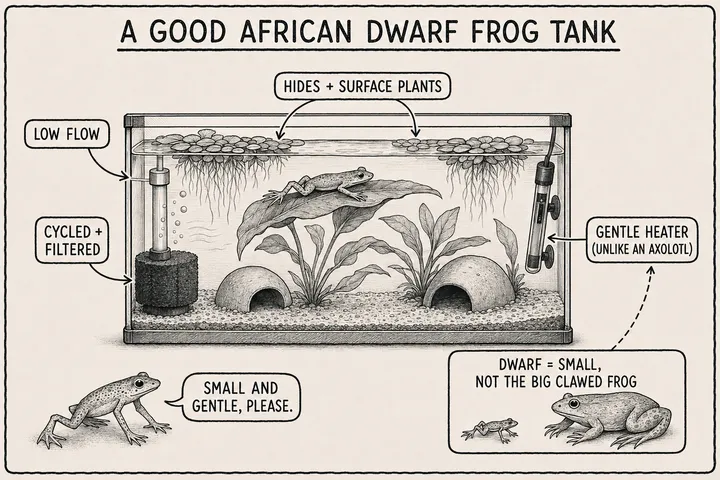
| Tank | 5 gal+ per frog, planted | 10–20 gal+, secure mesh lid |
| Temperature | 72–78°F (usually needs a heater) | 65–75°F (wide tolerance) |
| Lifespan | ~5 yrs (up to ~10) | 10–15+ yrs (some 20+) |
| Legality | Widely legal | Banned/restricted in some regions |
The quickest way to tell them apart
Look at the front feet and the eyes:
- African dwarf frog — all four feet are fully webbed (it’s a delicate little swimmer), and the eyes sit on the sides of the head.
- African clawed frog — the front fingers are un-webbed, the eyes sit on top of a flatter head, and the small dark claws it’s named for are on its hind toes.
And the tell that never lies: size and appetite. A true dwarf frog stays around an inch and a half its whole life. If your “dwarf” frog is steadily growing past 2–3 inches and hoovering up anything that fits in its mouth, you have a clawed frog.
The verdict
Want a tiny, peaceful frog for a small planted tank? That’s the African dwarf frog. It’s genuinely easy — if you treat it as a real aquatic pet with cycled, filtered, dechlorinated water, a gentle heater, and target feeding (they’re slow, and fish steal their food). Peaceful, endearing, and only a few years’ commitment.
The African clawed frog is a fine pet too — but a very different, bigger deal. It’s almost bomb-proof and can live 20 years, but it’s a predator (no small tankmates, ever), needs a bigger tank with a tight mesh lid (they push out and escape), and is banned or restricted in some regions because it’s so invasive. Buy one on purpose, not by accident — and never release it.
What they share
Both are fully aquatic and must always be able to reach the surface to breathe air — never seal either under deep water with no easy way up. Both want dechlorinated, gently filtered water with regular partial changes, and both are hardy as long as the water quality is real. Neither is a “throwaway” frog.
One thing to never do
Never house the two together, and never release a clawed frog. A clawed frog will eat a dwarf frog, and a released one can devastate local waterways. If you end up with a clawed frog you can’t keep, rehome it — don’t set it free.
💚 Mixed up at the till is the shop’s fault, not yours. Now you know the two tells — webbed feet + side eyes for the little dwarf, claws + top eyes for the big clawed frog — you’ll never be fooled again.
Compare them side by side in the amphibian comparison tool, or go deeper: the dwarf frog and clawed frog pages · the aquatic setup planner · aquatic frog questions.
Common questions
How do I tell an African dwarf frog from an African clawed frog?
Check the front feet and the eyes. African dwarf frogs have fully WEBBED front feet and eyes on the SIDES of the head, and stay tiny (~1.5 in). African clawed frogs have un-webbed front fingers (their claws are on the hind toes), eyes on TOP of the head, and grow to 4–5+ inches. The quickest tell: if it's getting big and eating its tankmates, it's a clawed frog.
Are African dwarf frogs and clawed frogs the same care?
No. Both are fully aquatic and hardy, but the dwarf frog is a tiny, peaceful community frog (5 gal+ per frog, gentle heater to 72–78°F, ~5-year life). The clawed frog is a large predator that needs a bigger tank with a tight mesh lid, no small tankmates, tolerates 65–75°F, and lives 10–15+ years.
Can African dwarf frogs and clawed frogs live together?
No — a clawed frog will eventually eat a dwarf frog, and it shouldn't be housed with fish or other small tankmates either. Never mix the two. Keep African dwarf frogs in a peaceful species tank and clawed frogs alone (or only with animals too big to swallow).
Why is the African clawed frog banned in some places?
Because it's a hardy, adaptable escape artist that becomes highly invasive if released, out-competing and eating native wildlife. Several US states and countries restrict or ban keeping them. Check your local law before buying one, and NEVER release one into the wild — rehome it instead.
I bought a 'dwarf frog' and it's getting huge — what is it?
It's almost certainly a mislabelled African clawed frog (or a young clawed frog sold as a dwarf). A true African dwarf frog tops out around 1.5 inches. If yours is pushing past 2–3 inches, eyes on top of its head and un-webbed front fingers, care for it as a clawed frog: bigger tank, tight mesh lid, no small tankmates, and check whether it's even legal where you live.

Join the Bognook burrow
Cozy amphibian care tips, aesthetic freebies, and the occasional frog fact — straight to your inbox. No spam, just good bog vibes.
Free amphibian care cheat-sheet when you join. No spam — pinky-promise. Unsubscribe anytime. See how we handle your data in our privacy notice.