I Found a Frog (or Toad) — What Should I Do?
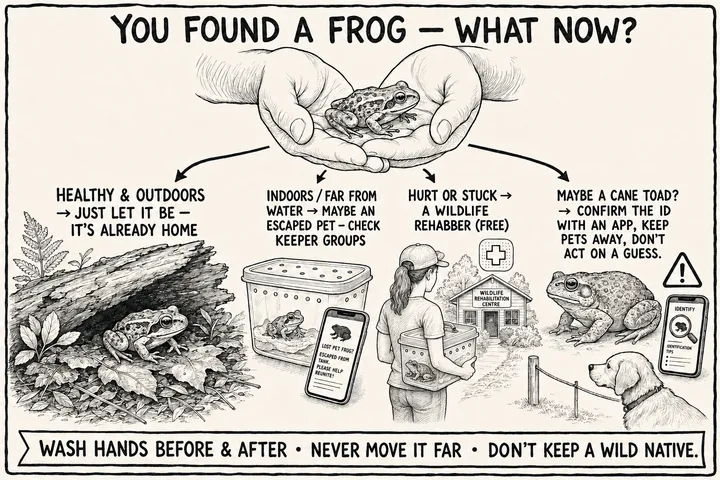
You found a little frog or toad, and now you are standing there wondering if you are supposed to do something. First: take a breath. Nothing bad happens in the next five minutes, and the fact that you stopped to check makes you exactly the right person to have found it. There are no silly questions here — this is the calm, no-shame version of the answer.
🐸 Want a personal answer in 30 seconds? Our free I Found an Amphibian tool asks you a few quick questions and walks you to the right next step. This guide is the fuller version behind it.
The 30-second answer
For most frogs and toads you find outdoors, the right move is beautifully simple:
Leave it where it is, or move it a short distance to the nearest damp, shady cover — and let it be. A frog in your garden, on your path, or under your porch light is not lost. That spot is its home, and it knows the way around far better than we do. No tank, no shopping list — just a small good deed done.
You only need to do something more in four situations. Here they are, from most common to least.
1. 🌿 It’s healthy and where it belongs → just let it be
This is the usual case, and the good news is it asks almost nothing of you.
- Release it (or leave it) right where you found it.
- If you’re holding it, keep your hands clean and damp and set it down gently under nearby cover — a log, leaf litter, or plants.
- That’s genuinely it.
You might have read a harsh “just leave wildlife alone” somewhere. Same truth, kinder version: it’s already home — you can simply let it be. Don’t take it inside to “raise” it (wild natives do best wild, and keeping them is illegal without a permit), and don’t relocate it far away.
“But it looked so dry on a hot day — shouldn’t I help?” You can, gently. Offer a shallow dish of dechlorinated or bottled water so it can soak if it chooses — amphibians hydrate through their skin, they don’t gulp. Don’t submerge it, don’t force it, and don’t use straight tap water (chlorine stings their skin). Honestly, nudging it toward damp, shady cover usually does more good than a water dish.
2. 🏠 It’s indoors or far from any water → maybe a lost pet
Found it inside the house, in the garage, or nowhere near a pond, creek, or greenery? It may be an escaped pet rather than a wild animal.
- Keep it damp and covered in a ventilated container while you check local lost-pet listings and reptile/amphibian keeper groups. Someone may be searching for it.
- If it’s near habitat but just somewhere awkward — a road, a pool, a path — move it a short distance to the nearest damp, shady cover.
- Not sure what it even is? A free ID app (Seek by iNaturalist) will tell you in seconds, and that decides the path.
Don’t move it miles away — even a displaced native belongs in its own neighborhood — and never put it down a storm drain or flush it. If it turns out to be a common captive species, our care guides (like toad care basics) can help you or its owner look after it properly.
3. 🚑 It’s hurt, stuck, or a pet caught it → get it real help
If it’s injured or a cat or dog got to it, you did the right thing by stopping. Now let’s get it to someone who can actually treat it.
- Handle it as little as possible — wet your hands first, or use a damp cloth or clean gloves rinsed in water. Never dry or bare hands.
- Settle it in a covered container with air holes, on a moistened paper towel (damp, not submerged).
- Keep it somewhere warm, dark, and quiet while you make one call.
- Call a wildlife rehabber before you drive anywhere — not every rehabber takes amphibians, so ring first.
Please don’t try to feed it (an injured amphibian needs a professional, not food), don’t treat the wound yourself, and don’t plan to keep it. A licensed rehabber will take it for free and give it the best shot — you getting it there is the kind, heroic part. To find one: Animal Help Now (24/7), the National Wildlife Rehabilitators Association directory, or your state wildlife agency.
This is first aid and a hand-off, not a diagnosis. Leave the actual treatment to the rehabber — that’s their job, and they’re good at it.
4. 🚫 You think it might be invasive (e.g. a cane toad) → confirm first, then call the authority
This is the one case where “put it back” is the wrong answer — but it comes with a big, important if.
If you’re in the southeastern US (Florida especially) or the western US, a few non-native amphibians are genuinely invasive — the cane toad and Cuban treefrog in the southeast, the African clawed frog and (out west) the American bullfrog. The catch: it is dangerously easy to mistake a harmless native for one of them.
So the whole job is confirming the ID before you do anything:
- Snap it in a free ID app (Seek) and check it against the native lookalike. A cane toad is big — about 6–9 inches, with no crests above the eyes. The native southern toad is only 3–4 inches with distinct brow “horns.” Never act on a guess. (Full guide: Cane Toad vs Native Toad — How to Tell.)
- If it really is a confirmed invasive: don’t release it elsewhere (that spreads the problem and is illegal in some states), and contact your state wildlife agency for the correct local action.
- Keep pets and small children away in the meantime.
Do not try to kill it yourself. If you’ve misidentified it, you could harm a protected native toad — the exact harm we’re trying to prevent. Leave that decision to the authority.
⚠️ A real safety note if you have a dog or cat: cane toad toxin can make a pet very sick — sometimes fatally — within minutes. If a pet mouths a toad and is alert, wipe its gums with a damp cloth and gently rinse its mouth forward with a hose (so it doesn’t swallow the water) for about 10 minutes, then call a vet right away. If it is disoriented or has collapsed, just wipe its mouth and get to a vet.
The three rules that cover almost everything
Whatever lane you’re in, these keep both of you safe:
- Wash your hands before and after — for you, and for its delicate skin (our soaps and lotions can hurt it).
- If you must hold it, wet your hands first. A dry or lotioned hand damages amphibian skin.
- Don’t move it far from where you found it.
Want to be the person the frogs keep coming back to?
If you’d rather help frogs thrive than just rescue the occasional lost one, your yard can become a haven:
- Skip the lawn pesticides — they poison the bugs amphibians live on.
- Leave a damp, shady corner — a log, a leaf pile, or a half-buried flowerpot.
- Add a small pond, and your yard becomes an amphibian nursery. (Here’s how to build a wildlife pond for frogs.)
💚 However this turns out, you already did the good thing: you cared enough to stop and check. Amphibians are quietly disappearing — and people like you are part of why some of them are still here.
Not sure which situation you’re in? The free I Found an Amphibian tool will walk you to the right answer in under a minute. Thinking of moving it — or moving spawn to a new pond? Read should I relocate a frog or its spawn? first (short answer: usually don’t). And if it turns out you’ve found (or been found by) a toad you want to help long-term, start with toad care basics or the toad warning-signs guide.
This is kind, general guidance — not legal or veterinary advice. Wildlife rules vary by state and country, so your local wildlife agency has the final word.
Sources & further reading
This guide was written and fact-checked against these authorities. It’s kind, general guidance — not a substitute for your state wildlife agency or a licensed rehabber:
- Florida Fish & Wildlife (FWC) — Cane Toad — cane toad vs. native southern toad ID (size, crests), pet-toxicity risk (a pet can die in as little as 15 minutes without treatment) and first aid, and why captured cane toads may not be relocated and released.
- Tufts Wildlife Clinic — what to do with a found sick or injured amphibian (no bare hands, moist covered container, don’t feed, don’t self-treat, call a rehabber before transporting).
- Animal Help Now — 24/7 finder for wildlife emergencies and rehabbers near you.
- National Wildlife Rehabilitators Association (NWRA) — state-by-state directory of licensed rehabbers.
- Your state wildlife agency — the authority for injured or invasive wildlife where you live.
- Seek by iNaturalist — free species identification to confirm what you found before acting.
Written and fact-checked by The Bognook Team against veterinarian-authored sources — if the animal may be sick or injured, contact a licensed wildlife rehabber.
Common questions
I found a frog in my yard — what should I do?
Most of the time, the kindest thing is also the easiest: leave it where it is, or move it a short distance to the nearest damp, shady cover. A frog in your yard or garden is already home — it is not lost, and it does not need rescuing. Only step in if it is clearly hurt, stuck, or a pet caught it, or if you think it might be a non-native invasive species. Wash your hands before and after, and never move it far from where you found it.
I found a dry-looking frog on a hot day — should I give it water?
You can offer water, but do it gently. Set the frog in a shallow dish of dechlorinated (or bottled spring) water so it can soak if it wants — amphibians drink and hydrate through their skin, not by swallowing. Do not submerge it, force it under, or use tap water straight from the faucet (chlorine harms their skin). Better still, move it to damp, shady cover and let it self-rescue. If it seems limp or unresponsive rather than just dry, treat it as a sick animal and call a wildlife rehabber.
Can I keep a frog or toad I found outside?
No — please do not. Keeping wild native frogs and toads is illegal in most places without a state or federal permit, and wild amphibians rarely thrive in captivity because their diet, temperature, and humidity needs are very specific. If the animal is healthy, release it exactly where you found it. If it is injured, a licensed wildlife rehabber will take it for free and give it a far better chance than a home setup can.
I found a frog inside my house or far from any water — what does that mean?
A frog found indoors, in a garage, or far from any pond, creek, or greenery may be an escaped pet rather than a wild animal. Keep it damp and covered in a ventilated container while you check local lost-pet groups and reptile/amphibian keeper communities — someone may be looking for it. If it turns out to be a common pet species, a proper care guide will help you (or its owner) look after it correctly.
How do I know if the toad I found is a cane toad?
Cane toads (an invasive species in the southeastern US, especially Florida) are large — about 6 to 9 inches — with no ridges or "horns" above the eyes. The native southern toad is much smaller, only 3 to 4 inches, with distinct brow crests. Because it is easy to mistake a harmless native for a cane toad, never act on a guess: confirm the ID with a free app like Seek, keep pets and children away (cane toad toxin can sicken or kill a dog or cat within minutes), and contact your state wildlife agency for the correct local action. Do not try to kill it yourself.
📚 Keep reading
- The Most Common Amphibian-Keeping Mistakes, Ranked
- What Amphibian Keepers Actually Ask: 1,165 Real Questions, Analysed
- The Complete Amphibian Buying Guide: Costs & What to Buy
- Best Beginner Amphibian: How to Choose (Axolotl, Toad, Tree Frog, Dart Frog & Newt)
- Amphibian vs Reptile Keepers: What 765 Questions Reveal
- Can You Handle Amphibians — and Which Ones Are Poisonous?

Join the Bognook burrow
Cozy amphibian care tips, aesthetic freebies, and the occasional frog fact — straight to your inbox. No spam, just good bog vibes.
Free amphibian care cheat-sheet when you join. No spam — pinky-promise. Unsubscribe anytime. See how we handle your data in our privacy notice.