Can You Handle Amphibians — and Which Ones Are Poisonous?
🔍 Fact check
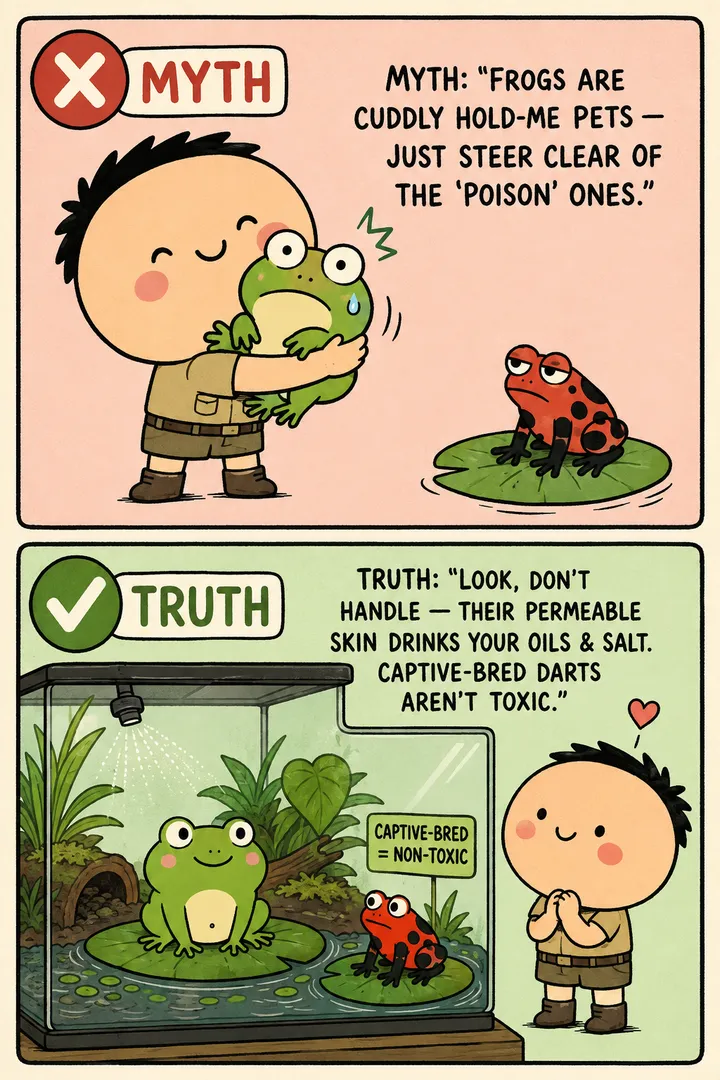
“Frogs are cuddly, hold-me pets — you only need to steer clear of the "poison" ones.” — A common beginner assumption
Verdict: False
Almost all amphibians are "look, do not handle" animals — not mainly because they will hurt you, but because their permeable skin absorbs the oils, soap, lotion and salt on your hands (and your body heat), which harms them. Many also secrete skin toxins that are safe to touch briefly but dangerous in your eyes, mouth or a cut. And the fear is backwards for dart frogs: captive-bred ones are non-toxic.
The evidence:
- Amphibian skin is permeable and absorbs what is on your hands. It takes up water easily, and toxins along with it, and it is delicate — so amphibians should be handled as little as possible (Merck Veterinary Manual — Housing for Amphibians; Introduction to Amphibians).
- Toxin potency varies by species; the danger is ingestion or mucous-membrane contact, not a careful touch. As veterinary toxicologist Sharon M. Gwaltney-Brant, DVM, PhD, DABVT writes in the Merck Veterinary Manual: "Toxins are produced by all toads; however, potency varies with species and apparently even between geographic areas for the same species."
- Captive-bred dart frogs are not poisonous. Dart frogs get their skin toxins from the insects they eat in the wild (AmphibiaWeb — Dendrobatidae), and frogs raised in human care on crickets and fruit flies are not poisonous (Smithsonian's National Zoo) — a key reason to buy captive-bred only.
“Can I hold it?” and “wait — is it poisonous?” are two of the most common questions new amphibian keepers ask, often at the same time. Here’s the honest answer for both: most amphibians are look, don’t handle animals, several are genuinely toxic if mishandled, and captive-bred dart frogs — despite the scary name — are not.
✋ The 30-second answer: Handle amphibians as little as possible — their skin absorbs the oils, soap and salts on your hands, which harms them. Many also secrete skin toxins that are fine to touch briefly but dangerous in your eyes, mouth or a cut. So: minimal handling, wet clean hands when you must, and always wash up afterward. Captive-bred dart frogs are non-toxic.
Two different questions hide in “can I handle it?”
There’s the risk to you (toxins) and the risk to the animal (its delicate skin). The second is actually the bigger, more universal one.
Why handling hurts the animal
Amphibian skin isn’t like ours — it’s permeable, used for breathing and absorbing water, which means it also soaks up whatever’s on your hands: hand oils, soap residue, hand sanitiser, lotion, and salt, plus your body heat (most amphibians want to be cool). Frequent handling also stresses them. That’s why keepers treat amphibians as display animals, not handling pets.
If you genuinely have to move one — a tank change, a health check — do it with clean, wet, product-free hands or, better, a container, and keep it brief. Rinse your hands with plain water first (no soap residue), and wash properly after.
Which amphibians are toxic — and how worried to be
Nearly all amphibians have some skin secretion; what varies is potency. The key point: the danger is from the toxin reaching your mouth, eyes, or a cut — or a pet ingesting the animal — not from a careful touch. As veterinary toxicologist Sharon M. Gwaltney-Brant, DVM, PhD, DABVT writes in the Merck Veterinary Manual, “Toxins are produced by all toads; however, potency varies with species and apparently even between geographic areas for the same species.“¹ — which is exactly why the toads below range from “wash your hands” to “genuinely dangerous.”
- 🟡 Tree frogs, most native frogs: mild secretions. Wash your hands; keep them from your eyes. Low risk.
- 🟤 Toads (true toads): parotoid glands behind the eyes make bufotoxins. Irritating to you, and a real danger to dogs that mouth them. Wash hands; keep pets away.
- 🔴 Cane toad & Colorado River toad: potently toxic. The Colorado River toad’s secretion (which contains 5-MeO-DMT and bufotoxins) and the cane toad’s are dangerous to pets and children — handle minimally, and these are also regulated in many places.
- 🐸 Fire-bellied toads (Bombina): the bright belly is a warning — mildly toxic secretions. Wash hands; don’t house with other species (the toxins harm tank mates).
- 🦎 Fire salamander: secretes samandarin, an alkaloid that can cause muscle and nerve effects if ingested. Wash hands, avoid eyes.
- 🟠 Newts (fire-belly, and especially some wild newts): many carry tetrodotoxin — the same class of toxin as pufferfish. Dangerous if ingested; wash hands thoroughly, never near your mouth, and never house with axolotls or fish.
- 🔵 Poison dart frogs: the famous ones — but captive-bred dart frogs are NOT toxic, because they build their toxins from wild insects they never eat in captivity. Wild-caught ones can be; another reason to buy captive-bred only.
None of these are a danger from simply keeping and watching them. The risk is ingestion or toxin-to-mucous-membrane — which is exactly what “wash your hands and don’t handle” prevents.
The rule that keeps everyone safe
One habit covers almost all of it: wash your hands before and after any contact, and never touch your face, eyes or mouth in between. Rinse (don’t soap-scrub) before touching the animal so you don’t transfer residue to its skin; wash properly after so you don’t transfer toxin to yourself.
Kids and pets: the real-world risk
The most common actual incidents aren’t keepers being poisoned — they’re dogs mouthing toads and kids not washing their hands. So:
- Keep wild and pet toads away from dogs. If a dog mouths one, rinse its mouth with water (head pointed down so it doesn’t swallow the rinse) and call a vet immediately — cane and Colorado River toads especially.
- Supervise children, and make hand-washing a firm rule.
“But I want a pet I can hold”
That’s a fair and important thing to know before you buy. Amphibians are wonderful, but they are watch-don’t-touch companions — if you specifically want an animal to handle, a different pet may suit you better, and there’s no shame in deciding that up front. (Our guide to choosing the right amphibian is honest about this.)
💚 Asking “is it safe to handle?” before reaching in is exactly the right instinct — it protects both of you. Look, don’t touch; wash your hands; keep toads away from the dog. Do that, and toxins are a fascinating fact about your pet, not a hazard.
Go deeper: Which amphibian is right for you? · check a worrying sign with the free symptom checker · more real questions in the Bognook Q&A.
Sources & further reading
This guide was written and fact-checked against these authorities. It’s general safety guidance — not a diagnosis, and not a substitute for a vet or poison-control line:
- ¹ Merck Veterinary Manual, “Toad Poisoning in Dogs and Cats” — by Sharon M. Gwaltney-Brant, DVM, PhD, DABVT, DABT (veterinary toxicologist). The quoted line on toad-toxin potency varying by species; also bufagenin/bufotoxin effects and treatment.
- Merck Veterinary Manual — Introduction to Amphibians — some amphibians release irritating toxins from their skin or glands, so handlers should wear moistened, powder-free gloves.
- AmphibiaWeb — Rhinella marina, AmphibiaWeb — Salamandra salamandra & AmphibiaWeb — Taricha granulosa — species toxicity (toad bufotoxins, fire salamanders’ poisonous skin secretions, newt tetrodotoxin) and natural history.
- Smithsonian’s National Zoo — poison frogs’ “detox” diet, San Diego Zoo — Poison frog & Daly et al. 1994, Toxicon — frogs raised in human care aren’t poisonous; wild-caught frogs keep their toxins for years.
- Pet Poison Helpline & ASPCA Animal Poison Control — toad-toxicity risk to dogs and what to do.
- Association of Reptilian & Amphibian Veterinarians (ARAV) — find an exotics vet.
Written and fact-checked by The Bognook Team against veterinarian-authored sources — if a pet or child contacts a toxic amphibian and shows symptoms, call your vet or a poison-control line now.
Common questions
Are pet amphibians poisonous to touch?
Many secrete skin toxins that are harmless to touch with intact skin but irritating-to-dangerous if they get into your eyes, mouth or a cut — toads, fire-bellied toads and newts, fire salamanders and dart frogs all do this to varying degrees. The safe rule is to treat every amphibian as "look, don't handle," and always wash your hands after any contact and before touching your face.
Are captive-bred poison dart frogs poisonous?
No. Dart frogs get their toxins from specific insects in their wild diet, which they never eat in captivity — so captive-bred dart frogs are not poisonous and are safe to keep. This is one big reason to only ever buy captive-bred, never wild-caught.
Can handling hurt the amphibian itself?
Yes, and this is the bigger reason not to. Amphibian skin is permeable and absorbs the oils, soaps, lotions and salts on your hands, plus your body heat — all of which can harm the animal. Frequent handling also stresses them. If you must move one, use clean, wet, product-free hands or a container, and keep it brief.
Is it safe for my dog or child to be near a toad?
Be careful. Toad parotoid secretions are irritating to toxic if licked or swallowed — a real risk to a dog that mouths one — and cane toads and Colorado River toads are potently toxic. Keep pets and small children away from wild and pet toads, and if a dog mouths a toad, rinse its mouth out with water (pointing the head down) and call a vet immediately.
Which pet amphibian is the most toxic?
Among kept species, the Colorado River toad (Incilius alvarius) has an especially potent parotoid secretion, and the cane toad is dangerously toxic to pets. Fire salamanders (samandarin) and newts (tetrodotoxin) are also notably toxic if ingested. None are a danger from simply looking — the risk is from mouthing, ingestion, or toxin reaching your eyes or a cut.

Join the Bognook burrow
Cozy amphibian care tips, aesthetic freebies, and the occasional frog fact — straight to your inbox. No spam, just good bog vibes.
Free amphibian care cheat-sheet when you join. No spam — pinky-promise. Unsubscribe anytime. See how we handle your data in our privacy notice.