Should I Move a Frog, Toad, or Its Spawn to Another Pond?
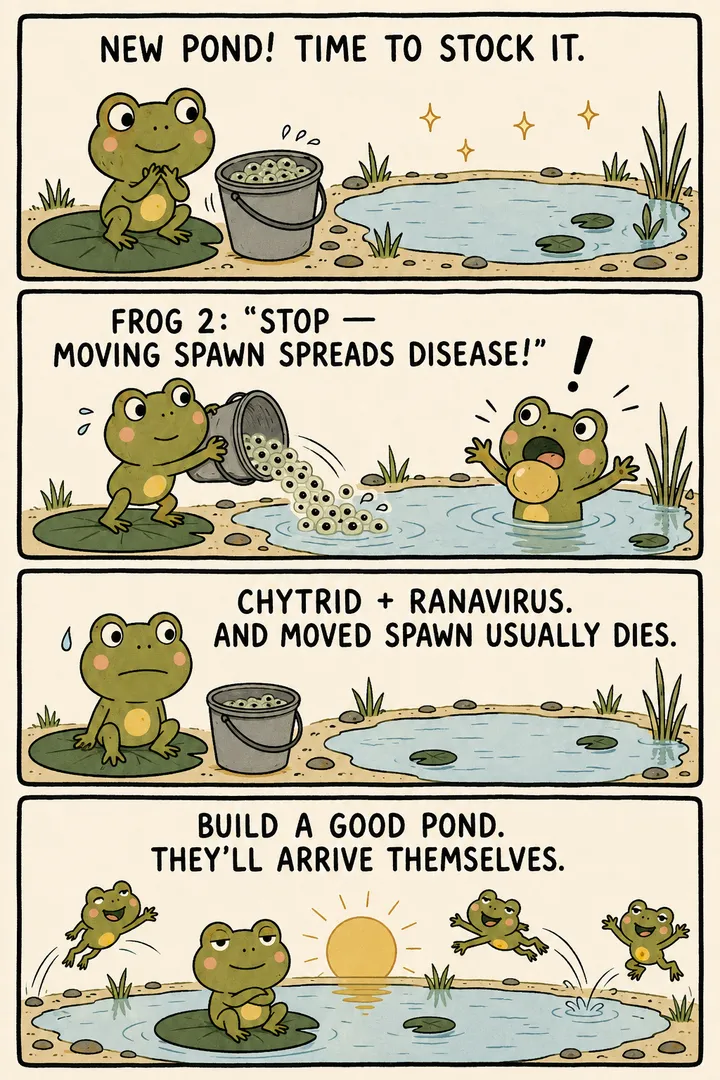
It’s a kind impulse: you dug a new pond and want it full of frogs, or you found frogspawn in a puddle that’s about to dry up, or a pond down the road is being filled in and you want to save its tadpoles. The instinct to help is good — but with amphibians, moving them is usually the wrong way to do it, and can do real harm. Here’s the honest guide to when to move, when not to, and what actually works.
🐸 The 30-second answer: generally, don’t move frogs, toads, or their spawn between waters. Doing so spreads devastating diseases (chytrid fungus and ranavirus), mixes locally-adapted populations, is often illegal for protected species, and usually doesn’t even work — moved animals disperse or die. The only justified move is a short one out of immediate danger (a draining pond, a road) to the nearest suitable spot in the same area. To get frogs in a new pond, build good habitat and let them arrive on their own — they will.
Why moving amphibians is risky
This is the part most people have never been told, and it’s the important one.
1. 🦠 Disease — the big one
Amphibians and their spawn carry diseases that have caused catastrophic declines worldwide — the chytrid fungus (Batrachochytrium) and ranavirus. These spread not just on the animals themselves but on water, mud, plants, nets, and even wet boots moved between sites. A single well-meaning introduction of spawn can wipe out the very frogs you were trying to help. You can’t see it, and you can’t undo it.
2. 🧬 Local adaptation
Frog populations are subtly adapted to their own pond and region — timing, temperature, local conditions. Mixing populations by moving spawn around can weaken both the source and the destination.
3. ⚖️ It’s often illegal
In many places, native amphibians and their spawn are legally protected, and moving them without a licence is an offence. Rules vary a lot by country and state — your local wildlife agency has the final word.
4. 🤷 It usually doesn’t even work
Frogs and toads have strong site fidelity. Relocated adults often try to return or simply fail to settle, and dumped spawn frequently fails. The effort commonly does more harm than good.
The narrow case where a short move is okay
There’s one situation that justifies moving an amphibian: immediate, unavoidable danger — a pond being drained or filled in, spawn in a puddle certain to dry out, an animal on a busy road. Even then, keep it short and local:
- Move it the shortest possible distance to the nearest suitable water or damp, sheltered habitat in the same area — ideally within the same pond network.
- Never move it to a distant or “better” pond, or into a different catchment.
- Don’t transfer water, mud, or plants from the old site with it, and clean any equipment (nets, buckets, boots) before and after.
- For a protected species or a large rescue (a whole pond’s worth), contact your local wildlife agency or an amphibian conservation group first — they can advise or take it on properly.
This isn’t about being fussy — it’s the difference between a genuine rescue and accidentally seeding a disease outbreak.
What to do instead: let them come to you
If your real goal is frogs in your garden or new pond, the good news is that the best method is also the easiest and safest: build the habitat and let amphibians find it themselves. They’re remarkably good at colonising new water — usually within a season or two.
- 🌊 Make the pond amphibian-friendly — gently sloping sides or a shallow end so animals can climb out, some native planting, and no fish (fish eat spawn and tadpoles). Here’s how to build a wildlife pond for frogs.
- 🌿 Leave damp, shady cover nearby — a log pile, leaf litter, a half-buried pot.
- 🚫 Skip the pesticides — they poison the insects amphibians eat.
Frogs that arrive on their own are local, healthy, and legal, with no imported disease risk. It’s slower than dumping in a bucket of spawn — and enormously better for the animals.
The bottom line
Moving amphibians feels like helping, but for spawn and healthy adults it usually isn’t. Leave residents where they are, don’t stock ponds by hand, and let a good habitat do the recruiting. Save relocation for genuine emergencies — short, local, and clean — and loop in the experts for anything protected or large.
💚 The kindest thing you can do for frogs isn’t to move them — it’s to make more places safe for them, and let them find those places themselves. Build the pond, skip the pesticides, and be patient. The frogs will come, and they’ll be yours the right way.
Go deeper: I found a frog — what should I do? · how to build a wildlife pond for frogs · helping a garden toad thrive · the I Found an Amphibian tool · more real questions in the Bognook Q&A.
This is kind, general guidance — not legal advice. Wildlife and amphibian-disease rules vary by state and country, so your local wildlife agency has the final word.
Sources & further reading
This guide was written and fact-checked against these authorities. It’s kind, general conservation guidance — not legal advice:
- Froglife & Amphibian and Reptile Groups UK (ARG UK) — why not to move frogspawn or amphibians between ponds, and biosecurity to prevent disease spread.
- AmphibiaWeb — Chytridiomycosis & AmphibiaWeb — Wildlife Disease — chytridiomycosis and ranavirus, how the amphibian trade spreads both, and how moving animals, water and equipment spreads chytrid.
- Amphibian Survival Alliance — global amphibian declines and disease-prevention practice.
- Your state or national wildlife agency — the legal authority on protected species and relocation where you live.
Written and fact-checked by The Bognook Team against veterinarian-authored sources — for a protected species or a large rescue, contact your wildlife agency or an amphibian conservation group.
Common questions
Can I move frogspawn to my new pond to get frogs?
It is strongly discouraged, and in some places illegal. Moving spawn between waters is one of the main ways amphibian diseases like chytrid fungus and ranavirus spread — a single introduction can wipe out the frogs in the pond you are trying to help. It also mixes populations that are locally adapted to their own site. The better route is to build good habitat and let frogs colonise your new pond naturally, which they usually do within a season or two.
Is it okay to relocate a frog or toad from my garden?
Usually no. A frog or toad living in your garden has chosen good habitat and often has strong site fidelity — moved animals frequently try to return or simply fail to settle. Leave residents where they are and make the space welcoming instead. The only time to move one is a short distance out of immediate danger (off a road, out of a pool), to the nearest damp, sheltered cover in the same area — never far away or to a different pond.
Why is moving amphibians between ponds so risky?
Three reasons. First, disease: amphibians, spawn, water, mud and even wet boots or nets carry chytrid fungus and ranavirus between sites, and these have caused catastrophic declines worldwide. Second, genetics: local populations are adapted to their own pond, and mixing them can weaken both. Third, legality: many amphibians and their spawn are legally protected, so moving them can be an offence. Moving animals also usually just does not work — they disperse or die.
A pond is being drained or filled in — can I rescue the spawn or frogs?
This is the one case where a move can be justified, but do it carefully and locally. Move animals or spawn the shortest possible distance to the nearest suitable water or damp habitat in the same area, ideally within the same pond network, and never to a distant "better" pond. Do not mix in water or plants from the old site, and clean any equipment. For a protected species or a large rescue, contact your local wildlife agency or an amphibian conservation group first — they can advise or take it on.
How do I get frogs in my new pond without moving any?
Build it and they will come. Frogs, toads and newts are good at finding new water on their own, usually within a season or two. Make the pond amphibian-friendly — gently sloping sides or a shallow end to climb out, some native planting, no fish, and no pesticides nearby — and leave damp, shady cover around it. Colonising naturally means the animals that arrive are local, healthy, and legal, with no disease risk imported.

Join the Bognook burrow
Cozy amphibian care tips, aesthetic freebies, and the occasional frog fact — straight to your inbox. No spam, just good bog vibes.
Free amphibian care cheat-sheet when you join. No spam — pinky-promise. Unsubscribe anytime. See how we handle your data in our privacy notice.