Cane Toad vs Native Toad: How to Tell (and What to Do)
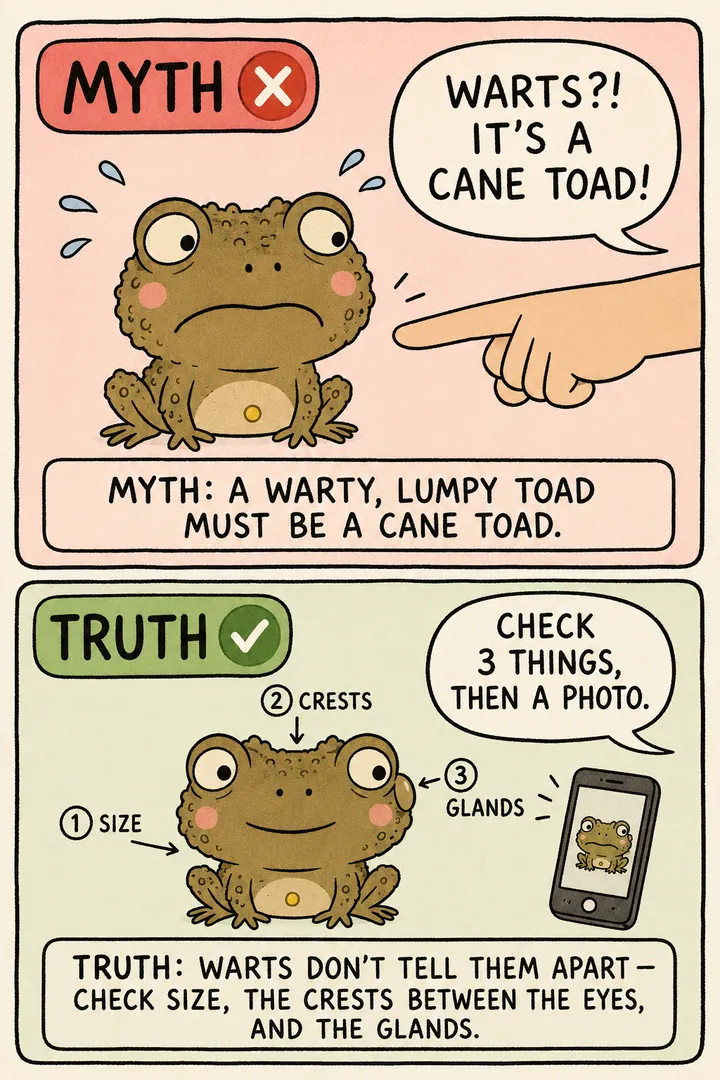
🔍 Fact check
“A warty, lumpy toad must be a cane toad.” — A common panic-ID
Verdict: False
Warts do not tell toads apart — every true toad is warty. The three reliable tells are size, the cranial crests ("horns") above the eyes (native toads have them; cane toads do not), and the parotoid glands (huge and sloping over the shoulders on a cane toad; small and oval on a native). Because misidentifying a protected native is the real risk, confirm with a photo ID before acting — never act on a guess, and never assume "harmless".
The evidence:
- The reliable tells are crests, gland shape and size — not warts. Native southern toads have well-defined cranial crests above the eyes and a small, oval parotoid gland; a cane toad (Rhinella marina) has no crests above its eyes and a larger, triangular gland angling onto the shoulders (Florida Fish and Wildlife Conservation Commission).
- Confirm before you act. Photograph it and check with a free ID app — Seek by iNaturalist — because harming a protected native by mistake is the real danger.
- Cane-toad toxin is dangerous to pets. Toxin from the large glands behind the eyes can seriously sicken or kill a dog that mouths a large toad such as a cane toad (Merck Veterinary Manual); keep pets away and follow your state wildlife agency guidance.
“Is this a cane toad?” is one of the most-asked, most-anxious questions in the whole amphibian world — especially in Florida — and for good reason: get it right and you protect your dog; get it wrong and you might hurt a harmless, beneficial native. So let’s make it genuinely simple. Take a breath, and let’s look at the three tells.
🐸 Found one right now and not sure? Our free I Found an Amphibian tool walks you through the ID and the safe next step in under a minute. This guide is the fuller version behind it.
The 30-second answer: the three tells
You can separate an invasive cane toad from a native toad on three features:
- Size. Cane toads are big — roughly 6–9 inches. Native US toads (like the southern toad) are only 3–4 inches. In the southeastern US, a toad bigger than your palm is very likely a cane toad.
- Crests above the eyes. Native toads have distinct ridges or “horns” (cranial crests) above the eyes. Cane toads have no crests above their eyes.
- The parotoid (poison) glands. A cane toad’s glands are large and slope down over the shoulders. A native toad’s are smaller, oval, and sit just behind the eyes.
If two or three of those point to “cane toad,” treat it as one — and confirm with a photo before you do anything (more on that below).
The tells, in detail
Size is your fastest clue. Native toads are small, tidy animals that fit comfortably in a palm. A cane toad is a genuine handful — heavy-bodied and often the size of a dinner plate’s centre. If you’re in Florida and looking at a big toad, size alone should put you on alert.
The head crests are the clincher. Look at the top of the head, between and just behind the eyes. Native toads (southern toad, oak toad, Fowler’s/American toad) have raised bony ridges or knobs there — little “horns.” A cane toad’s head is comparatively smooth, with no such ridges. This is the single most reliable feature when size is ambiguous (a young cane toad can be small-ish).
The parotoid glands seal it. Every toad has a pair of poison glands behind the eyes. On a native toad they’re modest, oval, and sit right behind the eye. On a cane toad they’re dramatically large and extend back and down over the shoulders — the most distinctive cane-toad feature of all.
Why this matters: your dog
This isn’t a trivia question — it’s a pet-safety one. Cane toads secrete a potent milky toxin (bufotoxin) from those shoulder glands as a defence. A dog or cat that licks or bites one can become seriously ill within minutes — sometimes fatally. Florida’s wildlife agency warns that a pet can die in as little as 15 minutes without treatment (FWC).
⚠️ If a pet mouths a toad, act immediately:
- Wipe the gums with a damp cloth and, if your pet is alert, gently rinse the mouth forward with a hose or running water — point the head downward so it doesn’t swallow the rinse — for about 10 minutes. If it is disoriented or has collapsed, don’t rinse; just wipe the mouth.
- Call a vet or a pet poison line right away. Don’t wait to see if symptoms pass.
Native toads carry a much milder toxin — still enough to make a dog drool and feel unwell, so the “keep pets away from all toads” rule stands — but the cane toad is the genuinely dangerous one. This is exactly why the ID matters.
What to do if you think it’s a cane toad
Here’s the responsible sequence — and the one rule that matters most is at the top:
- Confirm the ID first. Never act on a guess. Photograph it and check it in a free ID app like Seek by iNaturalist, comparing the size, crests, and glands above. Misidentifying a protected native toad is the real risk here.
- Keep pets and small children away from it in the meantime.
- Don’t relocate it and release it elsewhere. That spreads an invasive species, and a captured cane toad may not legally be moved and released.
- If you’re certain it’s a cane toad, they are a recognised non-native invasive in places like Florida, and your state wildlife agency publishes the correct, humane guidance — in Florida that’s the FWC. Contact them, or your local agency, for what to do.
- If you’re not certain — stop. Don’t try to remove or harm it. Keep pets away, and get the ID confirmed by the authority or a knowledgeable community first. It is far better to leave a real cane toad in place for a day than to harm a native toad by mistake.
We won’t give you a DIY method here on purpose: the honest, safe path for a homeowner is confirm the species, then follow your wildlife agency’s official guidance — never improvise.
Good news if it’s a native toad
If the crests, small size, and modest glands say native toad — relax, and leave it be. Native toads are quietly wonderful neighbours: a single toad eats thousands of pest insects (slugs, beetles, mosquitoes) a season, asks nothing of you, and belongs exactly where it is. Just keep curious dogs from mouthing it, and let it go about its night. If you’d like to help it thrive, see how to build a wildlife pond for frogs and our toad care basics for understanding the species.
A quick geography check
Cane toads are not native anywhere in the continental US. They’re established mainly in Florida (especially central and south Florida), plus Hawaii and parts of southern Texas / the Gulf coast. If you live well outside those areas, a big toad is almost certainly a native — but a photo and a 20-second ID check will settle it for sure.
💚 You did the right thing by stopping to check instead of guessing. Whether it turns out to be an invasive to report or a native to leave in peace, that careful instinct is exactly what protects both your pets and the little creatures that belong here.
Found a toad and want the safe next step? Run the free I Found an Amphibian tool, or read the fuller wild-finder guide: I Found a Frog or Toad — What Should I Do?
Sources & further reading
This guide was written and fact-checked against these authorities. It’s kind, general guidance — not legal or veterinary advice; your state wildlife agency has the final word:
- Florida Fish & Wildlife (FWC) — Cane Toad — cane toad (Rhinella marina) vs. native southern toad identification (size, cranial crests, parotoid-gland shape), pet-toxicity risk (a pet can die in as little as 15 minutes without treatment) and first aid, and the rule that captured cane toads may not be relocated and released.
- Seek by iNaturalist — free photo identification to confirm the species before you act.
- Merck Veterinary Manual — Toad Poisoning in Dogs and Cats & Pet Poison Helpline — Your Pets and Cane Toad Poison — toad toxicity in dogs and cats, how fast it can turn serious, and the first-aid response (flush the mouth with plenty of water).
- Your state wildlife agency — the authority for invasive wildlife and humane-removal guidance where you live.
Written and fact-checked by The Bognook Team against veterinarian-authored sources — if a pet has mouthed a toad, treat it as an emergency and call a vet now.
Common questions
How can I tell a cane toad from a native toad?
Three tells. Size: cane toads are big — about 6 to 9 inches — while native US toads like the southern toad are only 3 to 4 inches, so in the southeast a toad bigger than your palm is very likely a cane toad. Crests: native toads have distinct ridges or "horns" (cranial crests) above the eyes; cane toads have no crests above their eyes. Parotoid glands: a cane toad's poison glands are huge and slope down over its shoulders, where a native toad's are smaller, oval, and sit just behind the eyes. When in doubt, photograph it with a free ID app like Seek and never act on a guess.
Are cane toads poisonous to dogs?
Yes — dangerously so. Cane toads secrete a milky toxin (bufotoxin) from the parotoid glands on their shoulders, and a dog or cat that licks or bites one can become very sick within minutes, sometimes fatally. If a pet mouths a cane toad, act fast: wipe the gums with a damp cloth and, if the pet is alert, gently rinse the mouth forward with a hose or running water (pointing the head down so it does not swallow) for about 10 minutes, then call a vet or the pet poison line immediately. If it is disoriented or has collapsed, do not rinse; just wipe the mouth with a wet cloth and get to a vet. Native toads carry a much milder toxin, but you should still keep pets away from any toad.
What should I do if I find a cane toad in my yard?
First, confirm it really is a cane toad — check the size, the lack of head crests, and the large shoulder glands, and photograph it with an ID app like Seek, because it is easy to mistake a protected native toad for one. Keep pets and small children away from it, and do not move it somewhere else and release it (that spreads an invasive species and, for a captured cane toad, is not permitted). If you are certain it is a cane toad, they are a non-native invasive in places like Florida and your state wildlife agency (FWC in Florida) publishes humane guidance — contact them for the correct action. If you are not certain, do not act: harming a native toad by mistake is the real risk.
Where are cane toads found in the United States?
Cane toads are not native anywhere in the continental US. They are an introduced, invasive species established mainly in Florida (especially central and south Florida), and also in Hawaii and parts of southern Texas and the Gulf coast. If you live well outside those areas, a large toad is almost certainly a native species — but a photo and a quick ID check will confirm it.
Can touching a cane toad make me sick?
The toxin can irritate your skin and is dangerous if it gets into your eyes, mouth, or a cut, so wash and rinse your hands after any contact, never rub your eyes in between, and keep young children well away. A brief, clean-handed touch is not usually harmful to a healthy adult, but the safe rule is simple: do not handle it more than you must, and never let a pet get near it.
📚 More toads guides

Join the Bognook burrow
Cozy amphibian care tips, aesthetic freebies, and the occasional frog fact — straight to your inbox. No spam, just good bog vibes.
Free amphibian care cheat-sheet when you join. No spam — pinky-promise. Unsubscribe anytime. See how we handle your data in our privacy notice.