What Size Tank Does My Amphibian Need? (Every Species, Honestly)
“Is a 20-gallon okay?” “40-gallon breeder or 55?” New keepers ask about tank size all the time — so here’s the honest answer for every species, plus how to tell if the tank you already own is big enough.
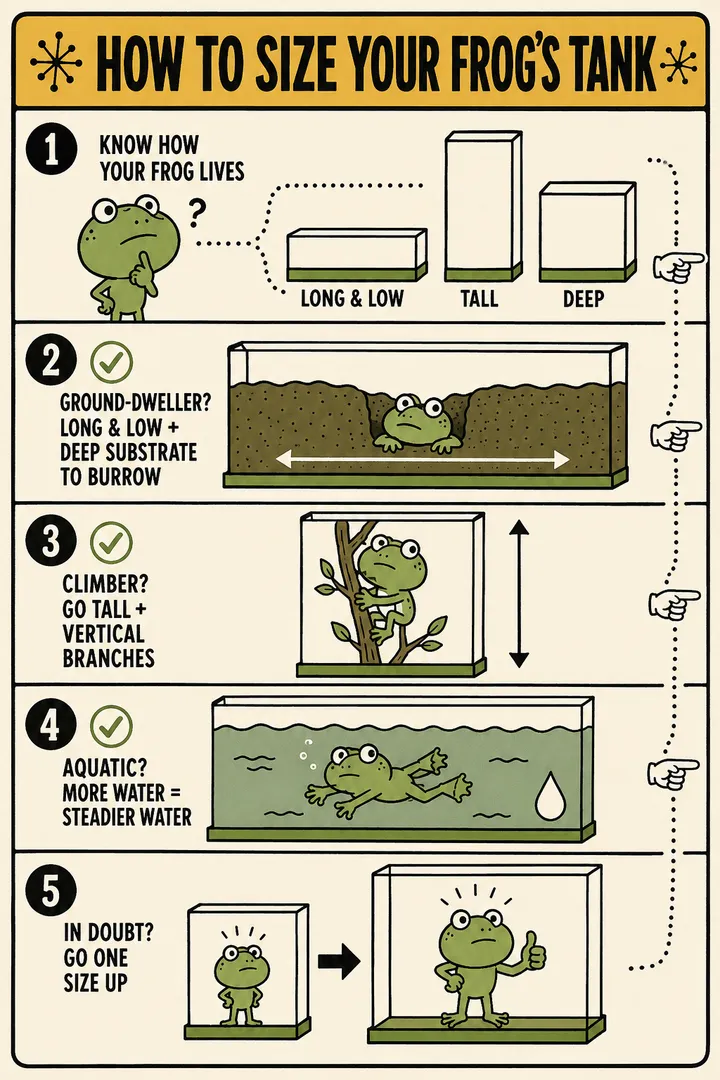
🏠 The 30-second answer: match the footprint to how the animal lives — length for ground-dwellers (toads, Pacman frogs, salamanders), height for climbers (tree frogs, dart frogs), and enough water volume for aquatics (axolotls, aquatic frogs). Below is the minimum for each. When in doubt, go one size up: bigger is more forgiving, especially for water quality.
The one rule that beats memorising numbers
Amphibians don’t need a “big” tank so much as the right-shaped one:
- Ground-dwellers (toads, Pacman & horned frogs, tiger/fire salamanders) want floor space and deep substrate to burrow — a long, low tank beats a tall one every time.
- Climbers (tree frogs, dart frogs) want height and vertical branches or planting.
- Aquatic species (axolotls, African dwarf & clawed frogs, mudpuppies, most newts) want water volume, because more water = more stable, safer water chemistry.
Get the shape right and the gallon number mostly takes care of itself.
The honest minimums, by species
These are sensible minimums for one healthy adult, drawn from the same figures on our per-species care sheets. “Per extra” means add that much for each additional animal (where cohabiting is even safe — many species must live alone).
| Species | Minimum for one adult | Shape / notes |
|---|---|---|
| 💗 Axolotl | 20 gal long (+10 gal each extra) | Long & low; fine sand or bare bottom |
| 🐸 Pacman frog | 10–20 gal | Terrestrial, deep substrate; one only (cannibal) |
| 🐸 African bullfrog | ~36×18×18 in (20–40 gal) | Big! Plan for the adult unit |
| 🌳 Tree frog (White’s, green) | 18×18×24 in tall | Arboreal, branches + plants |
| 🌳 White-lipped tree frog | Large & tall (24 in+) | World’s largest tree frog |
| 🔵 Dart frog | 18×18×18 in (1–3, ~10 gal each) | Bioactive, planted |
| 🟤 Toad | 10–20 gal | Terrestrial, deep moist substrate |
| 🦎 Tiger / fire salamander | 20 gal+ | Terrestrial, cool, burrowable |
| 🟠 Newt (fire-belly, Spanish ribbed) | 10–20 gal | Aquatic/semi-aquatic + a secure lid |
| 🐸 African dwarf frog | 5 gal per frog | Fully aquatic, gentle filter |
| 🐸 African clawed frog | 10 gal (20 better) | Fully aquatic, predatory |
| 🐸 Budgett’s frog | 20 gal / 18×18×12 | Shallow water; one only |
| 🐸 Surinam toad | 40 gal+ | Fully aquatic, gets big |
| 🦎 Mudpuppy | 55 gal+ | Cold, fully aquatic specialist |
If your species isn’t listed, its own species page and care sheet carry the number — every one of the 51 kept species has it.
“Is the tank I already have big enough?”
Three quick checks:
- Footprint over gallons. A 20-gallon long (30″×12″) is better for an axolotl or toad than a 20-gallon high (24″×12″×16″) — same volume, more floor. For climbers, flip it: you want the tall one.
- Can it do what it needs? A burrower needs several inches of substrate plus room to move; a climber needs vertical branches with space to perch; an aquatic animal needs enough clean water to swim and stay chemically stable.
- Are you sizing for the adult? The frog in the cup is not the frog you’ll have in a year. Pixie frogs, clawed frogs, tiger salamanders and Surinam toads all get much bigger than the shop animal — buy for the grown size now.
The common failure isn’t a tank that’s slightly small — it’s the wrong shape, or one bought for the baby instead of the adult.
When bigger needs to be smarter
More space is usually better, with one caveat: a small or shy species can get lost in a huge, empty tank. An African dwarf frog or a dart frog in a big, sparse setup may struggle to find food and feel exposed. The fix isn’t a smaller tank — it’s cover: dense planting, leaf litter, hides, and target-feeding so food gets to the animal. For aquatics, extra volume is almost always a plus because it buffers water quality.
Planning the aquatic ones
Aquatic amphibians live or die by their water, and volume is your friend — more water dilutes waste and holds temperature steadier. Whatever the size, it has to be cycled before the animal moves in, dechlorinated, and the right temperature for the species. Our Aquatic Setup planner gives the tank, water depth, filtration and lid for each aquatic species, and the Water Interpreter reads your test numbers.
💚 If you take one thing: buy for the adult, and match the footprint to how the animal lives. A right-shaped, right-sized home is the foundation everything else sits on — and it’s far cheaper to get right once than to upgrade twice.
Go deeper: every species page lists its minimum tank · plan an aquatic build with the Aquatic Setup planner · more real keeper questions in the Bognook Q&A.
Sources & further reading
This guide was written and fact-checked against these authorities and our own source-checked care sheets. It’s general setup guidance, not a diagnosis or a substitute for species-specific research:
- Josh’s Frogs care guides — Pac-Man frog, red-eyed tree frog, African green toad and dart frogs — enclosure sizes and footprints for frogs, toads and dart frogs.
- Caudata Culture — axolotl caresheet — tank sizing for axolotls; its Tiger Salamander 101 guide covers salamanders and its Housing FAQ covers newts.
- Merck Veterinary Manual — Housing for Amphibians — enclosure set-up, ventilation and water quality.
Written and fact-checked by The Bognook Team against veterinarian-authored sources — for species-specific setup, check the animal’s care sheet and an exotics vet or experienced keeper.
Common questions
Is a 20-gallon tank big enough for an axolotl?
Yes — a 20-gallon long is the sensible minimum for a single adult axolotl, and it is the right footprint (long and low, not tall) because axolotls live on the bottom. Add roughly 10 gallons for each extra axolotl. A standard 20-gallon "high" is worse than a 20-gallon "long" for the same volume, because floor space matters more than height for a bottom-dweller.
What size tank does a Pacman frog need?
A single adult Pacman frog is happy in a 10–20 gallon terrestrial tank. They barely move — floor space and deep, moist substrate to burrow in matter far more than height. One frog per tank only: Pacman frogs are cannibals and will eat a tank mate.
Can I keep an amphibian in a tank that is too big?
For most it is fine, but very large, sparse tanks can stress small or shy species and make feeding harder (an African dwarf frog or dart frog can struggle to find food in a huge tank). Give a big enclosure lots of cover, hides and planting, and target-feed. Aquatic species generally do better with more water volume, as it keeps water quality more stable.
How big a tank does an African bullfrog (pixie frog) need?
Plan for the adult, not the froglet. A grown African bullfrog needs a large terrestrial tank around 36×18×18 inches (roughly a 20–40 gallon footprint), because males reach 8–9 inches and 2–3+ pounds. The tiny frog in the shop becomes a giant, so buy the big tank up front.
Does tank size actually matter for amphibians?
Yes. Too small a tank means poor water quality for aquatics, no room to burrow or climb, cramped stress, and difficulty holding stable temperature and humidity. But "bigger" also has to mean "right shape" — length for ground-dwellers, height for climbers, and enough water volume for aquatics. Match the footprint to how the animal actually lives.

Join the Bognook burrow
Cozy amphibian care tips, aesthetic freebies, and the occasional frog fact — straight to your inbox. No spam, just good bog vibes.
Free amphibian care cheat-sheet when you join. No spam — pinky-promise. Unsubscribe anytime. See how we handle your data in our privacy notice.