Is My Amphibian's Behaviour Normal? Weird-But-Fine vs Not
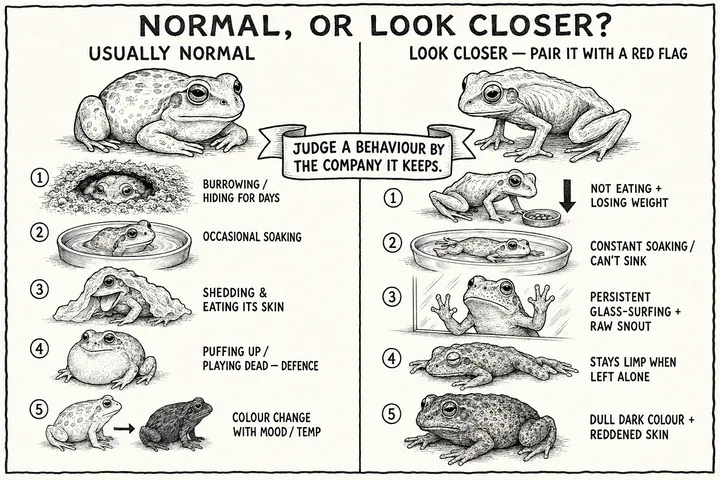
Amphibians are quietly strange animals, and they do a lot of things that look alarming to a new keeper but are completely, boringly normal. This is the honest catalogue: the weird behaviours that are fine, the ones worth a second look, and the one rule that tells them apart. It’s the companion to our is-my-animal-okay health check — behaviour is the other half of “is my pet alright?”
🔍 The 30-second answer: most “weird” amphibian behaviour — burrowing, soaking, colour-changing, going still for hours, shedding and eating skin, night-only activity, puffing up or playing dead — is normal. Behaviour on its own is rarely an emergency. It’s worth a closer look when it pairs with a red flag: not eating plus weight loss, bloating, gasping, open sores, or lethargy that doesn’t lift when husbandry is right. Judge a behaviour by the company it keeps.
The one rule that covers almost everything
Before the list, internalise this, because it saves a lot of panic: a behaviour by itself is rarely a problem — a behaviour plus a physical red flag is. A frog going still is normal; a frog going still and losing weight and developing sunken eyes is not. Keep that lens as you read.
The catalogue: normal vs. look closer
| Behaviour | ✅ Normal when… | 🔎 Look closer when… |
|---|---|---|
| Burrowing / hiding for days | Ground species (Pacman, bullfrog, toads) waiting out dry/cool spells; good body condition | Weeks buried with weight loss, or a species that shouldn’t (dart frog) hiding constantly → see brumation or sick? |
| Sitting / soaking in the water dish | Occasional soaking to hydrate | Constant sitting or full submerging → often too dry/warm, or unwell |
| Changing colour (darker/lighter) | Mood, temperature, humidity, time of day | Persistent dull/dark plus lethargy or reddened skin |
| Going completely still for hours | Resting, digesting, ambush-hunting (Pacman); breathing visible | Limp/unresponsive when undisturbed, or not righting itself |
| Shedding & eating its skin | Totally normal and healthy — instinct, and nutritious | Frequent, patchy, stuck sheds → humidity or health issue |
| “Glass surfing” / climbing the walls | Brief exploration, especially a new animal settling | Persistent, with a raw snout → stress: too few sightlines, reflection, or a too-open enclosure |
| Floating (aquatic — ADF, axolotl) | Dwarf frogs surface to breathe and rest at the top; axolotls sometimes gulp air to adjust buoyancy | Stuck at the top, floating upside down, or bloated → trapped air, overheating or illness; check water temp & quality, then see a vet |
| Not eating for a while | Well-fed adult skipping meals; settling in; dormancy | Combined with weight loss or a red flag, or dragging on for weeks |
| Calling / croaking loudly | Healthy males advertising — normal (if noisy!) | Rarely a health issue; see why does my tree frog croak so much? |
| Puffing up, playing dead, arching (unken reflex) | Defensive displays when startled/handled | Staying limp and unresponsive when left fully alone |
| Blinking hard while swallowing | Normal — amphibians use their eyes to help push food down | — |
A few of these, in a bit more depth
Colour change trips up more new keepers than almost anything. A White’s or American green tree frog going brown, a toad shifting shade, a Pacman lightening — these track mood, temperature, humidity and light, and are normal. Worry only when dull dark colour rides along with lethargy, not eating, or red skin.
Shedding and eating the skin looks bizarre — the frog seems to yawn, stretch, and wipe at its own face, then swallow a ghostly sheet of skin. It’s healthy and instinctive (the shed is nutritious). Only messy, patchy, stuck shedding suggests a humidity or health problem.
Glass surfing is the one behaviour on this list that leans toward “look closer.” Brief exploring is fine, but persistent climbing/pressing at the glass — especially with a scraped snout — usually means stress: not enough visual cover, a reflection it’s reacting to, or a too-exposed enclosure. Add planting and hides and reduce foot traffic.
Floating in aquatic animals is genuinely ambiguous. African dwarf frogs do rest and gulp air at the surface — they have lungs and must come up to breathe — and axolotls sometimes gulp air or let out gas to adjust their buoyancy. But an axolotl or frog that’s stuck at the top, floats upside down, or looks bloated may have trapped air in its gut or body, be too warm (for axolotls, above about 75°F / 24°C), or be ill — so check the water temperature and quality, read the health check, and see an exotics vet if it doesn’t settle.
When behaviour is the alarm
Behaviour crosses into “act now” when it’s paired with a physical sign. Treat these as red flags regardless of what the animal is “doing”: reddened legs/belly, a sudden all-over swelling, gasping, open sores, seizures, a prolapse, or not-eating combined with weight loss and lethargy. That’s the moment to stop watching and get an exotics vet — the full list is in Is my amphibian okay?.
💚 Amphibians are supposed to be a little strange — most of what looks worrying is just them being themselves. Learn the normal weirdness, watch for a behaviour that shows up with a physical red flag, and you’ll spend far less time panicking and more time enjoying a genuinely fascinating pet.
Go deeper: Is my amphibian okay — or does it need a vet? · Brumation, aestivation, or sick? · why does my tree frog croak so much? · why is my Pacman frog sitting in water? · the free symptom checker · more real questions in the Bognook Q&A.
Sources & further reading
This guide was written and fact-checked against these authorities. It’s kind, general guidance — not a substitute for an exotics vet:
- AmphibiaWeb — Agalychnis callidryas, AmphibiaWeb — Bombina bombina, AmphibiaWeb — Brachycephalus actaeus & AmphibiaWeb — Chytridiomycosis — colour change, defensive displays (unken reflex, thanatosis), and heavy skin shedding as a disease warning sign.
- Merck Veterinary Manual — Noninfectious Disorders of Amphibians — disease signs such as bloating, lethargy and fluid swelling (hydrocoelom).
- Worms & Germs Blog (Ontario Veterinary College) — African Dwarf Frog Facts and Carvalho et al. 2023, Virulence — dwarf frogs must surface to breathe air; abnormal floating and bloating as signs of disease.
- PetMD — Axolotl (Jessie M. Sanders, DVM), LafeberVet — Axolotl and Takami & Une 2018, Diseases of Aquatic Organisms — why an axolotl floats: air in the gut or body cavity, lung damage, or water that’s too warm.
- San Diego Zoo Wildlife Alliance — Axolotl fact sheet — axolotls normally gulp air at the surface to adjust their buoyancy.
- Established husbandry references (e.g. Josh’s Frogs — Pac-Man frog and smooth-sided toad care sheets, and Caudata Culture — Health & Behavior FAQ) — species-normal behaviour, signs of stress, and soaking.
Written and fact-checked by The Bognook Team against veterinarian-authored sources — if a behaviour pairs with a red-flag physical sign, see an exotics vet promptly.
Common questions
How do I know if my amphibian's behaviour is normal?
Most "weird" amphibian behaviour is normal: burrowing, sitting in the water dish, changing colour, going still for long stretches, shedding and eating the skin, and being active only at night. The single most useful rule is that behaviour on its own is rarely an emergency — it becomes a concern when it pairs with a red flag, such as not eating combined with weight loss, bloating, gasping, open sores, or lethargy that doesn't lift when husbandry is correct. Judge the behaviour by the company it keeps.
Why does my amphibian change colour?
Many amphibians darken or lighten with mood, temperature, humidity, stress, and time of day — a tree frog may go brown when cool or at night and brighten when warm and relaxed, and toads and Pacman frogs shift shade too. It is normal and usually not worth worrying about. Persistent dull, dark colour combined with lethargy, not eating, or reddened skin is the version worth investigating, since that pairs a behaviour with a possible health sign.
Why is my frog shedding its skin and eating it?
This is completely normal and healthy. Amphibians periodically shed their outer skin layer and almost always eat it — it is nutritious and it is instinct. You may see the frog appear to yawn, stretch, or wipe at its face as it works the skin off. Frequent or messy, patchy shedding that leaves bits stuck on can point to humidity or health problems, but the shed-and-eat behaviour itself is a good sign, not a bad one.
Is it normal for my amphibian to sit in its water dish all the time?
A regular soak is normal — amphibians hydrate through their skin, so the water dish is part of how they drink. It becomes a signal when it is constant: a frog that sits or fully submerges all the time is often telling you the enclosure is too dry, too warm, or that it feels unwell. Check the humidity and temperature first. Occasional soaking good; permanent soaking plus lethargy worth a closer look.
My frog puffed up / played dead / arched its back — what is that?
Those are defensive displays and they are normal. A frog or toad may inflate its body to look bigger and harder to swallow, some play dead (go limp) when they feel threatened, and certain newts and toads arch into an "unken reflex" to flash warning colours. These are stress responses to being handled or startled, not illness — the fix is to disturb the animal less, not to treat it. If it stays limp and unresponsive when left alone and undisturbed, that is different and worth checking.

Join the Bognook burrow
Cozy amphibian care tips, aesthetic freebies, and the occasional frog fact — straight to your inbox. No spam, just good bog vibes.
Free amphibian care cheat-sheet when you join. No spam — pinky-promise. Unsubscribe anytime. See how we handle your data in our privacy notice.