My Amphibian Buried Itself and Won't Eat — Brumation, Aestivation, or Sick?
🔍 Fact check
“Buried and not eating? It is dying — dig it up, peel the cocoon, and make it eat.” — A common panic reaction
Verdict: Mostly False
For many ground amphibians, burrowing down and refusing food is normal seasonal dormancy — aestivation (waiting out heat or dryness) or brumation (waiting out cold) — not illness. An animal that stays in good body condition, with no obvious weight loss or sores, is very likely fine: correct the conditions, keep the substrate lightly damp, and let it surface on its own. Let an aestivating frog shed its cocoon itself rather than peeling it. (Axolotls do not brumate — a still axolotl means check the water.)
The evidence:
- Burrowing and fasting is often normal dormancy. Ground frogs and toads aestivate or brumate — African bullfrogs famously form a protective skin cocoon underground for months (Animal Diversity Web).
- Judge by body condition, not by the fact it is buried. A dormant animal that stays in good condition, with no obvious weight loss or sores, is most likely resting; weight loss, sunken eyes, sores, or staying buried despite correct warm damp conditions are the real red flags.
- Let the frog shed its cocoon, and do not induce dormancy casually. An aestivation cocoon is made of shed skin layers that hold in moisture (Animal Diversity Web); for a pacman frog with thickened skin, a vet-written PetMD sheet advises raising the humidity so the frog can shed and eat it (PetMD). Deliberately brumating a pet is not for beginners.
It’s one of the most frightening things a new keeper sees: your frog digs itself into the substrate, goes completely still, refuses food for days or weeks, and looks — honestly — like it might have died. Take a breath. For a lot of amphibians, this is normal, seasonal behaviour, not an emergency. Here’s how to tell dormancy from illness, and what to do (mostly: not much).
🌙 The 30-second answer: burrowing, going still, and refusing food is often normal dormancy — aestivation (waiting out heat/dryness) or brumation (waiting out cold). Ground frogs and toads do it, and some form a cocoon of shed skin, which they shed themselves. A dormant animal that stays in good body condition, with no obvious weight loss or sores, is very likely fine — leave it be, keep the substrate lightly damp, and let it surface to feed. It’s only a worry when dormancy comes with weight loss, sunken eyes, sores, or won’t lift despite correct warm, damp conditions. Most keepers should not deliberately induce it.
The three words, in plain English
They get used interchangeably, but they mean slightly different things:
- Aestivation — dormancy triggered by heat or dryness. The animal digs down and slows its metabolism right down until moisture and cooler conditions return. African bullfrogs famously aestivate underground in a cocoon of shed skin for months in the dry season; Pacman frogs do a milder version when their substrate dries out or the tank runs too cool.
- Brumation — the cold-weather version, triggered by falling temperatures in winter. It’s the reptile-and-amphibian equivalent of hibernation, and it’s what temperate species (many toads, newts, and salamanders) do in the wild.
- Hibernation — the everyday word people reach for. Zoo amphibian keepers use it for a deep, fully still winter rest, and “brumation” for a lighter one where the animal stays a little active; you’ll see it used loosely for both.
For a keeper, the practical takeaway is identical: a dormant animal is resting, not sick — as long as its body condition is good.
Which species do which
| Group | What they do | Notes |
|---|---|---|
| 🐸 Pacman frogs | Aestivate when substrate dries or cools | Dig in, may form a light cocoon; surfaces when re-dampened and warm. |
| 🐸 African bullfrogs | Aestivate (strongly) | Famous for months-long dry-season cocoons; a healthy pixie may still burrow at home. |
| 🐸 Toads, tomato frogs | Burrow / mild dormancy | Dig down to wait out dry or cool spells. |
| 🦎 Temperate toads, newts, salamanders | Brumate in winter cold | A natural cold-season slowdown; often not induced in captivity. |
| 🐸 Tropical species (dart frogs, most tree frogs) | Little or none | No real dormant season — persistent hiding/not eating is more likely a husbandry or health issue. |
| 🦎 Axolotls | None | Cold-water year-round; a still/off-food axolotl means check the water, not brumation (see below). |
Normal dormancy vs. actually sick
This is the whole question. Use this tell:
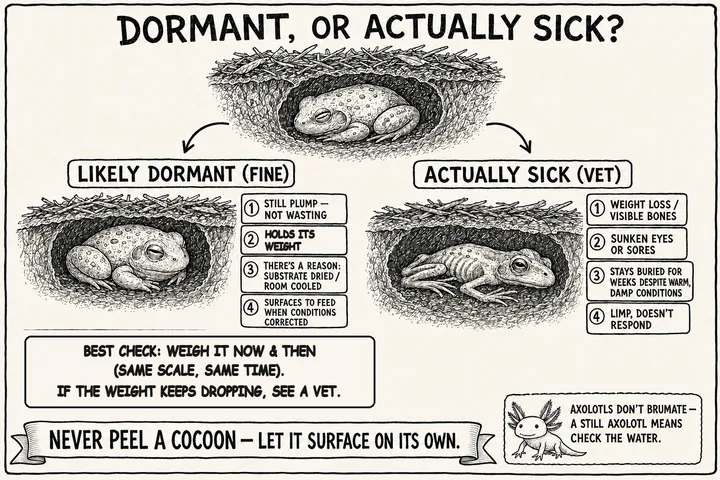
Likely normal dormancy ✅
- Good body condition — still plump-ish, not wasting.
- Holds its condition — no obvious weight loss or sores when you check. (A cool or cocooned animal may barely move, and a cocoon can cover the eyes, so don’t judge by movement or eyes alone.)
- There’s a reason: the substrate dried out, the room cooled, the season changed.
- Surfaces to feed when you correct the conditions.
Look closer / see a vet 🔴
- Obvious weight loss — a bony or shrunken look — or sunken eyes. (A long dormancy uses up some fat, so weigh to see whether the drop keeps going.)
- Sores, discolouration, or bloating.
- Stays dormant for many weeks despite correct warm, damp conditions.
- Lethargy that doesn’t lift when everything is right.
If you’re seeing the red-flag column, treat it as possible illness and read Is my amphibian okay? — dormancy shouldn’t come with wasting.
What to do (and not do)
- ✅ Leave it be — check the conditions rather than repeatedly digging it up.
- ✅ Keep the substrate lightly damp and provide appropriate warmth for the species — this gently signals “conditions are good again.”
- ✅ Offer food when it surfaces, and let it set the pace.
- ✅ Weigh it occasionally (same scale, same time) so you have real data on whether it’s holding condition.
- 🚫 Don’t pull a cocoon off — raise the humidity and let the frog shed it (PetMD’s advice for thickened skin in Pacman frogs).
- 🚫 Don’t force-feed a dormant animal.
Should you induce brumation or aestivation?
Short answer for almost everyone: no. A cooling or drying period is sometimes used to condition certain species for breeding — but it’s genuinely risky. A slowed-down, cool animal is vulnerable, and doing it wrong can kill an otherwise healthy pet. If you ever do it, it’s an advanced, deliberate project: a healthy adult in good body condition (zoos fast animals before cooling them), thorough species-specific research, careful temperature control, and ideally an experienced mentor or exotics vet. For a pet you simply want to keep happy, there’s no reason to induce dormancy at all.
The axolotl exception
Because people mix these up: axolotls don’t brumate. They’re neotenic, fully-aquatic, cold-water animals all year, so a still or off-food axolotl is not dormant by season — check water quality and temperature first, since poor or too-warm water is a common reason axolotls go off their food. The “fridging” you may have read about is a treatment to slow a sick axolotl’s metabolism (during a bad infection, ammonia exposure, or impaction), done with guidance — not a seasonal rest. Details: how to tub & fridge an axolotl.
💚 A buried, silent, not-eating frog is one of the great new-keeper scares — and usually it’s just an animal doing exactly what its body is built to do. Check its condition, keep the conditions right, resist the urge to dig it up, and let it wake on its own schedule.
Go deeper: Is my amphibian’s behaviour normal? · Is my amphibian okay — or does it need a vet? · the Simple Setup & Feeding checklist for ground frogs & toads · how to tub & fridge an axolotl · more real questions in the Bognook Q&A.
Sources & further reading
This guide was written and fact-checked against these authorities. It’s kind, general guidance — not a substitute for an exotics vet:
- AmphibiaWeb — Pyxicephalus edulis & AmphibiaWeb — Bombina orientalis — amphibian aestivation and dry-season cocoon formation (e.g. Pyxicephalus), and winter hibernation (brumation).
- Josh’s Frogs — Pac-Man frog care sheet & Josh’s Frogs — Pixie frog care sheet — captive aestivation in Ceratophrys/Pyxicephalus, the drying and cooling cues that trigger it, and how the skin cocoon is shed once the frog is rehydrated.
- Caudata Culture — Aquarium Cooling Methods — winter cooling (what some keepers call hibernation) for newts and salamanders; its axolotl caresheet gives the cool 14–22°C range axolotls are kept in.
- Merck Veterinary Manual — Noninfectious Disorders of Amphibians — weight loss, lethargy and dehydration from starvation; its Infectious Diseases page covers wasting diseases.
- PetMD — Pacman Frog Care Sheet and Tiger Salamander Care Sheet (both by Maria Zayas, DVM) — signs of a healthy animal vs. when to call a vet (weight loss, sunken eyes, skin lesions, lethargy), and letting thickened skin shed.
- PetMD — Axolotl (Jessie M. Sanders, DVM, CertAqV) — axolotls do not hibernate, so a still, off-food axolotl is not seasonal dormancy: check the water.
- LafeberVet — Ornate Horned Frog & Giant African Bullfrog and Animal Diversity Web — Pyxicephalus adspersus — horned frogs and bullfrogs going dormant when it’s too cool or dry; the bullfrog’s shed-skin cocoon.
- AZA Amphibian Husbandry Resource Guide (2012) — brumation vs. hibernation, winter cooling for temperate species, and the infection risk of induced hibernation.
- Peer-reviewed: Ochoa-Ochoa & Tarvin 2026 (aestivation and shed-skin cocoons), Fabrezi et al. 2016 (cocoons in Ceratophrys), and Groom et al. 2013 (horned frogs lose body mass during aestivation).
Written and fact-checked by The Bognook Team against veterinarian-authored sources — a dormant animal that is losing weight or won’t rouse in correct conditions needs an exotics vet.
Common questions
My frog buried itself and won't eat — is it dying?
Usually not. Burrowing down and going off food is normal dormancy for many ground amphibians — Pacman frogs, African bullfrogs, tomato frogs and toads dig in and wait out dry, hot or cool conditions. As long as the animal still has good body condition, with no obvious weight loss or sores, it is very likely fine. It becomes a concern when dormancy comes with weight loss, sunken eyes, sores, or when the animal stays buried for many weeks despite correct warm, damp conditions.
What is the difference between aestivation, brumation and hibernation?
Aestivation is dormancy in response to heat or dryness — the animal digs down and slows right down until conditions improve, sometimes forming a protective skin cocoon. Brumation is the cold-weather version, the reptile-and-amphibian equivalent of hibernation, triggered by falling temperatures in winter. "Hibernation" is the everyday word people use for both; zoo amphibian keepers use it for a deep, fully still winter rest and "brumation" for a lighter one where the animal stays a little active. For a keeper, the practical point is the same: a dormant animal is resting, not sick, if its body condition is good.
Should I peel the cocoon or dig my frog up?
No — let the frog deal with it. Aestivating frogs like African bullfrogs form a cocoon of shed skin layers that holds in moisture. Instead, gently correct the conditions that triggered dormancy — lightly dampen the substrate and provide appropriate warmth — and let the frog surface on its own, which it will do when it is ready to feed.
Do axolotls brumate or hibernate?
No. Axolotls are fully aquatic, cold-water animals year-round and do not have a natural dormant season, so an axolotl that has stopped moving or eating is not "brumating" — check the water quality and temperature, because poor or too-warm water is a common reason axolotls stop eating. The "fridging" you may have read about is a vet-adjacent treatment to slow a sick axolotl's metabolism (for example during a bad infection or ammonia exposure), not a seasonal dormancy, and it should only be done with guidance.
Should I deliberately brumate my amphibian to breed it?
Only if you are experienced, and never with a beginner or an unhealthy animal. A cooling (brumation) or drying (aestivation) period is used to condition some species for breeding, but it is genuinely risky — a cool, slowed-down animal is vulnerable, and doing it wrong can kill an otherwise healthy pet. It requires a healthy adult in good body condition, species-specific research, careful temperature control, and ideally a vet or experienced mentor. For most keepers, there is no reason to induce dormancy at all.

Join the Bognook burrow
Cozy amphibian care tips, aesthetic freebies, and the occasional frog fact — straight to your inbox. No spam, just good bog vibes.
Free amphibian care cheat-sheet when you join. No spam — pinky-promise. Unsubscribe anytime. See how we handle your data in our privacy notice.