What Substrate Is Safe? How to Prevent Impaction
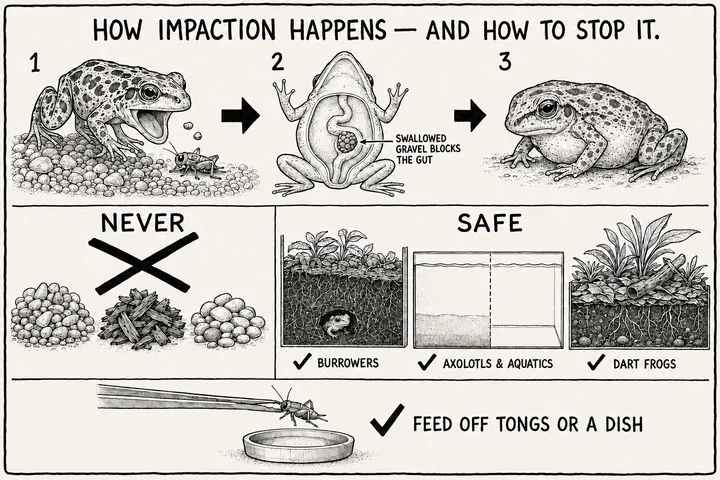
Impaction — a gut blocked by swallowed substrate — is a common and potentially fatal problem in pet amphibians. The good news: the right substrate and feeding method go a long way toward preventing it. Here’s the whole picture.
🪴 The 30-second answer: never use gravel or anything loose and swallowable. Use deep coco fibre for burrowing frogs and toads, fine sand or a bare bottom for axolotls and aquatics, and a proper planted bioactive setup for dart frogs. Then feed off tongs or a dish so the animal can’t gulp substrate with its food. Do that, and impaction essentially never happens.
What impaction is, and why it kills
Amphibians like Pacman frogs and axolotls lunge at food and swallow whatever’s underneath it. If that’s gravel or a sharp bit of bark, it goes down too — and can lodge in the gut, forming a blockage the animal can’t pass. The belly swells and hardens, droppings stop, the animal goes off food, and without help it often dies. Vets list it among the common problems in pet amphibians, and it can be fatal — but it’s avoidable.
The safe substrate for each kind of setup
Match the substrate to how the animal lives:
🐸 Burrowing frogs & toads (Pacman, bullfrog, tomato, chubby frog, toads)
Several inches of moist coco fibre (coconut-husk bedding), deep enough to burrow into. It’s soft, holds humidity, and if a little is swallowed it passes far more easily than gravel. Never gravel, bark chips, small stones, walnut shell, or anything sharp.
💗 Axolotls & aquatic animals
Fine sand or a bare bottom. Fine sand is the standard for axolotls; a bare-bottom tank is the zero-risk option and easiest to keep clean. Never gravel — axolotls suck it up while feeding, and swallowed gravel can block the gut. For other aquatics, soft sand or bare bottom with smooth, un-swallowable décor.
🌳 Tree frogs & 🔵 dart frogs (arboreal / bioactive)
A planted bioactive substrate (drainage layer, tropical soil mix, leaf litter) — but with the same caution: press moss flat, avoid loose swallowable pieces where the frog hunts, and dust feeders so crickets don’t drag substrate into the frog’s mouth.
The gravel trap (and other tempting mistakes)
Pet shops sell aquarium gravel and “natural” bark bedding right next to the animals, so it’s an easy mistake. The ones to avoid:
- ❌ Small aquarium gravel — a known impaction risk for axolotls and lunge-feeders.
- ❌ Bark chips / large orchid bark for burrowers — swallowable and sharp-edged.
- ❌ Small pebbles, walnut-shell, corncob, or gritty “reptile sand.”
- ❌ Anything sharp, dry and dusty, or loose and small enough to be swallowed near where it eats.
Feeding is half the battle
Even a safe substrate can be gulped if food is buried in it. So control the feeding, not just the substrate:
- Feed off long tongs — offer the food directly so the animal doesn’t strike the floor.
- Or feed in a shallow dish or on a flat tile the animal can’t swallow.
- Prey no wider than the animal’s head — oversized prey can injure or even rupture the gut.
- For lunge-feeders that miss and hit the floor, a bare-bottom or dish-fed approach removes the risk.
The rule: the animal should never take a mouthful of substrate with its meal.
Spotting impaction — and what to do
The signs of a gut blockage:
- 🟡 A firm, swollen belly (localised to the gut, not soft and all-over).
- 🟡 No droppings for an unusually long time.
- 🔴 Going off food, straining, and lethargy.
A mild case can sometimes pass with a warm, shallow soak in dechlorinated water (which can encourage a bowel movement) and correcting the substrate. But a belly that stays hard and blocked, or an animal that’s straining or clearly unwell, needs an exotics vet — impaction can require intervention, and waiting too long is dangerous. (Not sure if it’s impaction, fat, or bloat? See Is My Frog Bloated, or Just Fat? — they look alike and mean very different things.)
💚 Impaction is heartbreaking precisely because it’s so preventable. Skip the gravel, match the substrate to the animal, and feed off tongs or a dish — and you’ve headed off a serious, avoidable risk for the cost of a bag of coco fibre.
Go deeper: plan a safe setup with the Ground frog & toad checklist or the Aquatic Setup planner · every species page lists its safe substrate · more real questions in the Bognook Q&A.
Sources & further reading
This guide was written and fact-checked against these authorities. It’s general husbandry guidance, not a diagnosis or a substitute for an exotics vet:
- Merck Veterinary Manual — Environment and Husbandry for Amphibians — gravel should be either too large to swallow or small enough to pass in the feces.
- AZA Amphibian Husbandry Resource Guide — aggressive feeders such as horned frogs can swallow gravel by accident and become impacted; sand eaten in quantity is a similar hazard.
- Josh’s Frogs — red-eyed tree frog care sheet & its smooth-sided toad care sheet, plus Caudata Culture — axolotl caresheet — substrate choice for frogs, toads and axolotls, and avoiding impaction in tree frogs and axolotls.
- Association of Reptilian & Amphibian Veterinarians (ARAV) — find an exotics vet.
Written and fact-checked by The Bognook Team against veterinarian-authored sources — a hard, blocked belly or a straining, lethargic animal needs an exotics vet promptly.
Common questions
What is impaction in amphibians?
Impaction is a blockage of the gut, most often caused by the animal swallowing loose substrate (gravel, coarse sand, bark chips) along with its food. It shows as a firm, swollen belly with no droppings, often with a frog going off food or straining, and it is frequently fatal without treatment. It is also almost entirely preventable with the right substrate and feeding method.
Is gravel safe for a Pacman frog or axolotl?
No — swallowable gravel is a real danger for lunge-feeders and bottom-dwellers. Pacman frogs strike at food and gulp whatever is under it; axolotls hoover up gravel while feeding. Both can swallow pieces that block the gut. Use deep coco fibre for Pacman frogs and fine sand or a bare bottom for axolotls, never gravel.
What is the safest substrate for a burrowing frog or toad?
Several inches of moist coco fibre (coconut-husk bedding), deep enough to burrow into. It holds humidity, is soft, and if a little is swallowed it passes far more easily than gravel. Avoid gravel, bark chips, small stones, and anything sharp or swallowable, and feed off tongs or a dish so the animal cannot gulp substrate with its food.
Can sand cause impaction?
Fine sand is generally safe and is the standard choice for axolotls; the risk comes from coarse or sharp sand, or from lunge-feeders taking in mouthfuls. Keep sand fine, keep a layer thin if you are unsure, and always feed off a dish or tongs. When in doubt, a bare-bottom tank removes the risk entirely.
How do I know if my amphibian is impacted?
The signs are a firm, swollen belly, no droppings for an unusually long time, going off food, straining, and lethargy. A mild case can sometimes pass with a warm, shallow soak in dechlorinated water, but a belly that stays hard and blocked, or an animal that is straining or unwell, needs an exotics vet. Impaction is firm and localised to the gut, unlike soft, all-over dropsy.

Join the Bognook burrow
Cozy amphibian care tips, aesthetic freebies, and the occasional frog fact — straight to your inbox. No spam, just good bog vibes.
Free amphibian care cheat-sheet when you join. No spam — pinky-promise. Unsubscribe anytime. See how we handle your data in our privacy notice.