What Do I Feed My Amphibian? Feeder Sizes, Schedules & the Gut-Load Rule
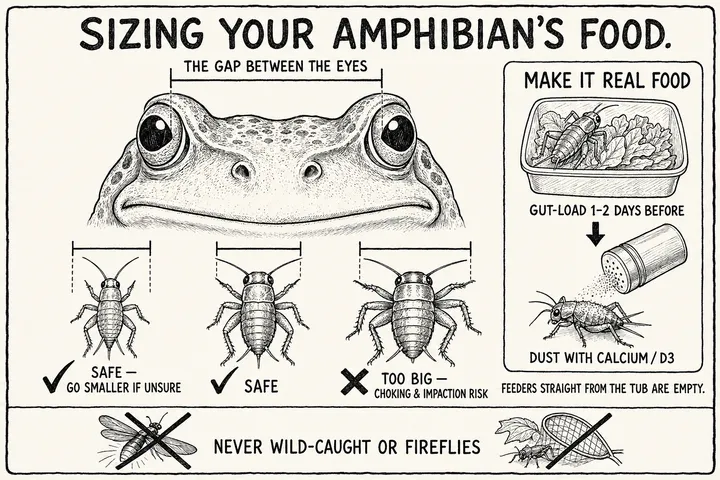
“What do I feed it, how much, and how often?” is the question behind a huge share of keeper worry — and the good news is that a few simple rules cover almost every amphibian, from a thumbnail-sized dart frog to a dinner-plate bullfrog. Here’s the whole system in one place, with the species-by-species menu.
🍽️ The 30-second answer: feed prey no wider than your animal’s head (for toads, its mouth), always gut-loaded and dusted with calcium/D3, in variety. Feed juveniles close to daily and adults every 2–4 days depending on species. Skip wild-caught bugs, fireflies, oversized prey, and rodent-heavy diets. Match the feeder to the species (fruit flies for dart frogs, worms for axolotls, roaches for big frogs) — the rules stay the same.
📊 You’re asking the #1 question in the hobby. In our analysis of 377 real amphibian-keeping questions, feeding was the single most-asked topic — about 36%, more than any other subject.
The two rules that matter most
Before the menu, the two things that keep an amphibian healthy, not just fed — they apply to nearly every species:
- Size it right. Prey should be no wider than the animal’s head (for toads, its mouth) — many keepers size down to the gap between the eyes to be safe. Oversized prey can injure or even rupture the gut of an animal that manages to swallow it. When unsure, go smaller.
- Gut-load and dust every feeder. Feed your insects something nutritious for a day or two, then dust them with calcium/D3 at most feedings (plus a multivitamin regularly). This prevents metabolic bone disease — soft jaw, bendy limbs, tremors — and it is not optional. Feeders straight from the tub are nutritionally empty.
Get those two right and almost everything else is detail.
The menu, by group
Match your animal to its staples — then rotate a few so the diet has variety:
| Your animal | Staple feeders | Notes |
|---|---|---|
| 🐸 Poison dart frogs | Flightless fruit flies, springtails | Tiny food — start a live culture before the frogs arrive. Dusting is critical (deficiency causes toe-tapping/wobble). |
| 🐸 Tree frogs | Appropriately sized crickets, dubia roaches, the odd worm | No wider than the head; don’t overfeed White’s (obesity-prone). |
| 🐸 Toads | Dubia roaches, crickets, earthworms | Enthusiastic eaters; dust and gut-load. |
| 🐸 Pacman frogs & African bullfrogs | Dubia roaches, earthworms, hornworms; rodents rarely | Big appetites — feed to a schedule; rodents only every 2–3 weeks (obesity and liver problems). See the full big-frog menu. |
| 🦎 Axolotls | Earthworms/nightcrawlers, soft sinking pellets | No gravel substrate (impaction). Don’t hand-feed with fingers over gravel. |
| 🐟 African dwarf & clawed frogs | Frozen bloodworms, blackworms, sinking pellets | They find food by smell; feed to the water, remove leftovers. |
| 🦎 Aquatic newts & salamander larvae | Bloodworms, blackworms, daphnia | Small, soft foods; keep the water clean (leftovers foul it fast). |
Whatever the species, rotate two or three feeders rather than relying on one — variety covers nutritional gaps and keeps a fussy animal interested.
How often — by age, not by begging
The single biggest feeding mistake is overfeeding, because most amphibians act starving regardless. Feed to a schedule:
- Juveniles (most species): roughly daily — they’re growing fast.
- Adult dart frogs & tree frogs: small meals every 1–2 days.
- Adult axolotls: every 2–3 days.
- Adult Pacman frogs: once or twice a week; African bullfrogs every 3–4 days.
A slightly-hungry amphibian is healthy; a chronically-overfed one gets obese. For these species, underfeeding is far safer than overfeeding.
Growing the feeder with the animal
Feeder “size progression” trips up a lot of new keepers. As your animal grows, step the prey size up gradually — always re-checking against its current head width, not the size it will be. A froglet on fruit flies moves to pinhead crickets, then small crickets/roaches, then adult feeders, over months. Jumping ahead to big prey too soon risks injuring the gut.
What to never feed
- 🚫 Wild-caught insects — may carry pesticides or parasites. Use captive-bred feeders.
- 🚫 Fireflies / lightning bugs — genuinely toxic; even one can kill a frog.
- 🚫 Oversized prey — wider than the head → it can injure or rupture the gut.
- 🚫 A rodent-heavy diet — obesity and liver problems, especially in bullfrogs.
- 🚫 Loose live prey left overnight — crickets and roaches will bite and stress a resting amphibian. Remove uneaten feeders.
When “not eating” is (and isn’t) a worry
A healthy adult amphibian skipping a meal or two is normal — and ground species may stop eating entirely while aestivating or settling into a new home. It becomes a concern when not eating pairs with weight loss, lethargy, or a red-flag sign, or drags on for weeks. If that’s what you’re seeing, check the husbandry first and read Is my amphibian okay?.
💚 Size the prey to the eyes, gut-load and dust it, offer variety, and feed to a sensible schedule — do that and your amphibian gets everything it needs, whatever species it is. The greedy face is not data; the body condition is.
Go deeper: What to feed a Pacman frog or bullfrog · the Feeder Culture tracker for dart-frog food · the Simple Setup & Feeding checklist · Is my frog bloated, or just fat? · more real questions in the Bognook Q&A.
Sources & further reading
This guide was written and fact-checked against these authorities. It’s kind, general guidance — not a substitute for an exotics vet:
- Josh’s Frogs — Tree frog nutrition and supplementation, Josh’s Frogs — Feeding dart frogs & Josh’s Frogs — Why should I supplement? — feeder options, prey sizing, gut-loading and supplementation for tree frogs and dart frogs.
- Caudata Culture — Care & Feeding FAQ — newt and salamander feeding (worms, bloodworms, pellets); its axolotl caresheet covers axolotl feeding.
- Merck Veterinary Manual — noninfectious disorders of amphibians — metabolic bone disease and obesity.
- AZA Amphibian Husbandry Resource Guide — prey that is too large can rupture the digestive tract of an amphibian that manages to swallow it.
- Merck Veterinary Manual — Noninfectious Disorders of Amphibians — overfeeding is the primary cause of obesity.
Written and fact-checked by The Bognook Team against veterinarian-authored sources — if your animal won’t eat for weeks or looks unwell, see an exotics vet.
Common questions
What size feeders should I give my amphibian?
Vets say no prey wider than the animal's head (for toads, its mouth); many keepers play it safer with the gap between the eyes. Oversized prey can injure or even rupture the gut if the animal manages to swallow it. As the animal grows, move up feeder sizes gradually — match the prey to the current head width, not the size it will eventually be. When in doubt, go one size smaller; a too-small feeder is harmless, a too-big one is dangerous.
How often should I feed my amphibian?
It depends on the species and its age. Fast-growing juveniles of most species eat close to daily. Adults eat far less: dart frogs and tree frogs are fed small meals every day or two, aquatic axolotls every 2 to 3 days, and big sit-and-wait predators like Pacman frogs only once or twice a week (African bullfrogs every 3 to 4 days). These greedy species will always act starving — feed to a schedule, because obesity is more dangerous than the occasional missed meal.
What does gut-loading and dusting mean, and do I have to?
Yes, it is essential for insect-eaters. Gut-loading means feeding your feeder insects something nutritious for a day or two before offering them, so they are not nutritionally empty. Dusting means coating them in a calcium/D3 powder just before feeding. Without both, amphibians develop metabolic bone disease — soft jaw, bendy limbs, tremors — from calcium deficiency. Feeders straight from the tub are poor food until you gut-load and dust them.
What do different amphibians eat?
Poison dart frogs eat flightless fruit flies and springtails; tree frogs and toads eat appropriately sized crickets, dubia roaches and worms; Pacman frogs and bullfrogs eat larger roaches, worms and (rarely) rodents; axolotls eat earthworms and soft sinking pellets; African dwarf and clawed frogs eat frozen bloodworms, blackworms and pellets; aquatic newts and salamander larvae eat bloodworms, blackworms and daphnia. All insect diets need gut-loading, dusting and variety.
What should I never feed my amphibian?
Avoid wild-caught insects (they may carry pesticides or parasites), fireflies/lightning bugs (genuinely toxic and can kill), any prey wider than the head (it can injure the gut), and a rodent-heavy diet (obesity and liver problems). Also never leave live crickets or feeders loose in the enclosure overnight — they can bite and stress a resting amphibian. Remove uneaten live prey.

Join the Bognook burrow
Cozy amphibian care tips, aesthetic freebies, and the occasional frog fact — straight to your inbox. No spam, just good bog vibes.
Free amphibian care cheat-sheet when you join. No spam — pinky-promise. Unsubscribe anytime. See how we handle your data in our privacy notice.