I Found Eggs — Should I Breed My Amphibian? (What to Do)
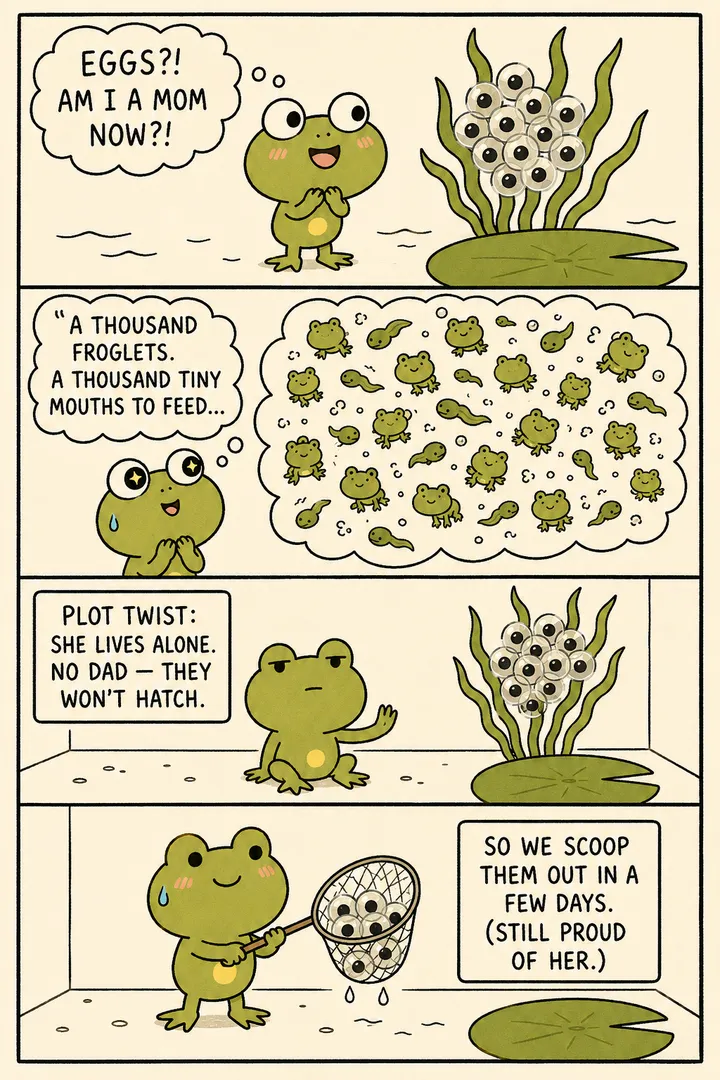
“Are these eggs?!” is one of the most-posted amphibian questions there is — usually with a mix of excitement and panic. Whether you found a surprise clutch or you’re weighing up breeding on purpose, here’s the honest guide: what you’re looking at, why it happened, and whether you should raise them.
🥚 The 30-second answer: clear or dark jelly-coated spheres in clusters or strands are eggs; fuzzy cottony white patches are mould. A lone female can lay unfertilised eggs that won’t develop — remove them after a few days. Breeding on purpose is a big commitment (lots of babies, food, space, and homes needed), so don’t do it casually — and never release pets or their offspring outdoors.
📊 You’re in good company. Breeding, eggs and morphing is the second most-asked topic among amphibian keepers — about 23% of care questions in our analysis of 377 real keeper questions.
First: is it eggs, or mould?
The two get confused constantly.
- ✅ Eggs: distinct round spheres in clear jelly, often dark in the centre, laid in clusters, strands, or stuck to plants and glass. Axolotl eggs are individual jelly balls on plants and décor; many frogs lay foamy or clumped masses.
- ❌ Mould / fungus: fuzzy, cottony white or grey fluff with no defined spheres — usually on uneaten food or decaying matter. That’s a cleanliness signal: remove it, remove any rotting food, and check your water.
If it’s clearly structured eggs in jelly, read on. If it’s fluff, it’s fungus.
Why a lone female lays eggs
This surprises a lot of keepers: a sexually mature female can lay eggs with no male present. Those eggs are simply unfertilised — they’ll never develop, and you can remove them after a few days. It’s completely normal, not a health problem, and not a sign you did anything wrong. Fertile eggs only happen if a male was also present and bred with her.
So the first question isn’t “how do I hatch these?” — it’s “do I even have a male, and do I actually want to raise babies?”
Should you breed? The honest version
Breeding amphibians is genuinely rewarding — and genuinely a lot. Before you decide, know what it involves:
- Numbers. A single clutch can be dozens to hundreds of eggs. Even a fraction surviving is a lot of animals.
- Live food, constantly. Larvae and froglets need a steady supply of tiny, appropriate foods (baby brine shrimp, microworms, then larger feeders) for weeks to months.
- Space. Growing animals need separate grow-out tanks — and many species are cannibalistic, so they can’t all live together.
- Water and time. Clean, stable, correctly-cycled water, daily attention, and careful management through fragile early stages.
- Homes. The big one: where will all the babies go? Responsible breeding means having outlets before you start — not a tub of frogs you can’t rehome.
For most keepers, the honest answer is: don’t breed casually. If you found an unplanned clutch, it’s perfectly fine — and often kinder — to simply not raise it.
If you don’t want to raise them
If the eggs are unfertilised, or you can’t commit to raising a clutch, it’s fine to remove them. A commonly recommended humane approach is to freeze the clutch before disposal. What you must never do:
- 🚫 Never flush or release eggs, larvae, or adults into waterways or outdoors. Releasing pets is illegal in many places and spreads disease (like chytrid) to wild amphibians. This is one of the most damaging things a keeper can do — the wild populations are already in trouble.
If you do want to raise them
If you have a fertile clutch and you’re prepared, the essentials:
- Separate the eggs (or the parents) — many species eat their own eggs and young.
- Clean, dechlorinated, stable water at the right temperature; gentle or no flow for delicate larvae.
- The right tiny foods at each stage — this varies a lot by species, so research yours specifically.
- Plan for metamorphosis — the make-or-break stage. As legs develop and gills or tail change, aquatic larvae must be able to climb out of the water or they drown. Lower the water and add a land exit / ramp at the right time. (Our Water-or-land planner explains the metamorphosis handover for salamanders and newts.)
Because it’s so species-specific and demanding, treat raising a clutch as a deliberate project, not an accident you improvise through.
The axolotl special case
Axolotl eggs are the most-asked version of this — a lone female laying jelly-ball eggs on the plants is completely normal, and those are infertile. If you do have a fertilised clutch, the full axolotl-egg guide walks through the decision and the raising basics.
💚 Finding eggs is a little thrilling — and it’s okay for the answer to be “lovely, but not this time.” Tell eggs from mould, know that a lone female’s eggs won’t develop, and never release anything outdoors. Whether you raise them or not, you’re doing right by the animals by deciding on purpose.
Go deeper: Accidental axolotl eggs — what to do · the Water-or-land planner for the metamorphosis stage · more real questions in the Bognook Q&A.
Sources & further reading
This guide was written and fact-checked against these authorities. It’s general husbandry and welfare guidance, not species-specific breeding instruction:
- Caudata Culture — Raising Newt and Salamander Eggs — newt and salamander egg and larval care, and metamorphosis; its axolotl caresheet covers axolotl eggs and larvae.
- AmphibiaWeb — Amphibian Facts — amphibian reproduction and development.
- AmphibiaWeb — Chytridiomycosis & AmphibiaWeb — Xenopus laevis — why never to release pet amphibians (disease and invasion risk).
Written and fact-checked by The Bognook Team against veterinarian-authored sources — for species-specific breeding, consult experienced keepers and an exotics vet.
Common questions
Are these eggs or mould in my tank?
Eggs are clear or dark jelly-coated spheres, laid in neat clusters, strands, or stuck to plants and glass. Mould and fungus are fuzzy, cottony white or grey patches with no defined spheres, usually on uneaten food or decaying matter. If you can see distinct round eggs in jelly, it is eggs; if it is a fuzzy fluff with no structure, it is fungus — remove it and check your cleanliness.
Why did my axolotl or frog lay eggs with no male?
A sexually mature female can lay eggs on her own — those eggs are simply unfertilised and will never develop, so you can remove them after a few days. It is completely normal and not a sign of anything wrong. Fertile eggs only happen when a male has also been present and bred with her.
Should I breed my amphibian?
Only with eyes open. Breeding can produce dozens to hundreds of eggs, and raising them means a huge amount of live food, separate grow-out space, careful water management, and — critically — homes for all the babies. Most keepers should not breed casually. If you simply found a clutch you did not plan, it is perfectly fine (and often kinder) to remove and discard an unfertilised or unwanted one.
What do I do with unwanted amphibian eggs?
If they are unfertilised (a lone female) or you cannot commit to raising them, it is fine to remove them — freezing the clutch first is a commonly recommended humane method before disposal. Never flush eggs or larvae into waterways or release them outdoors: releasing pets is illegal in many places and spreads disease to wild populations.
What is the hardest part of raising tadpoles or larvae?
Metamorphosis. As legs develop and the tail or gills change, aquatic larvae must be able to climb out of the water or they drown — so you have to lower the water and add a land exit at exactly the right time. That, plus providing the right tiny foods and clean water for weeks, is why raising a clutch is a real commitment, not a casual project.

Join the Bognook burrow
Cozy amphibian care tips, aesthetic freebies, and the occasional frog fact — straight to your inbox. No spam, just good bog vibes.
Free amphibian care cheat-sheet when you join. No spam — pinky-promise. Unsubscribe anytime. See how we handle your data in our privacy notice.