 Bognook Tools
Is my amphibian male or female?
The honest sexing guide · updated July 25, 2026
One of the most-asked keeper questions — and one where the honest answer often is "not yet." Most amphibians can only be sexed as mature adults, and many only in breeding condition. Pick your animal for the real tells, how reliable they are, and when you can actually tell.
Juveniles usually can’t be sexed. Anyone confidently sexing a baby frog is guessing — give it time, and let calling or egg-laying settle it.
Every group, honestly
 Axolotl Moderate
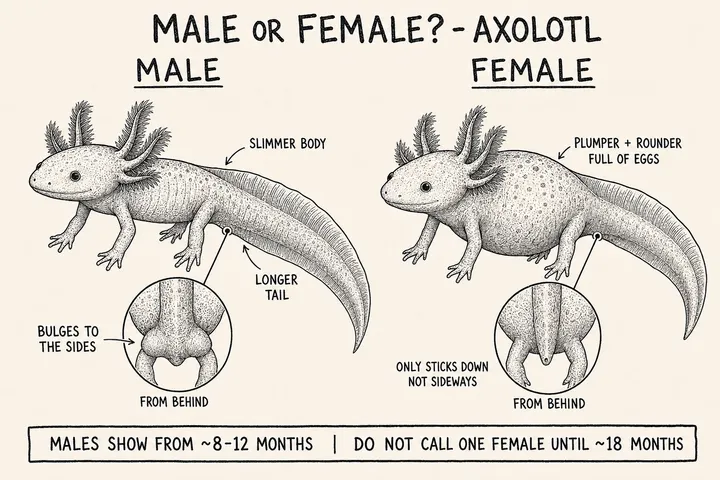
 When you can tell: Males often show from ~8–12 months; don’t call one female until ~18 months.
How: Look at the cloaca (the vent right behind the back legs), viewed from directly behind.
♂ Male
- An enlarged cloaca that BULGES out to the sides (obvious from behind)
- Often a slimmer body and a longer tail
♀ Female
- A small cloaca that only protrudes straight DOWN (not sideways)
- Often a plumper, rounder body (full of eggs) and a shorter tail
💡 Every axolotl looks "female" when young — a flat vent doesn’t confirm female until ~18 months. Body shape alone is unreliable; the vent is the real tell.
 African bullfrog / Pixie Easy
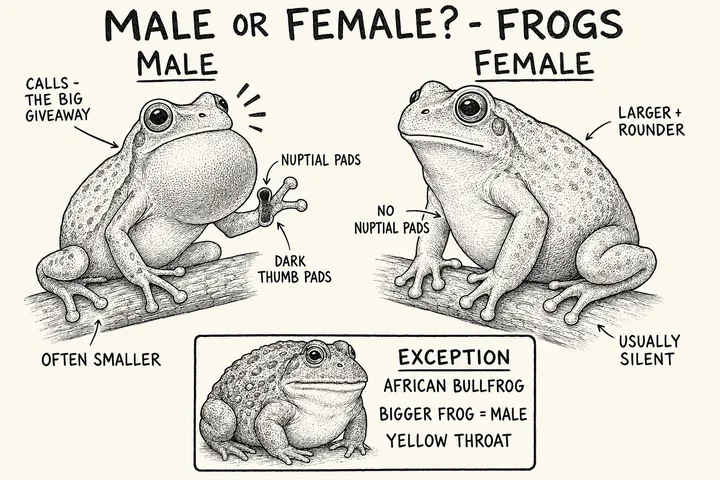
 ⚠️ Unlike almost every other frog, the BIGGER African bullfrog is the MALE.
When you can tell: Clear once mature (roughly 1.5–3 years).
How: Compare adult size and throat colour.
♂ Male
- Much LARGER — giant pixies reach ~8–10 in (females only ~5.5 in)
- Yellow-to-orange colour on the throat, often running down the sides
- Calls loudly, and is the one that fights other males
♀ Female
- Noticeably SMALLER
- A paler, whiter throat
💡 Young pixies can’t be reliably sexed — size only works once they’re clearly grown.
 Pacman / horned & ground frogs Moderate
 When you can tell: From ~1–1.5 years, and clearest in breeding condition.
How: Size, plus the male’s breeding features (nuptial pads + calling).
♂ Male
- Smaller overall
- A dark nuptial pad on the thumb and more robust forearms (for gripping in amplexus)
- Calls, often at night
♀ Female
- Larger and more rotund
- No nuptial pads; usually silent
💡 Nuptial pads and calling are clearest in breeding condition — juveniles usually can’t be sexed.
 Tree frogs Moderate
 When you can tell: Once mature and (for the clearest signs) in breeding condition.
How: Listen for calling and check for nuptial pads; compare size.
♂ Male
- CALLS — the single biggest giveaway
- Nuptial pads (often reddish/dark) on the inner front toes in breeding condition
- Frequently smaller, sometimes with a looser/darker throat (vocal sac)
♀ Female
- Larger and rounder
- No nuptial pads; typically silent
💡 If it calls, it’s a male — that’s the reliable one. Size and throat cues are softer and vary by species.
 Toads Moderate
 When you can tell: Once mature, clearest in the breeding season.
How: Male breeding features (nuptial pads + calling) and size.
♂ Male
- Dark nuptial pads on the thumbs and robust forearms (for amplexus)
- Calls, and often has a darker or looser throat
- Usually smaller
♀ Female
- Larger and more rotund
- No nuptial pads; usually silent
💡 Nuptial pads darken in breeding condition — outside it, sexing is harder. Juveniles can’t be sexed.
 Poison dart frogs Hard
 When you can tell: Males start calling from ~8–10 months.
How: Listen for calling; check toe-pad shape and overall build.
♂ Male
- CALLS — a soft trill or buzz (by far the most reliable sign)
- In many species (e.g. tinctorius), wider, heart-shaped front toe pads
- Sometimes dark "stretch marks" on the throat from calling
♀ Female
- Often slightly larger and bulkier
- Narrower, rounder toe pads; doesn’t call
- Frequently reveals herself by laying eggs
💡 Dart frogs are genuinely hard to sex — size is unreliable, and many keepers only know once a frog calls or lays eggs. Buying a proven pair or a group is the usual route.
 Newts Hard
 When you can tell: Clearest in the breeding season.
How: Look at the cloaca and seasonal breeding changes.
♂ Male
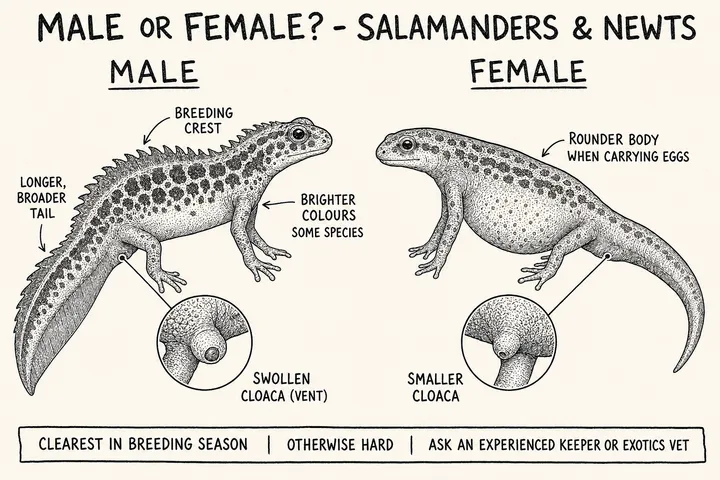
- A more swollen, prominent cloaca (especially in breeding season)
- Some species: brighter breeding colours, a crest, or rougher skin
- Often a longer, broader tail
♀ Female
- A smaller, less swollen cloaca
- A rounder body when carrying eggs
💡 Newt sexing is mostly a breeding-season thing — outside it, many are very hard to tell apart, and species vary a lot.
 Salamanders Hard
 When you can tell: Clearest in the breeding season.
How: Cloacal swelling in breeding condition; otherwise difficult.
♂ Male
- A swollen cloaca in breeding season
- Sometimes a slimmer build
♀ Female
- A rounder body when gravid
- A less swollen cloaca
💡 Most terrestrial salamanders are very hard to sex outside the breeding season — when in doubt, an experienced keeper or an exotics vet can help.
Quick answers
Is my African bullfrog (pixie frog) male or female?
Uniquely among frogs, the LARGER African bullfrog is the male — giant pixie males reach about 8–10 inches while females stay around 5.5 inches. Males also have yellow-to-orange colour on the throat and sides and call loudly; females are smaller with a paler, whiter throat. Adults are easy to sex, but young pixies can't be told apart until they're clearly grown.
How do I sex an axolotl?
Look at the cloaca (the vent behind the back legs) from directly behind: a male's is enlarged and bulges out to the sides, while a female's is a small bump that only protrudes straight down. Males often show this from 8–12 months; a female shouldn't be confirmed until around 18 months, because every axolotl looks "female" when young.
When can you tell an amphibian's sex?
Almost never as a juvenile — you usually need a sexually mature adult, and for many species the clearest signs (nuptial pads, calling, a swollen cloaca, breeding colours) only appear in breeding condition. If someone claims to sex a baby frog, be sceptical.
What's the most reliable way to sex a frog?
Calling. In frogs and toads, only males call, so a frog that calls is male — full stop. Male frogs and toads also develop nuptial pads (dark, roughened patches on the thumbs/inner toes) in breeding condition. Size helps too, but is less reliable and, in African bullfrogs, is reversed.

Figuring out your froglet?
Join the burrow for honest, no-nonsense keeper help — sexing, setups, health and more. No spam, no gatekeeping.
Free amphibian care cheat-sheet when you join. No spam — pinky-promise. Unsubscribe anytime. See how we handle your data in our privacy notice.